
Another $1.5M without accounting for the last $4.4M | What happens when homelessness is managed like a product line & funded like a slush fund
Nashville handed homelessness to a well connected executive who oversaw the merger of stolen foreign data grown into a $22.1m ICE contract. The results? Not looking looking good.

I received feedback yesterday that my previous post was too harsh on the nonprofits keeping the lights on in this city. That criticism is not unwarranted. In highlighting the gap between eviction prevention funding and outcomes, I was equating the actions of Metro Nashville with the organizations working exhaustive hours on razor-thin margins to fill gaps that government is designed to fill. That isn’t fair, and it isn’t accurate.
A specific correction from yesterday’s post: the organization requesting emails from those in urgent need of rental assistance was a “downstream” funding provider, not The United Way — and I’m told feedback is being given about the barriers this may present. Also, while many volunteers did fill in gaps during the crisis, it was an overstatement to say there was an “army” waiting to help out. Please reach out and support the orgs I mentioned, but let’s do all ask ourselves the hard questions about how we can aim our support at helping those most likely to be evicted. Which brings us back to OHS…
Let’s turn our attention to those who are creating the very gaps that are meant to be filled by the government — and see what it looks like when a city operates its most vulnerable systems like a business, offloads its duties to nonprofits it uses as an auxiliary backup government, and then wonders why it isn’t working for anyone except the those driving the evictions.
This latest proposed allocation to OHS is a chapter in a history book that is being written — figuratively, for now. It is a book about how the mayor’s office, acting through the Office of Homeless Services, spent $50 million in federal recovery funds dedicated to homelessness, who benefited, and who looked the other way.
The contracts, the invoices, the late files, the sole-source arrangements, the threshold structuring, the landlords paid for rooms whether they’re filled or not — all of it is being documented, sourced, and connected in real time. Everyone who touches this system becomes a character. The people who built it. The people who benefited from it. And the people who had the authority to ask questions and chose not to.
Tonight, Metro Council will vote on a late-filed resolution adding $1.5 million to a contract with the Hospitality Hub of Memphis to operate interim housing at the Rodeway Inn on Wallace Road.
This brings the total contract to nearly $4 million — for a Memphis nonprofit with no Nashville track record, paying $1.54 million in rent to RIA, LLC, the entity controlled by Rodeway owner Shabana Ali, for a property she purchased for $667,500 in 2010 and that the city now appraises at $3.1 million.
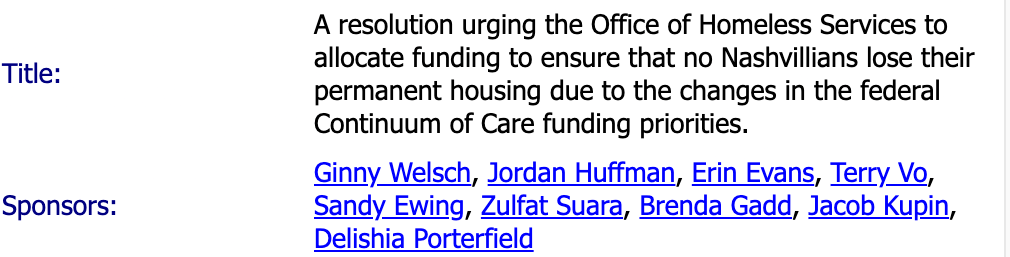
There is no transition plan, no tenant protections, and no answers to the questions Council already asked about the last $4.4m check they cut for OHS they’re supposed to provide a spending plan for. This latest allocations was signed by four Metro officials over 10 days ago but dropped on Council as a late file. The question nobody has answered: why?
Related Article

Why the Missing Spending Plan Matters Right Now
The reason Council’s unanimously requested spending plan matters — the reason it matters tonight — is that Nashville’s eviction crisis is accelerating and the system the mayor’s office built to address it is failing on both ends simultaneously.
As {Rich Text} reported yesterday, funding that was supposed to keep people from being evicted and flowing into homelessness is not showing up for those who need it most.
And today, breaking news from eviction court: Jennifer McCoy’s firm, the single highest-volume eviction attorney in Nashville, representing approximately one-third of all eviction filings, is not accepting any money on behalf of her tenants and is refusing to participate in diversion court at all.
From someone on-site on March 3 2026: Jennifer McCoy's firm refuses to accept rental assistance payments and will not provide tenants with their outstanding balances, which would allow them to seek funding independently. Of the more than 200 cases on today's docket, only two individuals were deemed eligible for storm relief, despite over a hundred defendants meeting the eligibility criteria.
This effectively renders the city’s efforts to slow the increase in homelessness null. One attorney’s non-participation neutralizes the entire diversion infrastructure for a third of the caseload.
So what Council is looking at is a system where money flows freely to places like the Rodeway Inn and to landlords housing people in volatile, undocumented conditions — and is rewarded for it — while the front end of the pipeline, where people lose their housing in the first place, goes unfunded and unanswered.
The $4.4 million spending plan Council unanimously requested under RS2025-1711 was supposed to address exactly this: how does the city prevent Nashvillians from losing their permanent housing? The mayor’s office has refused to answer. Tonight they want $1.5 million more for the back end.
And the money that has been spent is not confined to formal contracts. OHS has made over $350,000 in rent payments directly to various landlords outside of any procurement process or contract authorization. Please sit with this previously unreported fact.
I made a database to explore this shocking phenomenon.
It all has to do with “business unit 53902028,” funding that was supposed to go to Strobel House (and then some of it was legimitately reallocated for a few ‘competitive grants’). What you can see plainly is that much of this money went to “rent” payments to landlords that had precisely ZERO contract with Metro authorizing them to receive funding in this volume. I’ve made sure those running the ongoing internal audit were aware of this and have also noticed local media.
https://clovenbradshaw-ctrl.github.io/53902028/
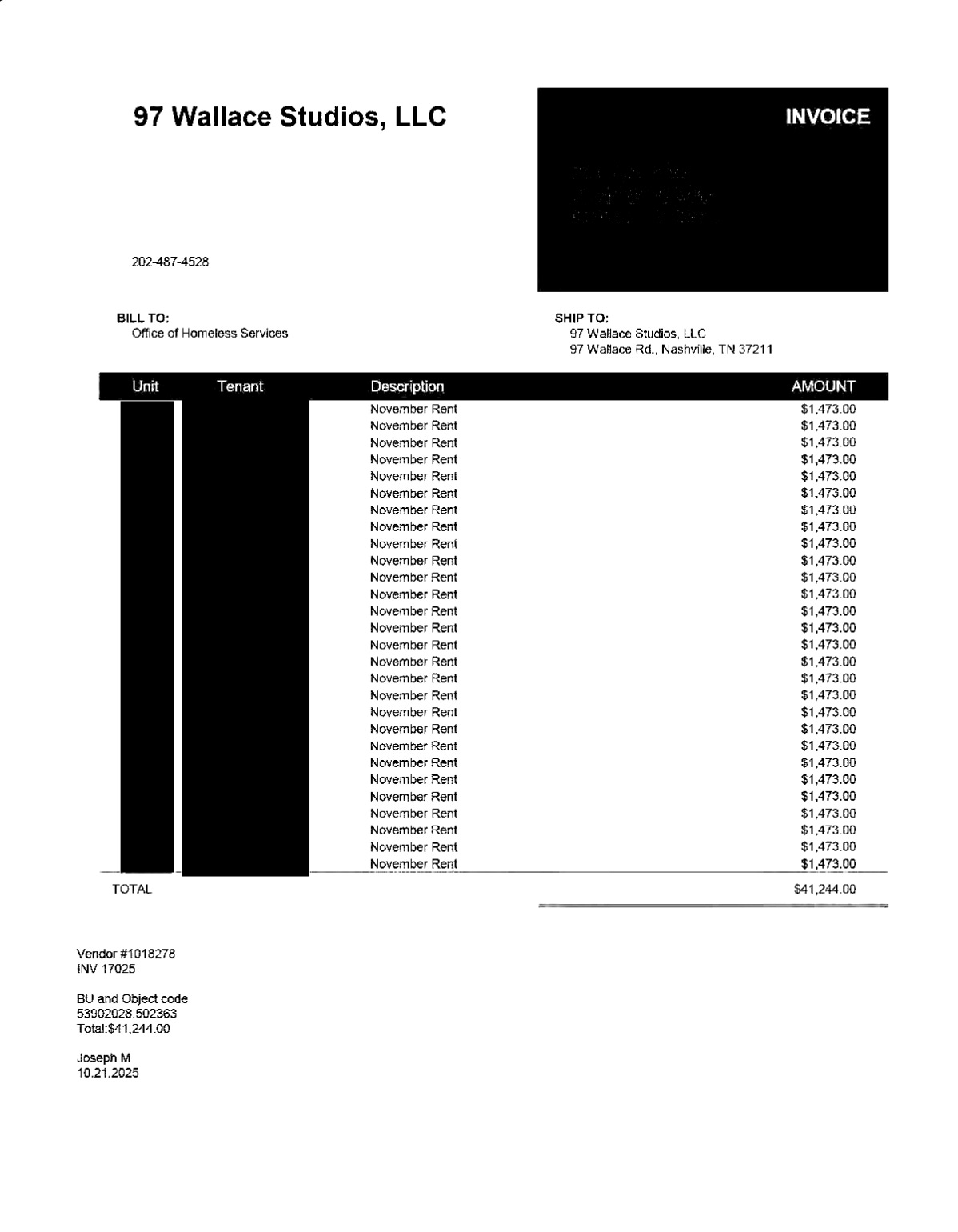
OHS has has made it clear to many that they “do not pay rent”. Invoices like the above say otherwise. It speaks to an illicit, off-the-books system where the priority is to remove people from politically undesirable places and stick them somewhere by any means necessary, procurement and housing first best practices be damned. Yet many people I’ve spoken to say that, dating back to January 2024, this is what happened to them:
They are placed into a facility by the city with promised for a year of support and a housing voucher.
They are led to sign leases. They are not given a copy of those leases, or any documentation of this arrangement of support from OHS.
And then the support stops, sometimes with the tenants learning that Metro has not been paying their rent for months.
With Metro appearing no where on their leases, it is the tenants, people who had previously been living in encampments in the throes of addiction, who end up in eviction court with judgements against them.
This is pattern happening at a scale that I am still trying to get a hold of, but it is not a “few times” thing. Two families have now filed formal Title VI Civil Rights complaints against OHS and Metro for these actions.
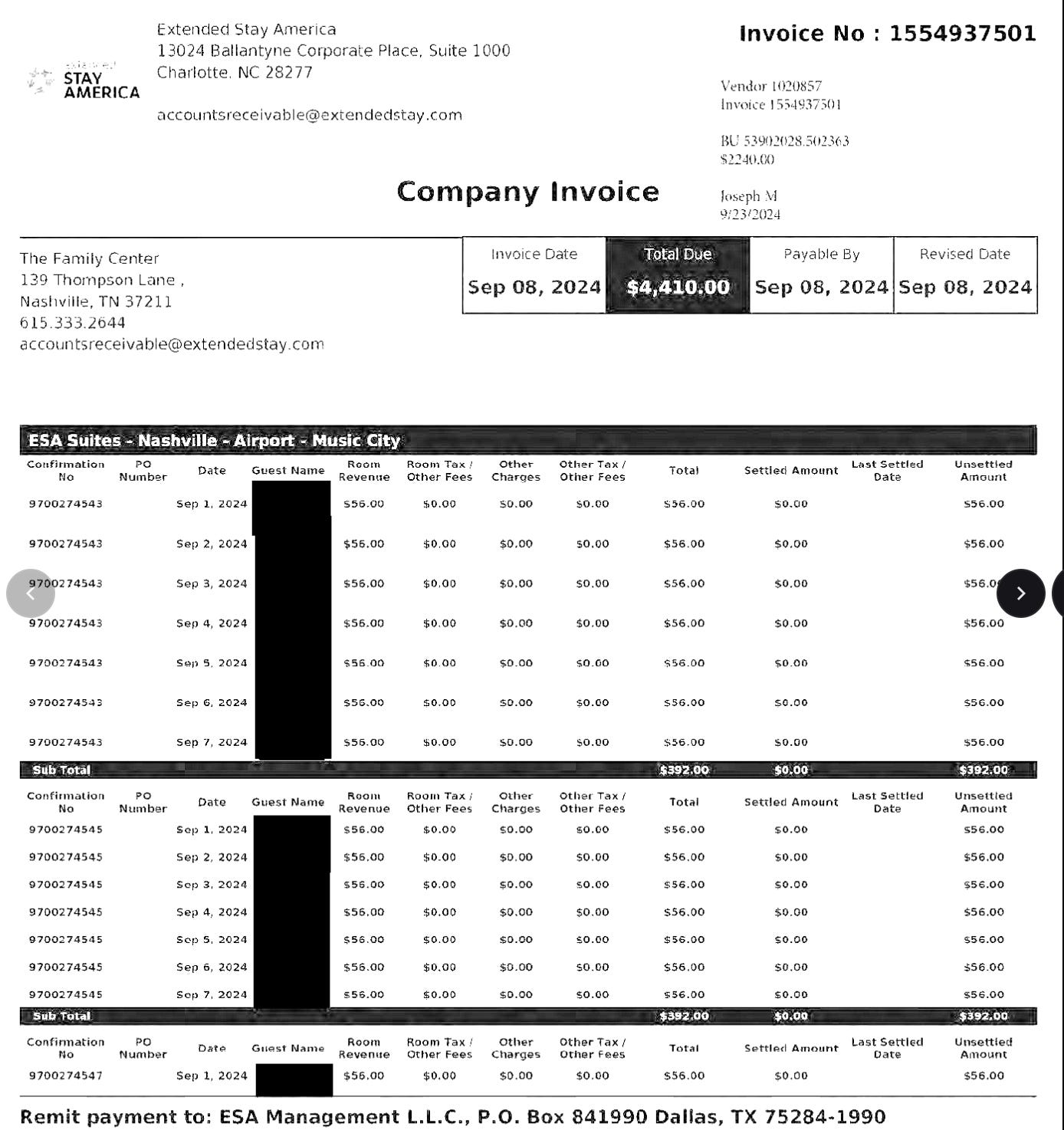
Take Wallace Studios at 97 Wallace Road — a separate property down the street from the Rodeway — it received nearly $100,000 in unauthorized furniture purchases and tens of thousands of dollars in direct rent payments, all outside any contract that would authorize the expenditure. These are not appropriated funds flowing through approved channels. They are discretionary payments made by OHS to landlords with no competitive bidding, no Council oversight, and no documented obligations to the tenants those payments were supposed to protect.
And this is precisely what the $4M that Metro Council wants a spending plan on seems geared to do, with Director Calvin’s language explaining how it will be “made available to Metro Officials” reading like a (speaking figuratively) bribe to have them look the other way. What’s clear to me is the the money Council is asking an accounting for is just a slightly more legitimate version of how they’ve been spending money for years, with these off-the-books rent payments with money not allocated for that and no contract validating it dating back to 2024.
The Business Approach to Homelessness
When Kristin Wilson was hired by the City of Atlanta, the press release said the quiet part out loud. Her “strong corporate background” would be an asset as the city sought to “improve business functions and efficiency” and “make real progress on the issue of street homelessness.” The City of Atlanta did not explain why her professional background in corporate America gave her any sort of insight on “street homelessness.” Here’s the full passage:
Ms. Wilson’s experience managing multi-million dollar acquisitions and strategic projects make her an ideal candidate to lead the City of Atlanta’s new Innovation Delivery Team,” Mayor Reed said. “Her strong corporate background will be an asset to the city as we seek to improve business functions and efficiency across the city and make real progress on the issue of street homelessness.
Wilson had managed $50 million in revenue at LexisNexis and coordinated the overall integration of the $4.1 billion acquisition of ChoicePoint by LexisNexis.
What Wilson integrated was not an ordinary data company. ChoicePoint had purchased Mexico’s entire voter registration database for $250,000 and sold it to the U.S. government through a contract with the Immigration and Naturalization Service — data that is strictly confidential under Mexican law.
The Mexican Federal Electoral Institute filed criminal complaints and one of the people responsible “went into hiding”. Before that, ChoicePoint had acquired the employee screening business of Pinkerton’s — America’s first private detective agency, founded in 1849, notorious for strikebreaking and labor infiltration — including a proprietary database called Esteem, which tracked retail employees who had admitted to workplace theft. A subsequent lawsuit let to LexisNexis settling millions for laborers who were discriminated against despite being charged for no crimes.
ChoicePoint’s contracts with the INS helped lay the groundwork for LexisNexis’ current $22.1 million contract with ICE to provide information on the location of over 276 million Americans. Wilson coordinated the integration of all of it — Pinkerton’s surveillance tools, stolen foreign voter data, and a global data brokerage infrastructure — into a single platform. Then she was brought into government to run homelessness the way you’d run a product line.
Wilson is now Nashville’s Chief of Operations and Performance. As the Nashville Scene reported, Mayor Cooper, knowing there was heat on Nashville from the state comptroller, named Kristin Wilson chief of operations immediately upon taking office. Her husband, the Nashville scene reported, is the son of Justin P. Wilson, Tennessee’s Comptroller of the Treasury until 2021 — the office responsible for fiscal oversight of local government. The city has seemingly operated with autonomy from the Comptroller’s office.
The system the mayor’s office, acting through OHS, oversees here — sole-source contracts, consultants cycling between advisory roles and paid engagements, nonprofits awarded millions with no local track record, landlords paid whether rooms are filled or not — is what a market approach to homelessness looks like. That system was made possible in part by a structural change: when Council created the Office of Homeless Services, then–Council Member Freddie O’Connell amended the legislation on the floor to make OHS report directly to the mayor’s office rather than through normal Board or Commission oversight.
The effect, after subsequent retooling of our homelessness system, was to place Nashville’s entire homelessness apparatus — its Continuum of Care, its Coordinated Entry system, its HMIS data, its vendor relationships — under direct mayoral control, with Kristin Wilson’s office as the point of coordination. Its target audience was always the business class: clean the encampments, move the numbers, signal progress. The question this article asks is what that approach looks like for the people it claims to serve.
People I’ve spoken with who were placed at the Rodeway from the Hermitage encampment describe conditions that should trouble anyone voting to extend this operation. They are now homeless again. Their full accounts are forthcoming.
What It Was Like Inside
{Rich Text} has spoken with eight people who were taken from the Hermitage encampment and placed at the Rodeway Inn during the Salvation Army’s operation of the facility. All eight are now experiencing homelessness again.
Their accounts — which will be reported in full in a forthcoming piece — describe a facility whose operating structure was designed by April Calvin while she was still at the Salvation Army, before she was appointed OHS Director.
According to those that were housed there, residents were discouraged by staff from seeking employment on the theory that earned income would jeopardize pending benefits applications. In many cases, those benefits never materialized. The result was a population with no legal income, no meaningful case management, and no clear path to permanent housing.
One former resident alleges that without the ability to earn legitimate income, she and others turned to sex work to survive.
Residents describe being warehoused, not housed — placed in rooms and left to wait for a system that never showed up for them.
When the placements fell apart, there was no safety net. No transition plan. No follow-up. They went back to the street.
These conditions existed under the previous operator, one that Director Calvin had worked at in a role central to these operations for over 20 years prior to joining Metro. Council is now being asked to nearly double the funding for the current operator — at a facility with the same owner, the same oversight from the mayor’s office, and the same contract structure — without any evidence that what happens inside those rooms has changed.
And if the follow the same rubber stamping indifference to performing actual oversight, they’ll likely give it to them.
Character choices in the history book of Nashville.
Council Is Owed an Answer It Hasn’t Gotten
In December, Council unanimously passed RS2025-1711 non-bindingly asking the Office of Homeless Services to present a plan for how it would use its $4.4 million budget increase to prevent Nashvillians from losing their permanent housing. The mayor’s office fought that resolution. It passed anyway. OHS has not delivered the plan. It’s been more than two months.
At the last Homelessness Planning Council meeting, OHS Assistant Director of Planning and Research Allison Cantway said providing a plan “was not the intent” of a resolution whose title literally says “allocate funding to ensure no Nashvillians lose their permanent housing.”
So the mayor’s office, acting through OHS, is asking for $1.5 million more tonight while actively refusing to account for the $4.4 million Council already gave them.
The Budget Lines Deserve Questions
The revised budget in this amendment raises questions that deserve time and scrutiny. The occupancy line on the grant sits at $1.54 million — rent to RIA, LLC, the entity controlled by Rodeway owner Shabana Ali, for a property appraised at $3.1 million that she purchased for $667,500 — and whose owner once offered rooms to the city for free. Security is $833,000 for a roughly 90-room motel. Travel and conferences is $118,000 — for an interim housing operation. And there is zero recipient match across every single line item.
These aren’t gotcha questions. They’re the kind of questions the normal legislative process exists to surface. So why the late file? We don’t know. But the pattern is familiar. Since Kristin Wilson arrived in Nashville, the homelessness system has operated on a consistent principle: move fast, keep it vague, and structure things so that by the time anyone with oversight authority gets a look, the money is already out the door.
How This Contract Came to Exist
The Rodeway Inn was previously managed by the Salvation Army under a gap housing contract that ran through October 2024. According to sources intimately familiar with the arrangement, that contract was written intentionally vague — consistent with what multiple recipients of major OHS contracts describe as a preference, originating from the mayor’s office, for language loose enough that funds can be moved without clear tracking. When the Salvation Army’s new operators grew frustrated with demands from OHS that went beyond anything the contract actually required, they pointed out that the agreement contained no terms of service obligating them to comply — and rescinded their collaboration.
OHS Assistant Director Cantway then publicly accused the Salvation Army of refusing to use a separate $1.9 million grant for gap housing. NewsChannel 5 reviewed the documents and confirmed the Salvation Army was right: the grant was written for their LIFNAV outreach program, not Rodeway operations.
This is the pattern. Contracts are written without clear obligations. When partners push back, they are blamed publicly. And the lack of specificity is not a bug — it is the operating method, and it has been since Wilson’s office took the reins. It is the same method behind the mayor’s office’s refusal to deliver the $4.4 million spending plan Council unanimously requested under RS2025-1711 — a resolution that faced direct opposition from Kristin Wilson’s office before it passed anyway. And it is the same method behind tonight’s late file: present the spending as urgent, compress the timeline, and trust that Council won’t say no to money that’s supposed to help homeless people.
Meanwhile, motel owner Ali had 80 rooms ready since March 2024 and told reporters she was “kept in the dark.” FOX 17 reported that only 30 of the Rodeway’s 110 beds were occupied. Council members expressed alarm. Nothing happened.
Within two months of the Salvation Army’s departure, a Memphis-based nonprofit with zero Nashville track record received a contract for nearly $2.5 million for the site. That contract is now being expanded to nearly $4 million — tonight, as a late file.
The Precedent: How the Mayor’s Office Built This System
This pattern has a longer history, and it traces directly to the mayor’s office, acting through OHS — not to any single department acting alone.
In 2022, the Cooper administration brought in Stacy Horn Koch — operating through Housing NOLA, a New Orleans-based entity — to produce a homelessness study. The contract was sole-source and cost $500,000. Open Table Nashville’s Paula Foster called the result “a colossal waste of $500,000, to tell us exactly what we already knew.” A comparable assessment by Focus Strategies in 2015 had cost $25,000.
But what Ms. Foster likely could net yet see is that is this was not a simple report being drafted, it was the first salvo of war to redesign the entire homelessness system around Nashville’s highest executive, and more specifically, reporting directly to Kristin Wilson.
Koch had a prior working relationship with Kristin Wilson. In Atlanta, Wilson served as Deputy Chief Operating Officer while Koch served as Interim Director of Human Services. Wilson’s office was Koch’s largest single source of payments from the City of Atlanta. When Wilson came to Nashville as Cooper’s Chief of Operations and Performance, Koch’s contract followed.
Six months after Koch presented her study, her entity received a second contract — this one for “Assistance with homeless encampment closures,” sole-source, designated high-risk, with no Council legislation required. The initial amount was $237,100. It was then amended by exactly $12,900 — bringing the total to exactly $250,000, the threshold at which Metro Code requires Council approval. In other words: the contract was structured in two installments that kept the total just below the line where Council would have had to vote on it. This is the same pattern as tonight’s late file — not identical in mechanism, but identical in function. The money moves before oversight can engage.
As recently as December 2024, the Outdoor Homelessness Strategy approved by the Homelessness Planning Council still describes Koch as a “mayoral advisor” who helped develop the original encampment strategy — language that frames what was supposed to be a one-time consulting engagement as an ongoing advisory relationship with no visible end date.
The original Nashville contract for Koch had a single Council sponsor: then–District 19 Council Member Freddie O’Connell.
The Eviction Pipeline
Council members are increasingly being evaluated by the number of evictions in their districts. Every time the mayor’s office, acting through OHS, places someone in housing without a master lease, without documented tenant rights, without copies of their own lease agreements, and that placement falls apart — an eviction gets filed. It shows up in the data. It reflects on the district and its Council Member.
The track record is already clear at Wallace Studios. Eviction filing after eviction filing — including against people OHS placed there using “landlord engagement funds” with no underlying contract. Families were promised vouchers that never came, or that were processed so slowly landlords initiated eviction before the paperwork cleared.
Tonight’s $1.5 million creates the same exposure at 95 Wallace. The Hospitality Hub contract pays for occupancy whether rooms are filled or not. But there is no documented transition plan for what happens to residents when the contract ends in June 2026. There is no master lease protecting them. There is no evidence their rights are documented. Council is being asked to fund the front end of a housing pipeline whose back end is eviction court.
The ARPA Clock Is the Excuse, Not the Reason
All of this money flows from ARPA funds originally allocated to Shared Equity Housing under RS2022-1860, then reallocated to homeless services under RS2024-490. It must be spent by December 31, 2026, or returned to the federal government. That creates pressure to approve spending fast and ask questions later.
But the ARPA deadline is not a surprise. The mayor’s office, acting through OHS, has known about it for years. There are nine months of runway. So what makes this a late file? What changed between last week and tonight that required bypassing the normal filing timeline? Nobody has said. But the answer may be simpler than it looks: this is how the system has operated since Kristin Wilson’s office took control of homelessness spending. The Koch contract was structured to avoid Council approval. The Salvation Army contract was written vague enough to avoid enforceable obligations. The $350,000 in landlord payments went out without procurement. Tonight’s late file is not an aberration. It is the method.
Who This Administration Works For
Two weeks ago, Tom Morales — the man who saved the Loveless Cafe, the Woolworth building, and Acme Feed and Seed — told the mayor his property taxes had gone from $129,000 to $600,000 in a single year and asked for a meeting. The mayor wouldn’t take it. When FOX 17 asked O’Connell directly, his response included the line: “It’s not up to me whether he keeps that business open. The market evolves. New businesses start even as beloved old businesses close.” His office later accused FOX 17 of selective editing, but the station published the unedited version and stood by its reporting. Council Member Kupin, who represents downtown, said he was “appalled”.
That’s the market, baby.
But if you’re a landlord housing people off the books, using funding not legally set aside for these purposes, expect this administration to send good money after bad. The Rodeway’s owner paid $667,500 for the property in 2010. Now she’s collecting $1.54 million in “occupancy” from a single contract period — more than twice what she paid for the entire building. Wallace Studios collected hundreds of thousands in unauthorized rent, furniture, and landlord engagement payments — and evicted a quarter of its tenants, including people OHS placed there. Tonight, Council is being asked to approve nearly $4 million total for a Memphis nonprofit with no Nashville track record to continue operating a facility with no transition plan, no tenant protections, and no answers to the questions Council already asked — all as a late file, with no explanation for the urgency.
Acme Feed and Seed can’t get a meeting. These landlords can’t stop getting checks.
Mr. Morales might consider renting out space in his building for the unhoused and operating it like (as former residents have described the Rodeway Inn “an indoor encampment, but worse because you can’t choose who your neighbors are”). Maybe then he could get time on Ms. Wilson’s calendar.
Finally, someone said it.
Thank you!!!