

Kristin Wilson, Mayor O’Connell’s Chief of Operations and Performance, is coordinating Nashville’s proposed $15 million surveillance agreement with MNPD and the Nashville Downtown Partnership. The MOU returns to Metro Council on January 20, 2026.
Before entering public service, Wilson spent six years at LexisNexis Risk Solutions.
That company currently holds a $22.1 million contract with ICE. Agency procurement documents state it needs this contract because local governments increasingly “do not share information about real time incarceration of foreign-born nationals with ICE.” In plain English: when cities refuse to hand over jail records, ICE buys the data from LexisNexis instead.
Wilson’s role at LexisNexis, according to her professional biography: managing the integration of ChoicePoint into LexisNexis—a $4.1 billion acquisition she says resulted in “$150M in annual synergy value creation.”1 In a 2011 press release from the city of Atlanta regarding her first job in government, it cited precisely this experience as her qualifications.
In her role, she managed approximately $50M in revenue for LexisNexis Risk Solutions division. She also coordinated the overall integration of the $4.1B acquisition of ChoicePoint by LexisNexis in 2008 and provided oversight of integration projects across all businesses and functions, and administration of integration budgeting & reporting.
ChoicePoint was already in the immigration enforcement business before the merger Wilson managed, and that business line continues to this day. FOIA documents obtained in 2002 revealed contracts with the Immigration and Naturalization Service to provide citizen registry and motor vehicle data from Mexico, Brazil, Argentina, Colombia, and Costa Rica. ChoicePoint had purchased Mexico’s entire voter registry—a database legally restricted to electoral purposes—through a subcontractor and was selling it to U.S. immigration authorities.
When the contract came to light, Mexico’s Special Prosecutor for Electoral Crimes declared that “there is a presumption that a crime has been committed”—the simple act of removing voter data from the electoral arena and selling it commercially violated Mexican law. ChoicePoint returned ten disks containing the voter files, but Mexican prosecutors wanted proof the company had actually destroyed its copies.
Mexico sent a delegation to ChoicePoint's offices in Alpharetta, Georgia, to witness the deletion. ChoicePoint's response: it demanded a statement exonerating its employees before it would comply. Mexico refused—they couldn't exonerate anyone in the middle of an active criminal investigation. DHS stopped using the Mexican voter data specifically; there is no indication the other Latin American databases were discontinued. And when LexisNexis absorbed ChoicePoint in the merger Wilson oversaw, the immigration enforcement business came with it—the merged company now holds a $22.1 million contract with ICE.

ChoicePoint had also acquired DBT Online—the firm that provided Florida with the voter purge lists used in the 2000 presidential election. State officials instructed DBT to use 80 percent name matches rather than exact matches, sweeping eligible voters into the purge. After the NAACP sued, ChoicePoint reprocessed the list and found 12,000 voters who should never have been labeled felons. George W. Bush’s certified margin of victory in Florida, which won him the election, was 537 votes.
And in 2001, ChoicePoint acquired Pinkerton’s employee screening division—the infamous detective agency that since the 1850s had been a primary antagonist of organized labor, at points leading violent opposition to unionizing efforts. By the turn of the 21st century, Pinkerton had taken much of its work into the digital realm. Its tool for blacklisting workers: a database called Esteem, which left retail employees facing “automatic disqualification from employment opportunities without any due process of law for a period of seven years”—even when no criminal charges were ever filed.
A class action suit alleged Pinkerton’s Esteem platform “wrongfully labels job seekers as criminals even if they have not been convicted of a crime.” That database was part of the ChoicePoint portfolio Wilson absorbed into LexisNexis. The company settled the lawsuit in 2014 and suspended Esteem—but not before it had contributed to the “$150M in annual synergy value creation” Wilson’s resume highlights.
Wilson did not create any of this. But she helped consolidate all of it into the entity that profits from it today in a $22.1 million contract with ICE.

Why This Matters Now
This revelation comes at a moment when communities across the country are successfully pressuring corporations to stop profiting from the deportation machine.
Yesterday, Avelo Airlines announced it would end its deportation flights for ICE, closing its Mesa, Arizona base on January 27. The airline cited operational complexity and costs—but the decision followed months of nationwide protests, boycott campaigns, and pressure from municipalities. Avelo flies commercial flights out of Nashville.
The message is clear: there are consequences for profiting off mass deportation.
Nashville has already rejected surveillance tools with ties to federal immigration enforcement. In April 2025, Mayor O’Connell abandoned Fusus—a surveillance integration platform—citing federal overreach under the Trump administration. The Metro Council had fought the expansion for years, with community groups warning it could be co-opted by ICE.
But the MOU Wilson coordinated appears designed to route similar tools through the Nashville Downtown Partnership—a private nonprofit that operates beyond normal democratic oversight.
One item in the original MOU stands out: LeoSight, a surveillance integration platform led since March 2025 by Mark Wood. According to his LinkedIn, Wood was the Chief Revenue Officer of Fusus until February 2024—the same executive who personally signed contracts with MNPD Chief Drake that later expanded beyond procurement restrictions and sidestepped public hearing requirements.
In other words: Nashville killed Fusus. The executive who sold it to MNPD founded a new company. That company wound up in the MOU that Wilson coordinated with MNPD and the Downtown Partnership.
Following community opposition, Council amendments stripped LeoSight and Fivecast from the approved spending list. But the broader pattern remains: surveillance technology that can’t survive democratic scrutiny keeps finding new paths into Nashville’s public safety infrastructure.

The Question Facing Nashville
She came to Nashville in 2019. Weeks after her father-in-law, State Comptroller Justin Wilson, publicly criticized Metro’s finances, the new Mayor hired her to oversee the city’s budget. She has now served two Nashville mayors.
Wilson’s mergers and acquisitions experience was precisely what got her into government. In 2011, Bloomberg Philanthropies awarded $3.3 million to establish an “Innovation Delivery Team” in the Atlanta Mayor’s Office—and hired Wilson to lead it, despite having no prior government experience. The press release cited her role managing the ChoicePoint integration.
The question facing Nashville residents: What safeguards exist when the official directing surveillance procurement helped build the infrastructure designed to circumvent local oversight?
The surveillance MOU returns to Metro Council on January 20, 2026.
What can you do?
Tell Council how you want to use this $15M TODAY.
Community members are working on a survey aimed at creating a publicly endorsed set of items that Metro Council should require NDP to earmark instead of the surveillance and policing tech that is still in the MOU.
As I’ve written about previously, Council has extraordinary leverage over NDP as they oversee the entire allocation of specially assessed funds that comprise nearly 100% of its budget. NDP, a longstanding good partner with the city (as its leadership consistently pledged they were in Council meetings last month) should have little issue agreeing to accept more funds for things like public restrooms and outreach services. And if MNPD is in need of additional tools to perform their jobs, they can always submit it in their budget request for FY27.
Ask The Mayor What’s Going On

Request for Comment
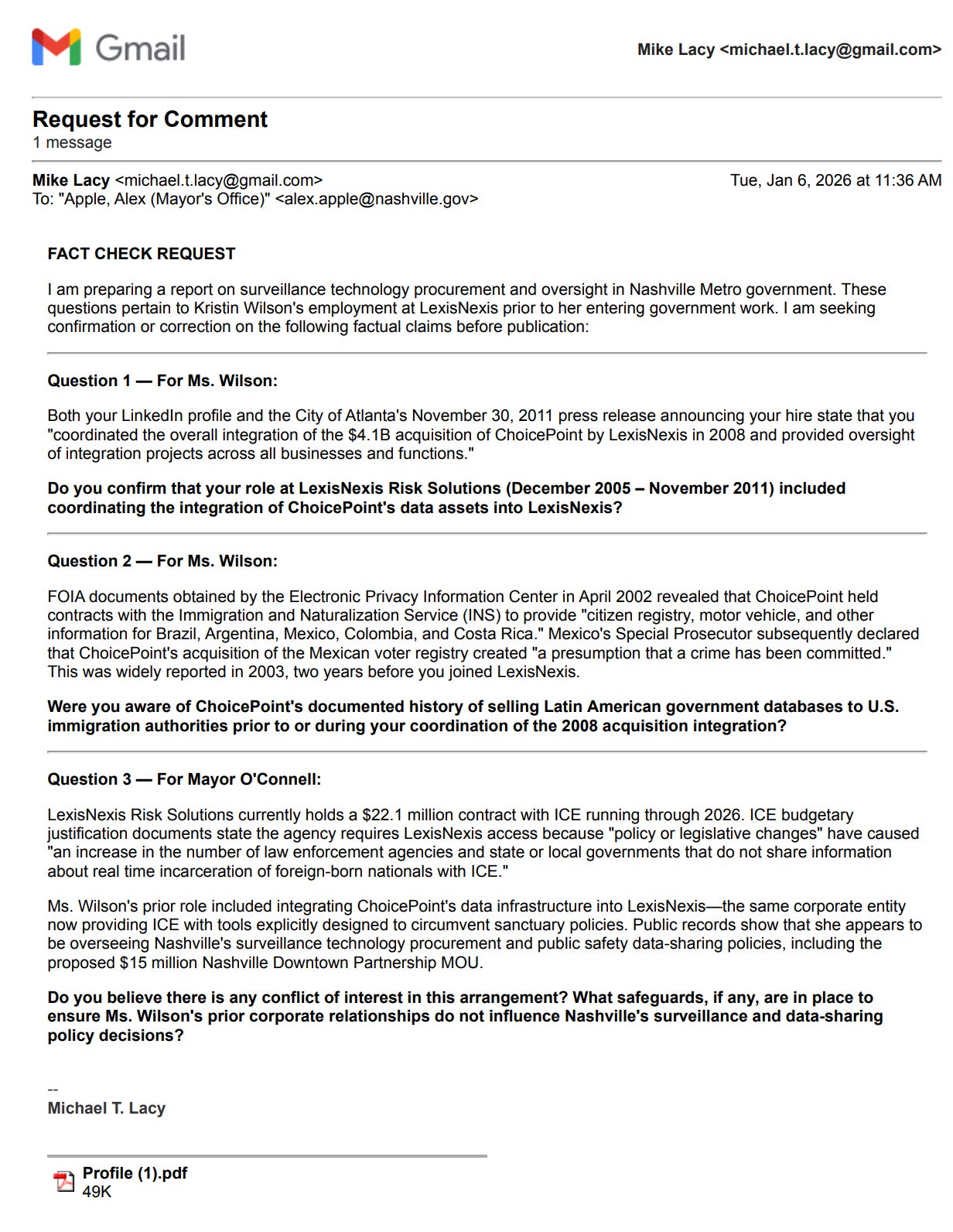
On Tuesday, January 6, I reached out to the Mayor’s Office with the following questions:
Question 1 — For Ms. Wilson:
Both your LinkedIn profile and the City of Atlanta’s November 30, 2011 press release announcing your hire state that you “coordinated the overall integration of the $4.1B acquisition of ChoicePoint by LexisNexis in 2008 and provided oversight of integration projects across all businesses and functions.”
Do you confirm that your role at LexisNexis Risk Solutions (December 2005 – November 2011) included coordinating the integration of ChoicePoint into LexisNexis?
Question 2 — For Ms. Wilson:
FOIA documents obtained by the Electronic Privacy Information Center in April 2002 revealed that ChoicePoint held contracts with the Immigration and Naturalization Service (INS) to provide “citizen registry, motor vehicle, and other information for Brazil, Argentina, Mexico, Colombia, and Costa Rica.” Mexico’s Special Prosecutor subsequently stated that ChoicePoint’s acquisition of the Mexican voter registry created “a presumption that a crime has been committed.” This was widely reported in 2003, before you joined LexisNexis.
Were you aware of ChoicePoint’s documented history of selling Latin American government databases to U.S. immigration authorities prior to or during your coordination of the 2008 acquisition integration?
Question 3 — For Mayor O’Connell:
LexisNexis Risk Solutions currently holds a $22.1 million contract with ICE. ICE budgetary justification documents state the agency requires LexisNexis access because “policy or legislative changes” have caused “an increase in the number of law enforcement agencies and state or local governments that do not share information about real time incarceration of foreign-born nationals with ICE.”
Ms. Wilson’s prior role included integrating ChoicePoint into LexisNexis—the same corporate entity now providing data services to ICE. Public records indicate she is involved in Nashville’s surveillance technology procurement and public safety data-sharing policies, including coordination of the proposed $15 million Nashville Downtown Partnership MOU.
What safeguards, if any, are in place regarding potential conflicts of interest in surveillance and data-sharing policy decisions? Is Ms. Wilson recused from any matters involving LexisNexis or related data broker contracts?
This article will be updated with any responses received.
A fact checking note on that figure: contemporary reporting described it as projected cost savings “by the third year”—her resume appears to characterize it as an ongoing annual achievement.
For several years I worked in an investigative capacity in criminal cases. One of the tools available to me was LexisNexis. It has an crazy amount of information on individuals. As one who spent time learning how to use it, I did a deep dive into what data there was on me. It's not an entirely flawless set up. Incorrect and incomplete info can be dangerous, not to mention all the rest that's no one else's business.
Thank you, Mike and Michele