
Dispatch from the December 15th Budget and Finance Committee Meeting
What happened last night

Update:
An amendment to the MOU has been submitted which a Council Member has referred to as “removing surveillance.” I believe that he was referring to this amendment from CMs Porterfield and Sepulveda.

It is a good attempt to remedy the problems with this resolution, but it does not address the core problems I have laid out and CM. Suara and Porterfield herself discussed at length last night: why is Metro facilitating moving the grant recipient to NDP, while the actual current recipient, the DMC, has 100% budget oversight from Council.
But perhaps more to the point, the amendment does not actually remove all the surveillance tech. It still lists at least two items that fall squarely into the “surveillance technology” category in the 2017 ordinance.
I would argue that as written, the resolution and MOU trigger the surveillance public hearing requirement in Metro code because it is establishing that Metro will be accepting gifts for surveillance and that it is not appropriate to wait until they are actually given.
But what is even more objective is that these two items that survived the culling from CM Porterfield and Sepulveda are clear examples “surveillance technology” as defined in the 2017 ordinance. Here is my recent email to them and Vice Mayor Henderson and Special Council Darby.
from: Mike Lacy
to: ”Sepulveda, Sandra (Council Member)” <sandra.sepulveda@nashville.gov>,
“Porterfield, Delishia (Council Member)” <delishia.porterfield@nashville.gov>
cc:”Darby, Margaret (Council Office)” <margaret.darby@nashville.gov>,
“Henderson, Angie (Vice Mayor)” <angie.henderson@nashville.gov>
date: Dec 16, 2025, 1:54 PMsubject:Surveillance Tech Still in the MOUHi CM,
I understand that you have filed a late file amendment which may be the one CM Kupin has referred to as “removing surveillance”. I think, however, the MOU still lists these elements:
Mobile Command Post & Tactical Support Post
Downtown Tech Center
I applaud you for being able to get language in the MOU changed, a feat that was seemingly impossible only two weeks ago. However, I do not think framing this as “removing surveillance technology,” as that term is defined by the relevant ordinance, is accurate.
The ordinance definition clearly covers these items. From Section 13.08.080(A)(2):
“Surveillance technology” shall mean any electronic surveillance device, hardware, or software that is capable of collecting, capturing, recording, retaining, processing, intercepting, analyzing, monitoring, or sharing audio, visual, digital, location, thermal, biometric, or similar information or communications specifically associated with, or capable of being associated with, any specific individual or group; or any system, device, or vehicle that is equipped with an electronic surveillance device, hardware, or software.
It’s very important to read the end of that first clause: “capable of being associated with any specific individual or group” -- anything that helps do that is surveillance technology. So for example, a SWAT rescue vehicle is not inherently surveillance technology. Put an ALPR reader on it, or buy one that has one built in, that is surveillance technology.
Command posts are vehicles equipped with video, communications, and monitoring systems. The description in the MOU itself states they provide “on-site command, control, and communication capabilities.” The point of that technology is to provide information about particular people of interest. That is surveillance technology.
The Downtown Tech Center is described as providing “staff and support equipment for Metro’s downtown traffic management center” — traffic management centers use CCTV and monitoring systems, which are explicitly enumerated as surveillance technology under subsection (a)(iii) and (a)(vii). If something can record license plates, it is surveillance technology.
Note: surveillance technology is not defined as inherently tied to MNPD or law enforcement. It is technology that aids in collecting information that can be “capable of being associated with any specific individual or group.”
The exclusions do not apply. The ordinance excludes “routine office hardware...that will not be used for any surveillance or law enforcement functions” — but command posts are explicitly for law enforcement functions. It excludes devices that “cannot record or transmit audio or video or be remotely accessed” — but command posts are designed for real-time transmission and remote coordination. It excludes “manually operated technological devices used primarily for internal communications...not designed to surreptitiously collect surveillance data, such as radios” — but command posts deployed at large events are designed to monitor those events, not merely facilitate internal radio traffic.
The “replacement” argument does not apply. The only exception for existing technology is in Section C(1), which applies solely to installing surveillance technology in the public right of way. It does not apply to Section C(3) — “accepting state or federal funds or in-kind or other donations for surveillance technology” — or Section C(4) — “acquiring new surveillance technology, including but not limited to procuring such technology without the exchange of monies or consideration.” If NDP is funding and donating these vehicles to Metro, Council approval is required with no replacement exception.
The approval trigger: Beginning July 1, 2017, approval by the Metropolitan Council, by a resolution adopted after a public hearing, shall be required prior to accepting donations for surveillance technology or acquiring new surveillance technology.
As written, there is still surveillance technology in the MOU, even if it is framed as capital expenditure. I would argue this automatically triggers the public hearing requirement, and voting for the resolution without one puts it at risk of being overturned by a court. But at a minimum, I do not think these items can remain while claiming in good faith that this amendment “removes surveillance” from the resolution.
Best,
Mike Lacy
Original Post
I spent Monday night at Metro Council having conversations and watching the Budget and Finance Committee meeting on the Nashville Downtown Partnership surveillance funding proposal. What happened in that room—the questions Council members asked, the non-answers they received, and what Council legal staff confirmed on the record—reveals why this morning’s Tennessean op-ed by David Ewing fundamentally misrepresents what’s actually at stake.
We welcome commentary from concerned Nashvillians. We love the Tennessean actually reporting on local politics (welcome!). But we would like to draw the columnist’s attention to an NPR investigation that was published at virtually the exact same time as his op-ed—documenting how New Orleans routed live facial recognition surveillance through a private nonprofit to bypass city oversight, the precise pattern Manaen Hall warned about in public comment Tuesday night.

We wish the Tennessean would concern itself with actual statutory realities of oversight when it comes to the District Management Corporation, and pay attention to how it’s only through outside action from organizations like the Nashville Community Safety Network that this MOU’s contents even came to public awareness.
If this resolution’s contents change in any way for the better, it’s not through people unquestioningly accepting the terms of public-private partnerships—it’s because people actually asked questions and pushed back. But from everything currently on the table, a Council ‘no’ vote is a vote for Downtown public safety.
The Grant Structure Nobody Wants to Explain Clearly
Here’s what I said from the public comment podium, and what the rest of the meeting confirmed:
The District Management Corporation received this $15 million state grant. That’s documented. That’s in the grant application. The DMC is a 501(c)(3) entity.
Metro Council has 100% oversight of the DMC’s budget. I stated this clearly: “The person who has been awarded this grant, you have 100% oversight of their budget. That’s a fact. That’s code.”
This resolution moves the recipient to the Nashville Downtown Partnership, which is a 501(c)(6). Different organization. “You do not have oversight of their budget.”
What followed was an hour of Council members asking variations of the same question: Why are we contracting with NDP instead of the DMC, which we actually control?
If downtown needs lighting, restrooms, and outreach services—provide them through the DMC with a proper MOU under Council budget oversight, or through Metro departments with established accountability. We don’t give special appropriations for the CBID directly to NDP, why should we skip the DMC now?
The Circular Answers
CM Porterfield: “DMC got the money right... is there anything wrong with us actually contracting with the DMC directly?”
Mr. Rosenberg (Administration): “I think that would leave out the organization that’s going to that’s involved with the grant, where the money is going to be and who’s going to be performing functions under it.”
CM Porterfield: “Can I have somebody from Legal. Is there anything stopping us from contracting with DMC directly?”
Special Counsel Darby: “I don’t think that there’s a prohibition against Metro contracting with the District Management Corporation.”
CM Porterfield: “Okay, so there’s no prohibition... So if we decide that we want to deal with the one that we have actual control over, there’s nothing stopping us from doing that.”
Darby: “There’s nothing prohibiting Metro from contracting with the District Management Corporation.”
Let me repeat that: Metro Council’s Special Counsel confirmed on the record that there is nothing prohibiting Council from contracting directly with the DMC, the entity that received the grant and whose budget Council has 100% oversight over.
CM Suara pressed even harder on this point after the legal confirmation:
“I still think that if we want to do this and we are not prohibited from having an agreement with the entity that got the grant, which is the one that we said we will work with, which the grant says you should have a letter of agreement with that entity according to the grant document. I see no reason why we should go into the NDP, especially if we’re not prohibited from doing so.”
The New Orleans Parallel - Published This Morning
Manaen Hall’s public comment referenced New Orleans’ surveillance workaround through Project NOLA. This morning—the same day as the Tennessean op-ed—NPR published a detailed investigation confirming exactly this pattern:
“In New Orleans, the technology was introduced by a private non-profit organization, Project NOLA... While Lagarde says he was open from the start about his use of facial recognition, it still took many by surprise when a Washington Post story in May detailed New Orleans’ first-in-the-country system.”
University of Washington law professor Ryan Calo called the New Orleans situation a “shell game” for legal responsibility: “My concern would be that if the surveillance is done ‘by the community,’ by people that are not official actors, that it will circumvent those protections.”
The ACLU’s Sarah Whittington noted that without clearer prohibitions, “I think we’ve defaulted to a private model.”
This isn’t speculation about what could happen. This is documentation of what is happening when surveillance systems get routed through private nonprofits that operate outside direct governmental oversight.
Hall warned Council:
“Nashville rejected FUSUS. You established surveillance oversight requirements and procurement rules. Now we’re being asked to send $15 million flowing through the Nashville Downtown Partnership, a private nonprofit, to purchase or handle the technology that MNPD handpicked.”
The parallel is exact: When direct municipal procurement faces community resistance, the same technologies reappear through nonprofit arrangements that bypass oversight mechanisms.
What NDP Representatives Said
Ben Simpson from the Nashville Downtown Partnership was asked directly about the grant structure.
CM Kupin:
“I’m looking at the letter of intent, and it looks to be that the mayor and Metro says 0%. The Nashville DMC is 0%. And the downtown partnership is 100% of who’s going to apply for the grant. So it would seem to me that than the downtown partnership would have been the one to apply for the grant. But then the grant application has the DMC as the grant application. So how does that how do we reconcile those two documents that don’t seem to line up?”
Simpson: “It’s a great question. The answer is we followed the guidance we were given by the state.”
That’s not an answer. That’s a deflection.
CM Suara had clearly done homework, reading the grant documents and fiscal analysis the night before, and noted the same discrepancy:
“I was reading the fiscal analysis last night, and it kept saying that the NDP is applying for, the NDP is getting the money, and that language is still there. Looking at who is responsible for what in terms of Metro to the state government... all of this is muddled together.”
Too much airtime has been given to the MOU and not the resolution. The resolution clearly states Metro will not be applying for these funds (but could). But since the DMC and not the NDP is was awarded these funds ALREADY, it creates the appearance that a net new application is being submitted or at most an alteration or the original grant.
There has been nothing presented in any conversation on this grant that explains why, if the recipient can be changed form “DMC” to “NDP”, it can't just go to Metro Nashville — the organization first stipulated as being eligible for these funds when the grant was announced.
The Real Question Nobody Answered
CM Porterfield:
“I still think that if we want to do this and we are not prohibited from having an agreement with the entity that got the grant, which is the one that we said we will work with, which the grant says you should have a letter of agreement with that entity. According to the grant document. I see no reason why we should go into the NDP, especially if we’re not prohibited from doing so.”
That’s the entire issue in one statement. If there’s no prohibition against contracting with DMC, and DMC has the grant, and Council has 100% budget oversight over DMC—why are we routing this through NDP?
Nobody provided a coherent answer to that question. Mr. Rosenberg kept saying NDP would be “doing the work,” but that doesn’t explain why the contract can’t be with DMC for work that NDP performs under their existing contractual relationship. Council members established that DMC and NDP already have agreements where NDP operates on behalf of DMC.
It was stated multiple times that NDP gets all of its funding from the DMC, and so it made no sense to give the funds to the DMC. That is a lie. NDP has many contracts irrespective of the DMC. One such contract was for operating the Nashville Downtown Library Parking Garage.
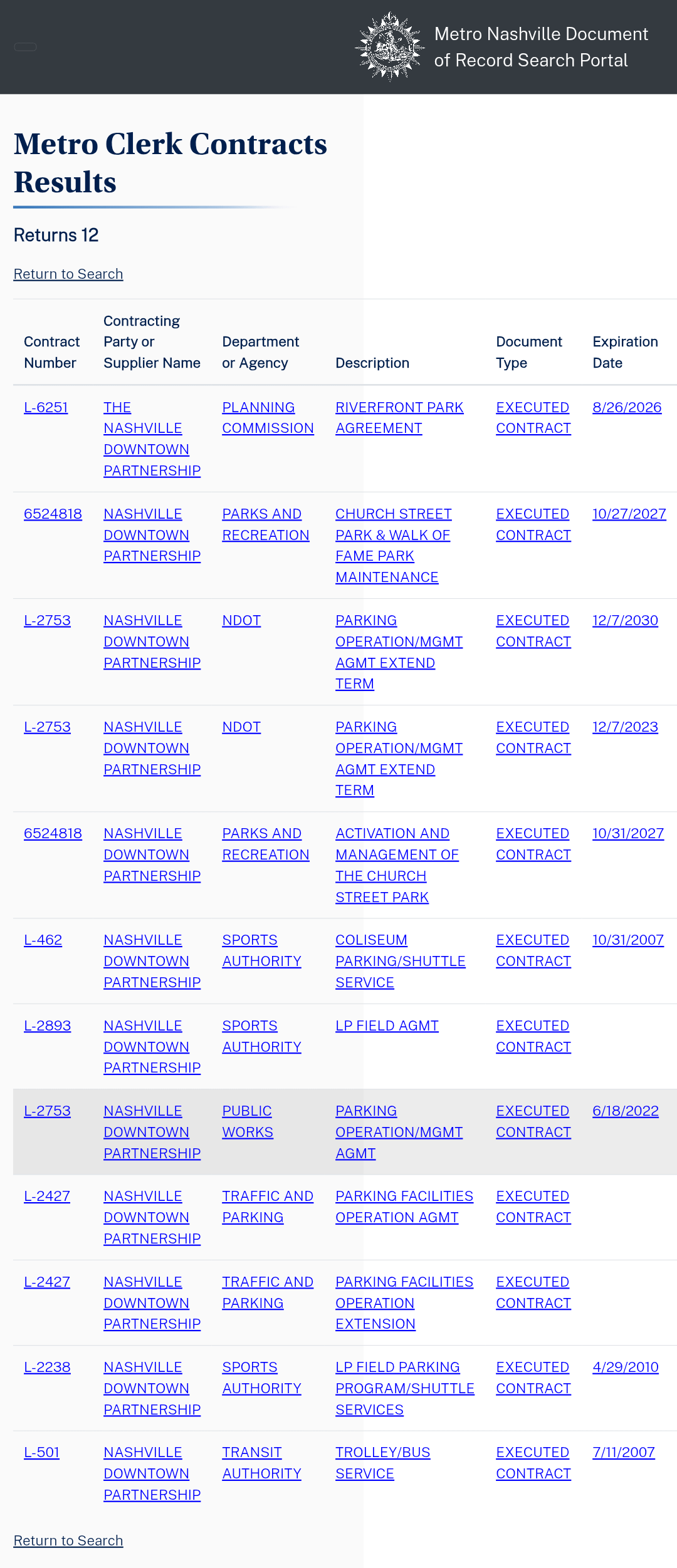
Conversations on the floor and around council were textbook examples of bad faith arguments. Students of logical fallacies should scrub the YouTube link for examples of “Circular Reasoning”, “Appeals to Authority,” “Arguments from Ignorance,” and “False Dilemmas.”
What's particularly striking is the absence of any “affirmative case.” When Council members ask "Why must it be this way?" the administration never provides positive reasons—only circular restatements that this is the way, appeals to unnamed guidance, or vague references to who's "doing the work."
This is what makes CM Suara's observation so sharp: when you can't articulate why a particular structure is necessary, and legal counsel confirms it's not required, the structure itself becomes evidence of intent to circumvent oversight—regardless of what anyone claims their intentions are.
When contracts and grant awards were presented to an official representing the Downtown Partnership contradicting his statements, his response was “I disagree.”
When it comes to the difference between the DMC, which has its entire budget subject to Council approval, and the NDP, a fully independent 3rd party, the priorities of the Mayor’s Office appear to be obligating not only Metro Officials, but lawyers employed by outside non-profits to operate in a completely “post-truth”, thoroughly Trumpian bizarro world.
It is, as people I spoke to last night with intimate knowledge of the matter agree, very, very weird. I am reminded of what a friend of mine steeped in systems theory often refrains to me: “you cannot convince anyone of a truth they are paid not to believe.”
The Surveillance Technology That Appeared From “Conversations”
CM Kupin: “How are the items decided on that became part of the exhibit A?”
Mr. Rosenberg: “There were conversations between metro departments, identifying metro priorities and with NDP about their priorities and shared priorities.”
“Conversations.” That’s how surveillance technology got on a list that’s supposed to govern $15 million in state funding. Not through competitive bidding. Not through formal procurement processes. Not through transparent public planning. “Conversations.”
This is exactly what Manaen Hall described in public comment when he referenced New Orleans’ facial recognition workaround:
“A private nonprofit with no formal city contract operated the cameras... City officials claimed they weren’t violating the ban because technically, the city didn’t own the cameras.”
The pattern is clear: When direct municipal procurement faces community resistance—as FUSUS did—the same technologies and often the same vendors reappear through nonprofit partnerships that bypass oversight mechanisms.
The Software Shell Game and the MOU’s Structural Weakness
Amendments were proposed to remove “Leo Sight” by name from the MOU. But as CM Porterfield noted:
“The exhibit now takes out specific software, but it still has software in the list... And so that could be any software that the entity decides to buy in the future.”
CM Suara opposed even this amended language:
“I will be a no on the amendment because software by itself is just very ambiguous to me and it means so many different things and I’m still not comfortable with that.”
Here’s the fundamental problem with the MOU’s structure: Because it doesn’t state limits or restrictions, amendments removing specific surveillance technology names can still allow the NDP to purchase surveillance equipment. The MOU could even allow money donated to Metro to then be used to purchase surveillance, as was the originally stated purpose of the agreement.
Mr. Rosenberg tried to provide assurance:
“This would be done by Metro, so it would not be them doing it. It would be council approving, purchasing whatever software it is before it would be used by Metro.”
But when pressed about whether the MOU approval would be “a blanket approval of software”:
Rosenberg: “I believe that they would end up donating the money for the software because it would be hard to. But it would not be restricted to two specific pieces of software that were in the original MOU, and then council would need to approve whatever it was.”
The administration confirmed that surveillance equipment would be subject to existing Metro Code requirements for public hearings. That’s good. But it doesn’t address how these particular technologies got on the list without competitive bidding, or why we’re creating a structure where NDP purchases equipment that Metro then has to approve after the fact—or could potentially donate funds for Metro to purchase.
What the Meeting Revealed
Special Counsel Darby, when asked if surveillance tech purchased by NDP would require public hearing before Council approval: “Yes. This does not circumvent the public hearing provisions or council, or the Metro Code of Laws in any way.”
CM Porterfield: “So I just want to clarify that on December 15th at 6:40 p.m. for the time stamp. So if we need to come back and replay this for the receipts.”
That’s a Council member putting a time stamp on the record because these assurances may need to be referenced later when the administration tries something different. That’s not confidence in the process—that’s documentation for future accountability.
CM Porterfield also pressed on why all three entities couldn’t be named in the MOU if they’re supposedly the same:
CM Porterfield: “Would there be any benefit or is there anything prohibiting all three entities being named in the MOU? So Metro, NDP and then the umbrella, DMC?”
The administration couldn’t give a clear answer why not, only circular explanations about who’s “doing the work.”
“It Gives the Appearance of Trying to Circumvent”
After establishing there was no legal prohibition on contracting with the DMC, CM Suara laid out why this entire arrangement looked problematic:
“So I just want to get some things in writing, on record, because... it gives the appearance of trying to circumvent, especially when there’s the allegation of different entities, different control system. That may not be the intent, but that is the appearance that it gives.”
When Ben Simpson from NDP was asked whether there would be changes to spending without Council approval, he avoided a direct answer: “I would love to be able to bind my organization, this council in the mayor’s office... from this podium. But I don’t think I have that authority.”
Suara’s questioning revealed someone who had studied the actual grant documents, noticed the discrepancies between what was written and what was being said, and understood that regardless of stated intent, the structure itself creates the appearance of circumventing oversight.
How This Reframes the Tennessean Op-Ed
David Ewing’s piece in this morning’s Tennessean claims: “A ‘yes’ vote will give the council more input, more oversight and create accountability.”
Notably, this op-ed was published the same morning NPR released its investigation into New Orleans’ surveillance workaround through private nonprofits—the exact pattern Manaen Hall warned about in public comment, and the exact concern CM Suara articulated about “the appearance of trying to circumvent.”
Tuesday night’s meeting proved the opposite of Ewing’s claims.
The documented facts:
The grant is with the DMC, which has 100% Council budget oversight
There is no legal prohibition against contracting with DMC directly
The administration chose to route funds through NDP, which Council does not control
When asked why, representatives gave circular non-answers
Surveillance technologies got on the list through “conversations” not competitive bidding
NDP representatives indicated they’d be fine with funds flowing through DMC
The push for this particular structure is coming from the Mayor’s Office
Ewing writes: “Voting ‘no’ on the MOU puts the Council on the sidelines and out of the decision-making process.”
What Council established: The MOU could be written with the DMC, maintaining actual oversight. They’re actively choosing the structure that provides less accountability. If Council votes no, they can demand proper structure—a DMC MOU with actual oversight, or direct Metro departmental control.
Too much airtime has been given to the MOU and not the resolution. The resolution clearly states Metro will not be applying for these funds (but could). But since the DMC and not the NDP is was awarded these funds ALREADY, it creates the appearance that a net new application is being submitted or at most an alteration or the original grant.
There has been nothing presented in any conversation on this grant that explains why, if the recipient can be changed form “DMC” to “NDP”, it can't just go to Metro Nashville — the organization first stipulated as being eligible for these funds when the grant was announced.
Ewing writes: “This is about investment, not surveillance.”
What the meeting showed: The Mayor’s Office inserted surveillance technologies through “conversations,” removed specific vendors only after investigative journalism exposed problems, and is now using generic “software” language that could be filled in later. The entire structure bypasses the competitive bidding and public scrutiny that killed FUSUS.
Ewing writes: “The MOU keeps decision-making where it belongs—in public view, through elected officials.”
What legal staff confirmed: Without the MOU, NDP can spend the money however they want within grant parameters. But that’s an argument for a DMC contract with real oversight, not for legitimizing a 21-year pattern of NDP operating outside required budget approvals.
The Questions That Didn’t Get Answered
After hours of discussion already on Council floor, these basic questions remained unanswered:
Why can’t the MOU be with the DMC, which received the grant and which Council controls? “Because NDP does the work” is not an answer—they already do work for DMC under existing agreements. NDP has no special status I have ever found as the “operator” of the DMC, they are simply a vendor.
How did specific surveillance technologies get on the approved list? “Conversations” is not a procurement process.
Why is the Mayor’s Office so invested in routing funds through NDP instead of DMC? If they’re functionally the same entity, why specifically choose the structure with less oversight?
Why were problematic vendors removed only after publication? If procurement was proper, why the retroactive changes?
If NDP would be fine with funds flowing through DMC, whose interest does this structure serve? Not NDP’s, apparently. Not Council’s oversight role. Not public accountability. So whose?
It seems that only a Mayor’s Office intent on obtaining surveillance tools by any means necessary would be interested in this arrangement. If they would like the prove me wrong, then surveillance tools should be explicitly banned in this arrangement and/or Council oversight should be implemented over the funds BEFORE they arrive at NDP by passing them through the DMC.
What Should Happen
CM Suara made it clear: “I still think that if we want to do this and we are not prohibited from having an agreement with the entity that got the grant, which is the one that we said we will work with... I see no reason why we should go into the NDP.”
That’s the right analysis. If downtown needs lighting, restrooms, and outreach services—provide them through the DMC with a proper MOU under Council budget oversight, or through Metro departments with established accountability. We don't give special appropriations for the CBID directly to NDP, why should we skip the DMC now?
The surveillance technologies should go through competitive bidding with public hearings before any money is committed—not through “conversations” that result in donations Metro has to accept or reject after NDP makes purchasing decisions.
The Pattern We Keep Seeing—Now Documented Nationally
Community rejects FUSUS → Same executives create LeoSight → Technologies appear through nonprofit partnerships → When caught, remove specific vendors but maintain the structure → Route money through entity with 21-year history of avoiding oversight → Frame opposition as rejecting “investment.”
This morning, NPR documented this exact playbook in New Orleans, where private nonprofit Project NOLA operates live facial recognition surveillance that bypasses city oversight. University of Washington law professor Ryan Calo called it a “shell game” for legal responsibility. The ACLU noted they’ve “defaulted to a private model” when public oversight fails.
This isn’t about noise cameras. This isn’t about public restrooms. This is about building infrastructure for accountability-avoidance.
When the Mayor’s Office can’t explain why they need this particular structure, when they’re indifferent to NDP’s preferences, when they only remove problematic vendors after publication, when they actively choose less accountability over more, when CM Suara documents that “it gives the appearance of trying to circumvent,” and when NPR publishes documentation of this exact playbook being used in New Orleans—that tells you what this is really about.
Metro Council should vote no and demand this MOU be rewritten with the DMC, or fund these services through Metro departments with actual oversight. Not because downtown doesn’t need investment, but because:
The New Orleans precedent is documented: Private nonprofits operating surveillance that bypasses oversight, published by NPR this morning
Nashville’s own pattern is clear: FUSUS rejection → LeoSight reappearance → NDP routing
The 21-year history matters: NDP violated budget approval requirements for two decades
Legal counsel confirmed alternatives: Nothing prohibits contracting with DMC, which has 100% Council oversight
Council members see it: As Suara said, regardless of intent, this “gives the appearance of trying to circumvent”
The MOU’s structure allows it: Without stated limits or restrictions, surveillance can still be purchased even with amendments removing specific vendor names
We welcome concerned Nashvillians engaging with these issues. We ask that they engage with the actual statutory realities, the documented patterns of accountability failure both here and nationally, and recognize that when things improve, it’s because people pushed back—not because they accepted reassuring words about partnerships while fundamental oversight questions went unanswered.
Mike, this looks so corrupt. Is there any chance of litigation to stop it?
At this point I'm wondering if the administration's actions are worthy of an ethics complaint.