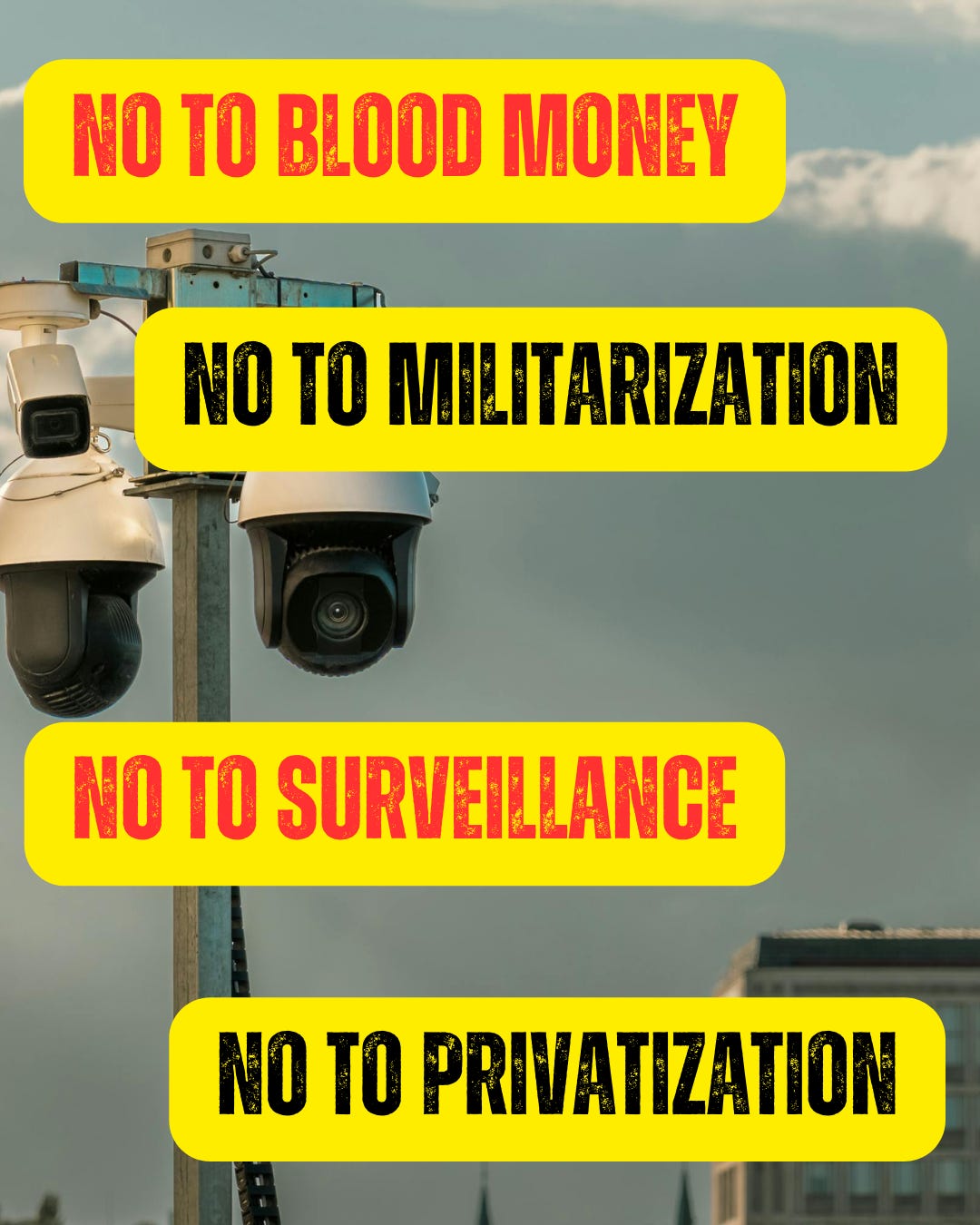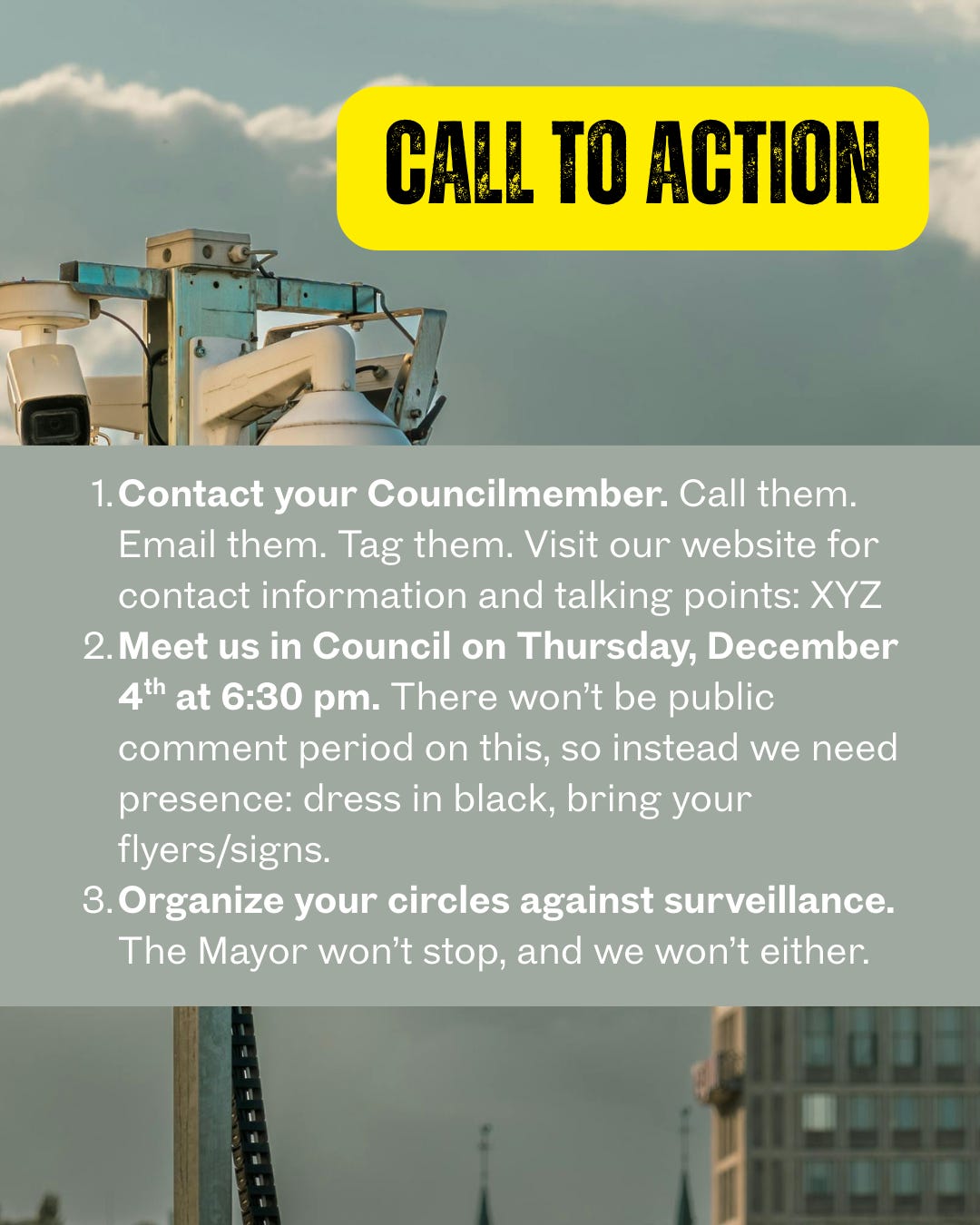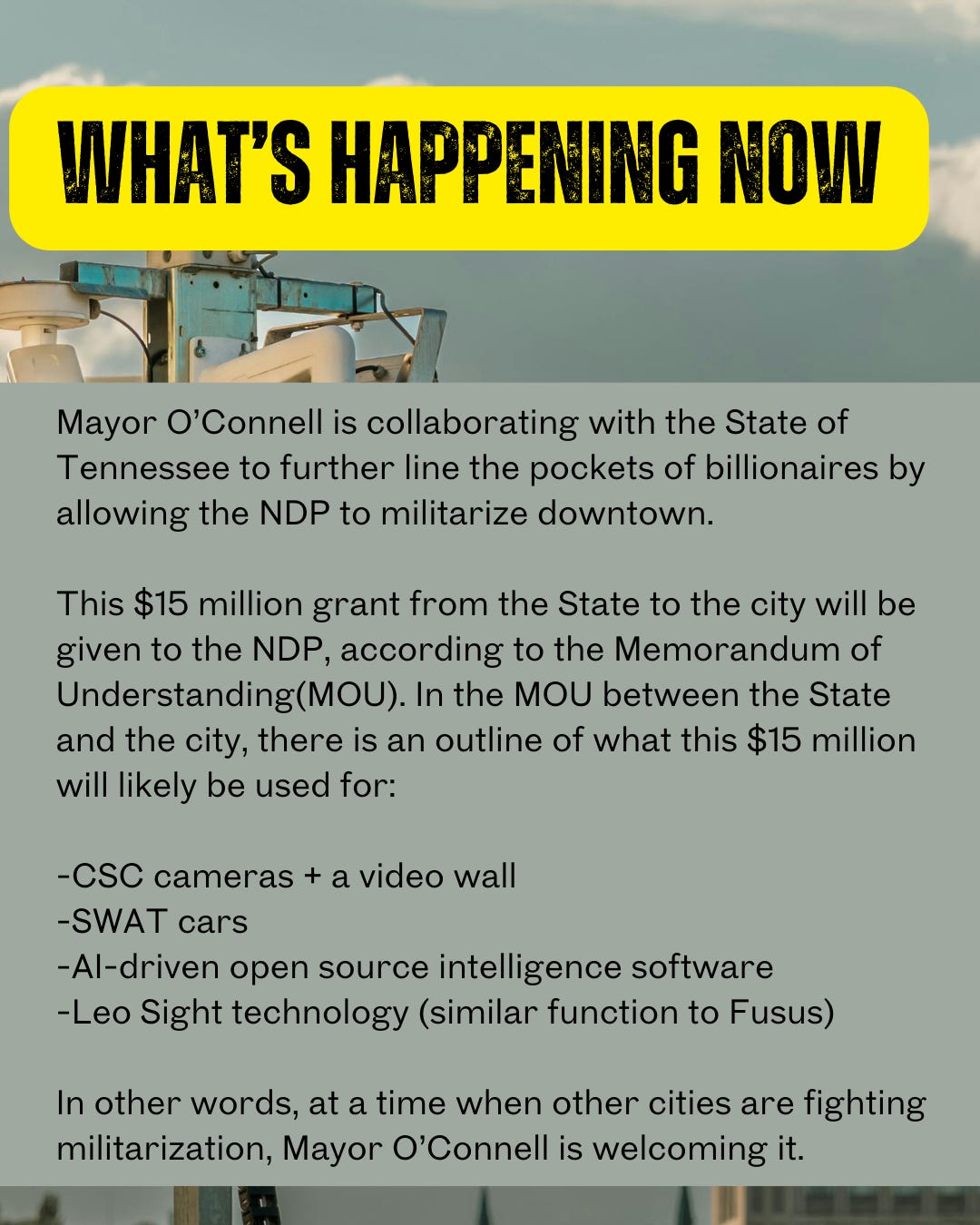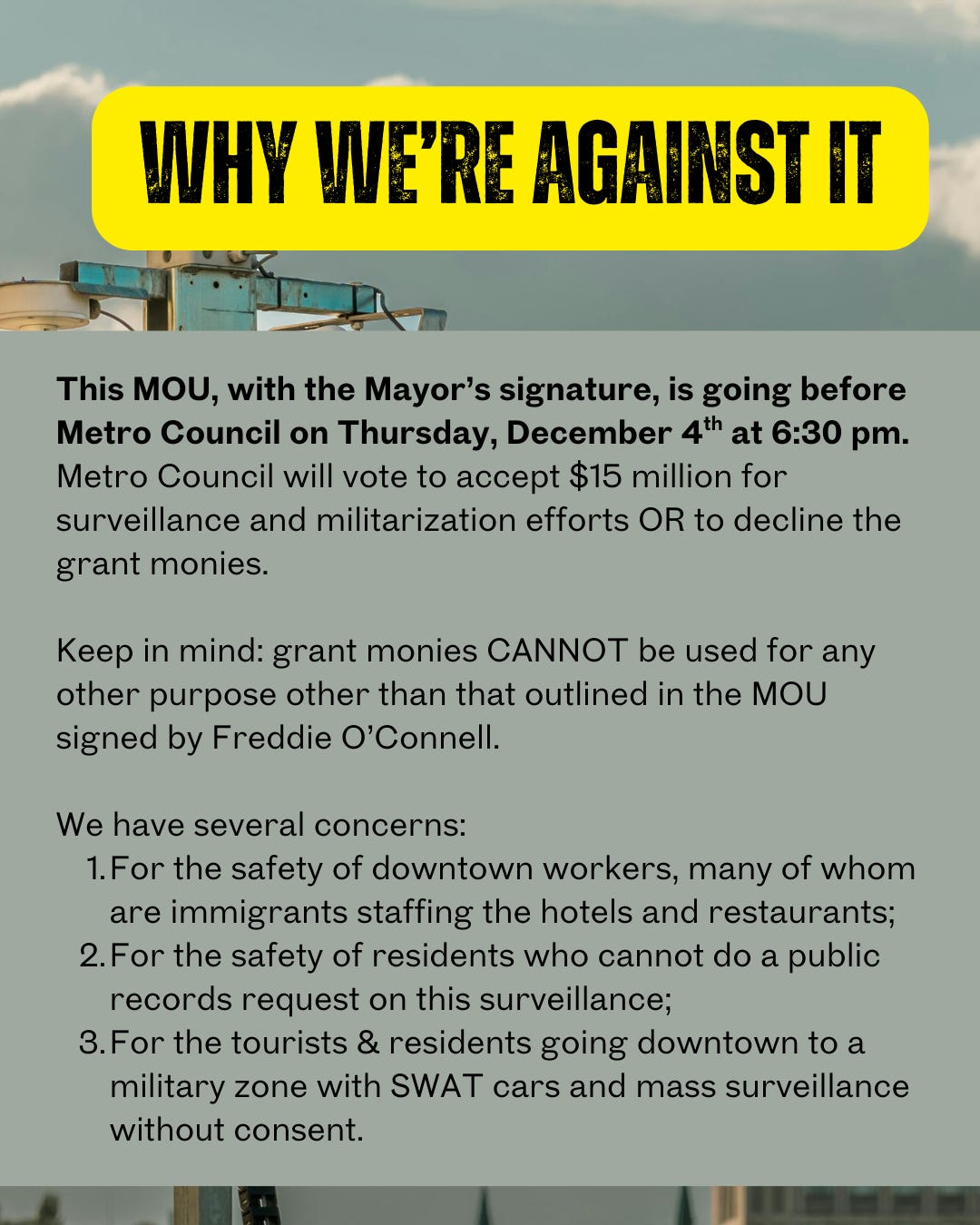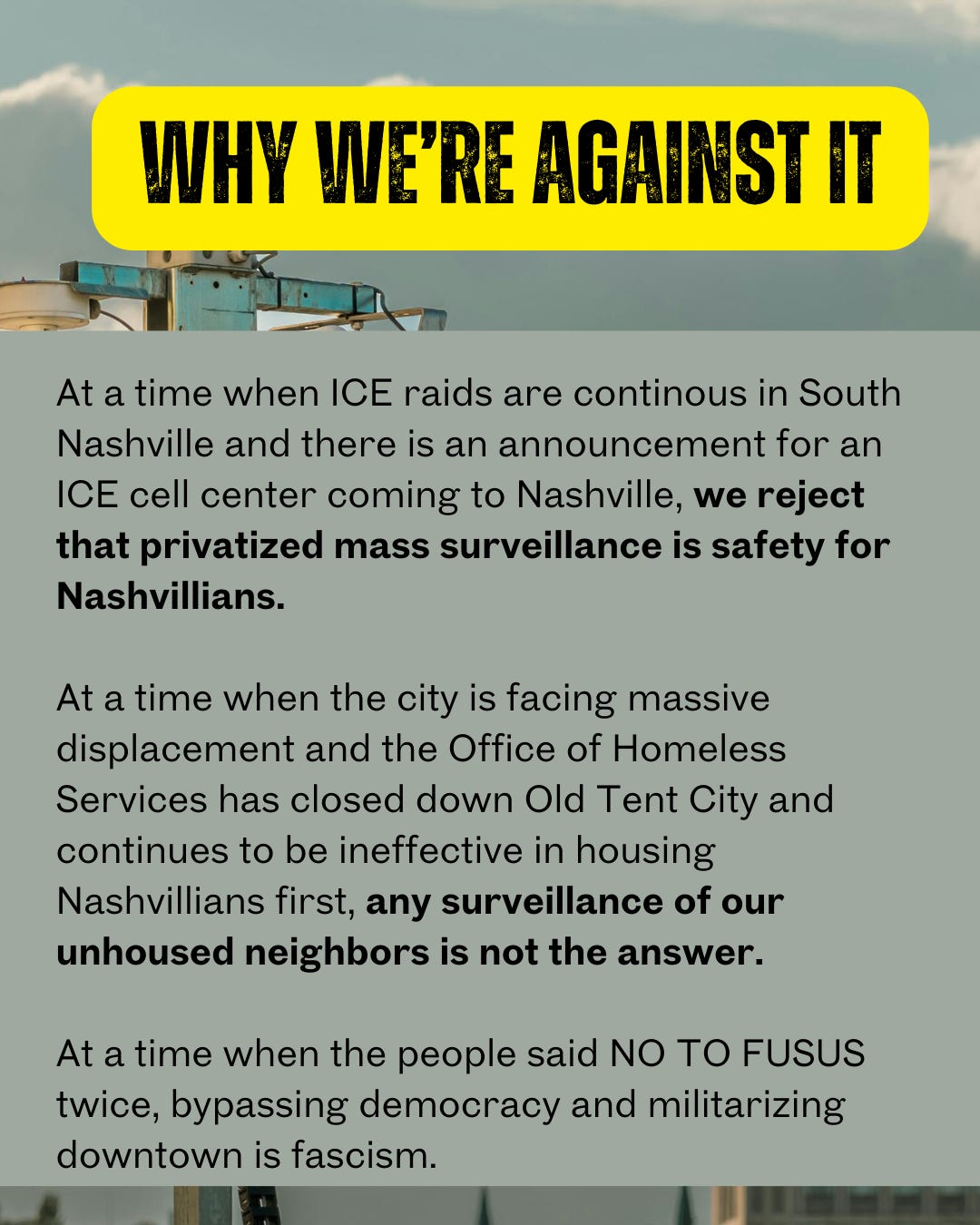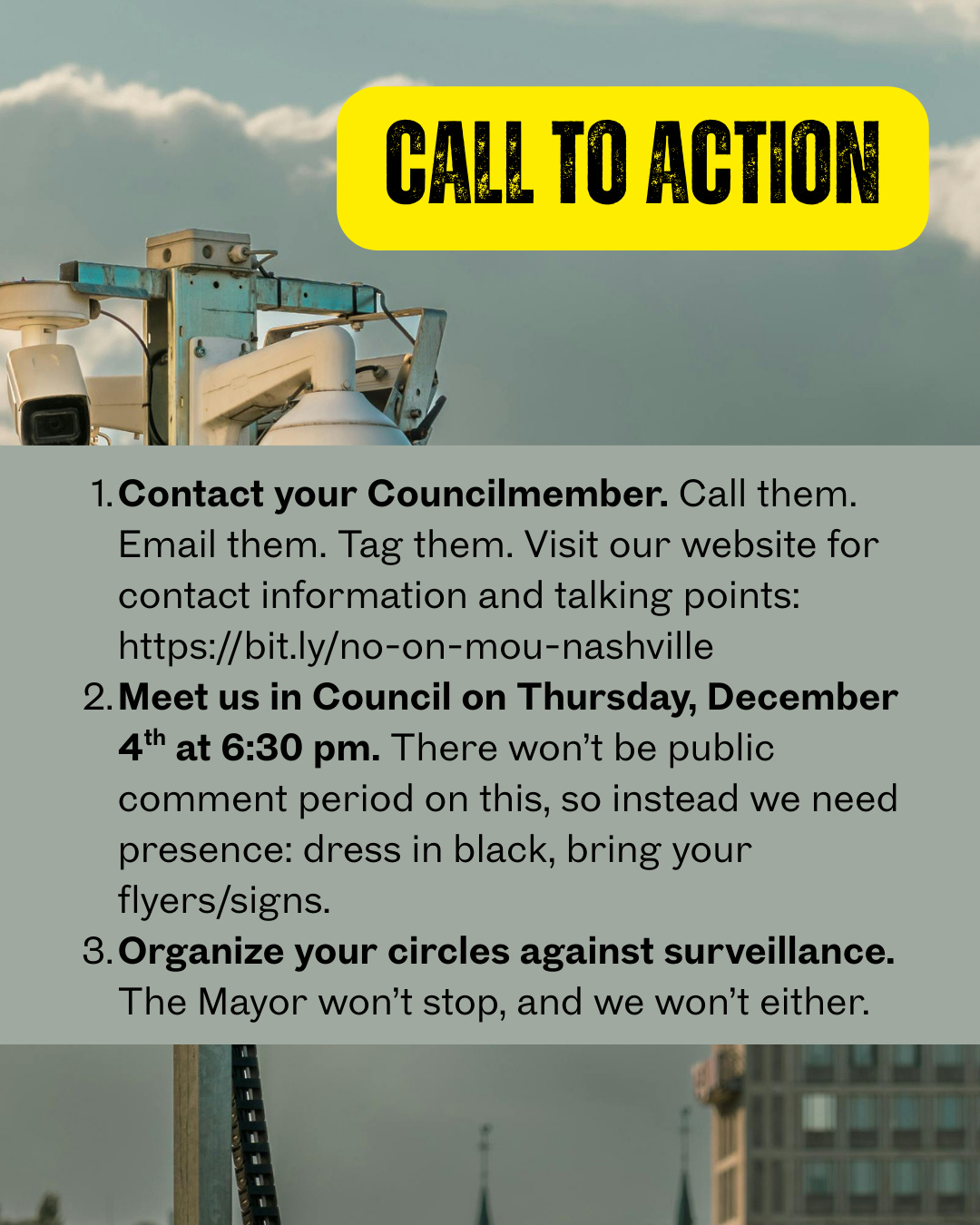
Council is likely to vote on this resolution December 4, 2025. Tell them how you feel about this here.
Learn everything here at this website.
Social Media Content you can repost at the bottom of this email.
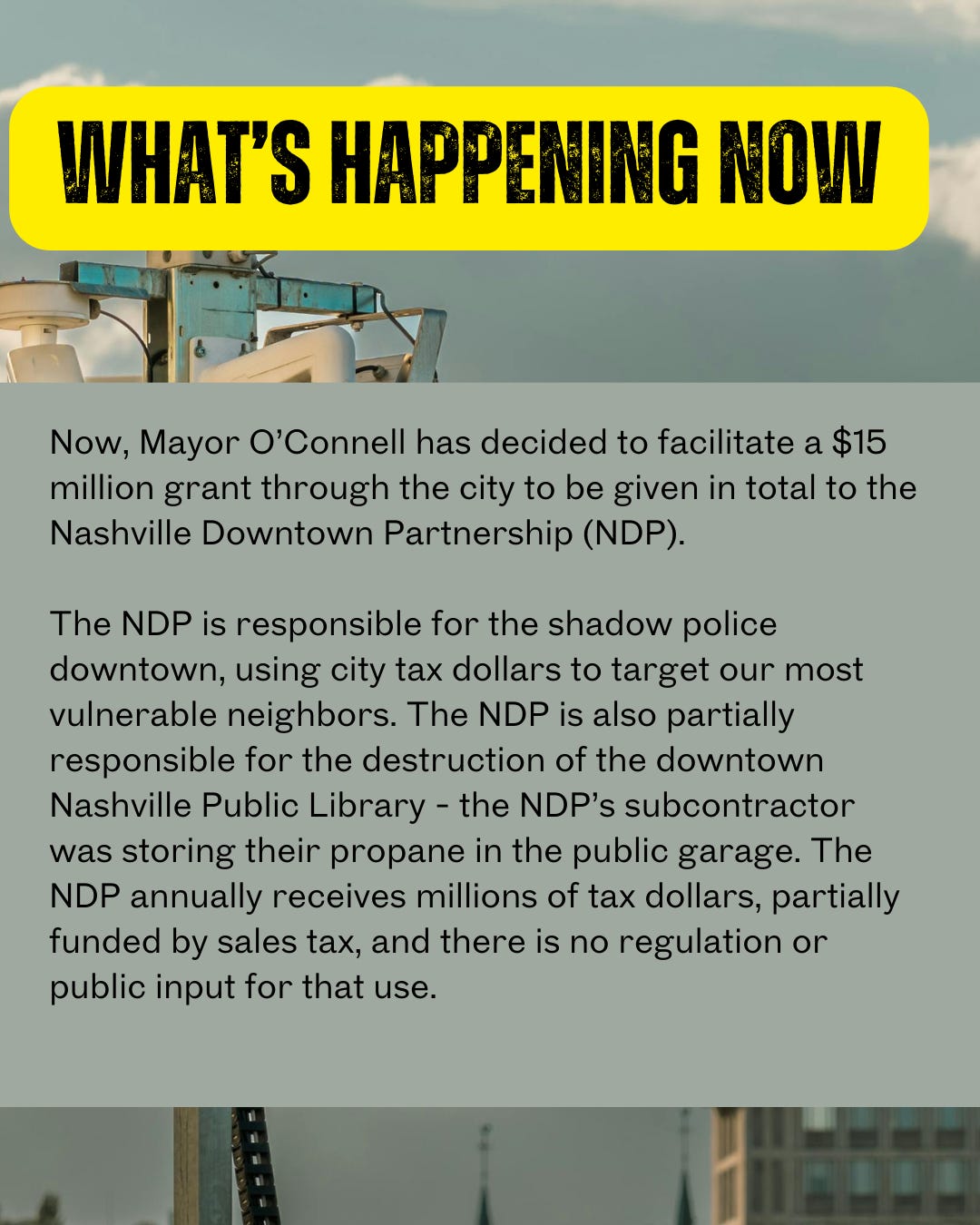
Yesterday, the Nashville Community Safety Network’s Instagram account was the first to report that Mayor O’Connell had signed a deeply troubling memorandum of understanding (MOU) with the Nashville Downtown Partnership — an agreement that routes $15 million toward acquiring expansive new surveillance technology.

Since then, even more information has surfaced. I published a follow-up piece in which I described this system as “Fusus on steroids,” referring to the highly controversial surveillance platform the Metro Council repeatedly rejected. At the time, I meant it metaphorically. As in like, “it’s the same kinda product, just different companies, but more.”
But shortly after I posted it, subsequent research shows that I was being far more accurate than I realized.
Here’s what I found out:
Axon/Fusus — the same company Nashville spent three years fighting to keep out of the hands of overreaching government agencies — had a Chief Revenue Officer who, earlier this year, left to found a new company offering nearly identical surveillance capabilities.
And just seven months after Fusus was finally stalled in Council, that new company appears in the very MOU Mayor O’Connell has now signed.

Nashville said “no” to Fusus for three years straight.
Multiple Council votes. Hours of public testimony. Sustained, organized community resistance that ultimately forced Mayor O’Connell to abandon the platform in April 2025, citing federal “erosions in the rule of law.” But last Friday, he submitted an MOU agreeing to help give funding for an extremely similar service from a company whose CEO’s last job was as the Chief Revenue Officer of Fusus.
Hmm.

Meet LeoSight!

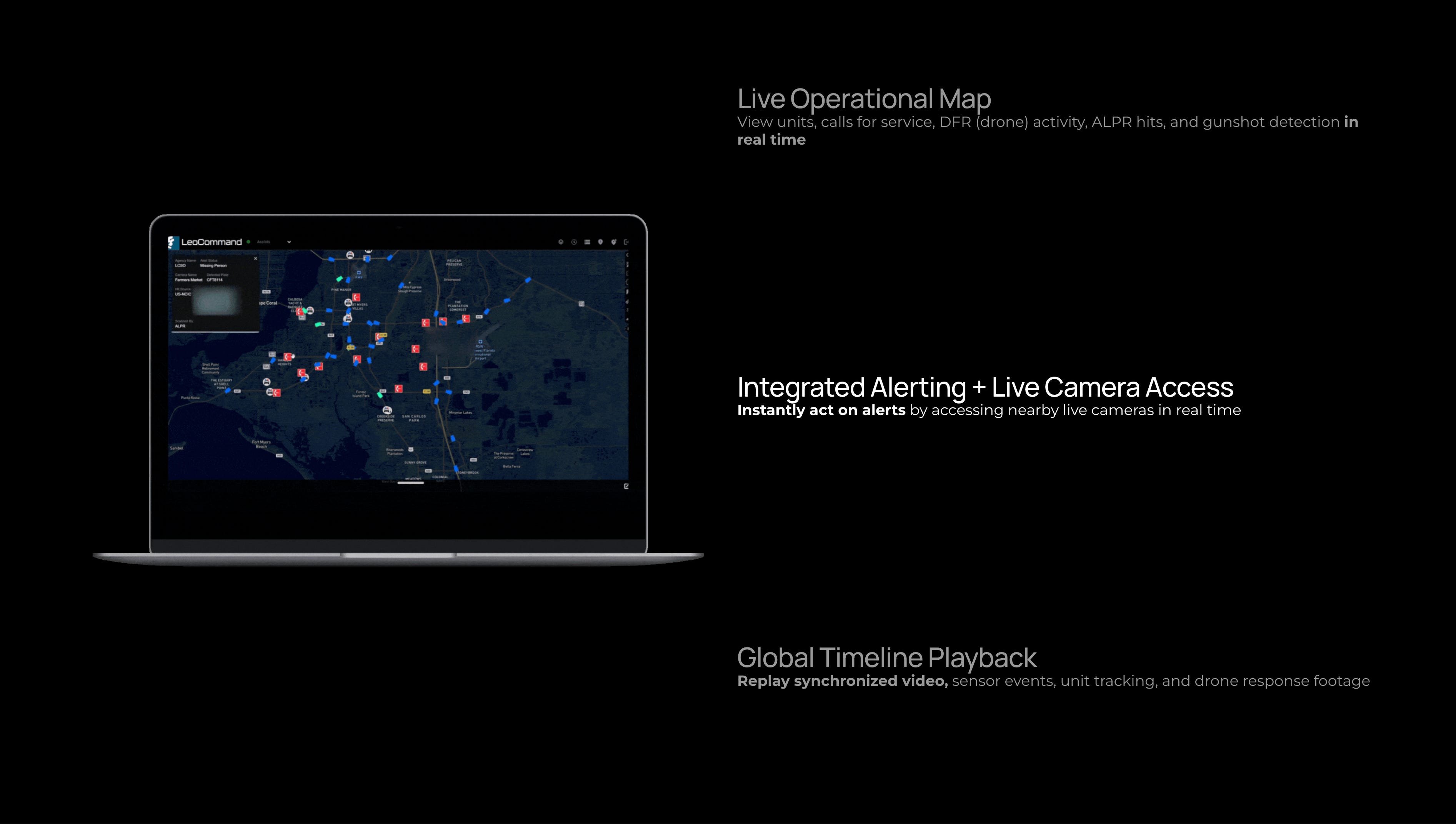
In March 2025—at precisely the same time privacy advocates in Nashville killed Fusus and O’Connell announced he would not be pursuing it again — [name redacted] founded LeoSight.1
LeoSight, a data surveillance aggregation platform presumably named after people born between July 23 and August 22, seems to have emerged from the ashes of Fusus’ tainted brand. Like all Leos, this one, despite being less than a year old, is very self-assured and comfortable in the spotlight.
LeoSight itself is actually a rebrand of a company founded in 2015 called “Live Earth”.

And the “founder” of LeoSight according to his LinkedIn? His previous job?
It was Chief Revenue Officer at Fusus.
You can’t make this stuff up.
Here’s his redacted resume from LinkedIn.


I’m choosing not to include his name for now. It’s been my experience that those who track other people for a living are, ironically, quite sensitive when publicly available details about themselves — including information they’ve posted online — are brought to light.
But given that this information is currently available on LinkedIn, and this organization is explicitly cited in an MOU using public money to surveil the public, his anonymity is being preserved at this time as a courtesy as this is all a developing story. This anonymity should not be expected from other publications that have editors and lawyers on staff.
The spin doctoring is already underway.
You will hear things like: “Yes, but LeoSight doesn’t involve community cameras. That was the problem with Fusus, right? The protestors just didn’t like that the community could send footage to the police more easily [mutters under breath: probably because they like committing crimes in their free time]. But this doesn’t involve privately owned cameras [checks LeoSight’s website] I think...”
I am eager to receive these questions, and happy to discuss these matters with anyone. Much more eager, I’d assume, than the CEO of LeoSight/Former CRO of Fusus.

LeoSight’s CEO

[Name redacted] was honored to be presenting Fusus at the International Association of Chiefs of Police conference in 2023.
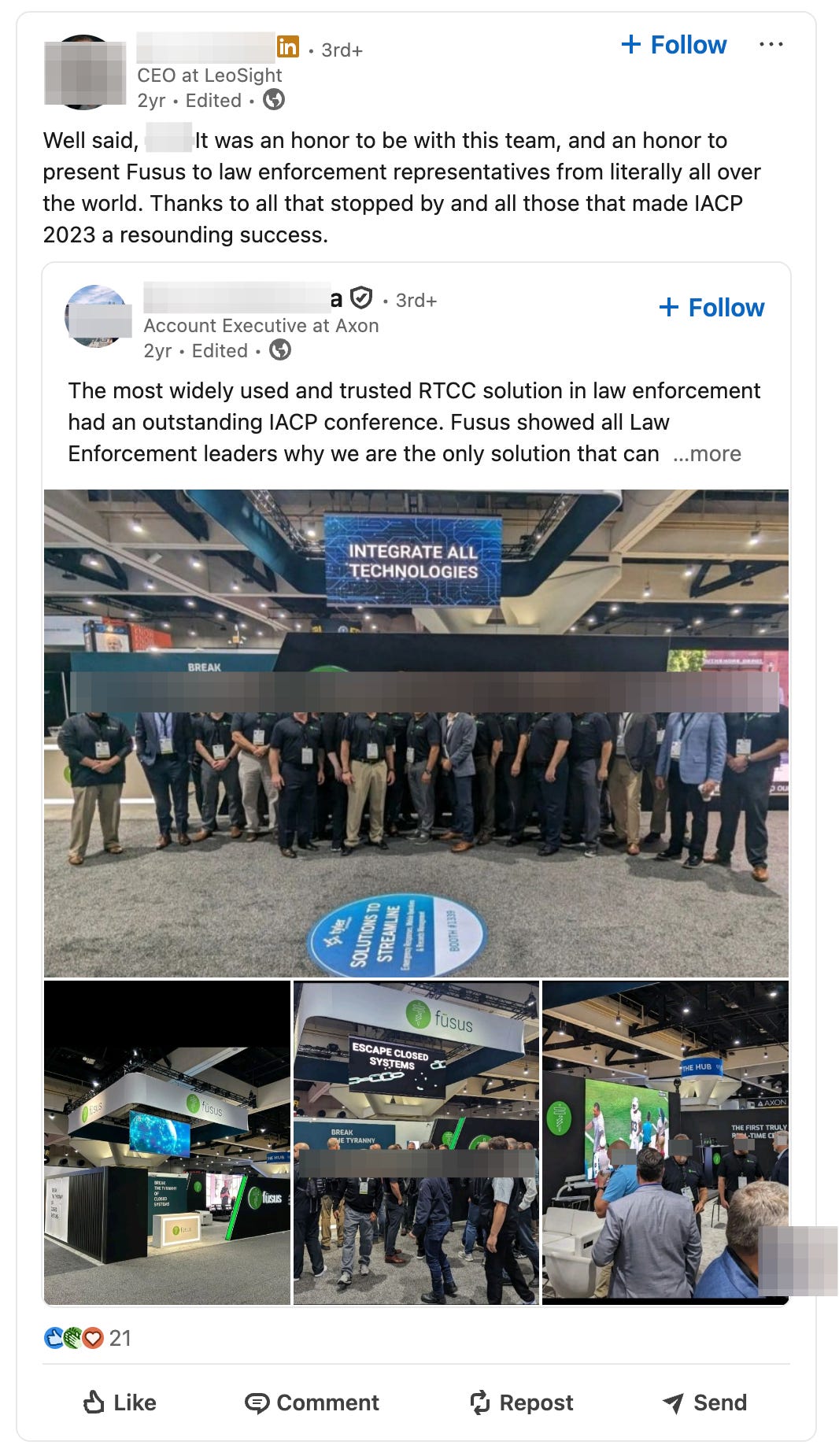
And in March 2025, he was “happy to share” that he was the founding CEO of LeoSight. Not happy enough to do more than to use the auto-generated LinkedIn announcement to share this, but who really has time for making heartfelt LinkedIn posts when you're starting a new company?

All this happening just as Fusus was being defeated by advocates who asked Axon and Fusus simple questions about how their products worked and how Nashville could ensure its citizens’ privacy.
These facts are quite stunning. LeoSight’s CEO spent over three years at Fusus, through Axon’s acquisition of the tool, helping sell the exact surveillance platform Nashville rejected.
Around the same time as Nashville doing the Fusus brand pretty dirty in national media, [redacted] jumped ship and became the CEO of LeoSight, a rebrand of Live Earth, a company that does extremely similar things to Axon (which owns Fusus). Similar enough that I’m surprised he did not have a non-compete clause that prevented him from taking the position.
Now after just over six months in the job, his new company finds it way into an MOU signed by the Nashville Downtown Partnership and Mayor Freddie O’Connell, former privacy advocate turned total surveillance enthusiast.
It’s all just, weird.
And, if not for people like the Nashville Community Safety Network exposing it, all of this all would have gone unnoticed. “Exhibit A” of the Downtown Partnership MOU, filed the Friday before Thanksgiving, includes specific information about the software they were going to purchase:
CSC Software, Leo Sight: Public Safety software allowing all partners to have situational awareness and communicate via mapping and talk channels. Software has accountability metrics, digital evidence storage, and analyst workflow.
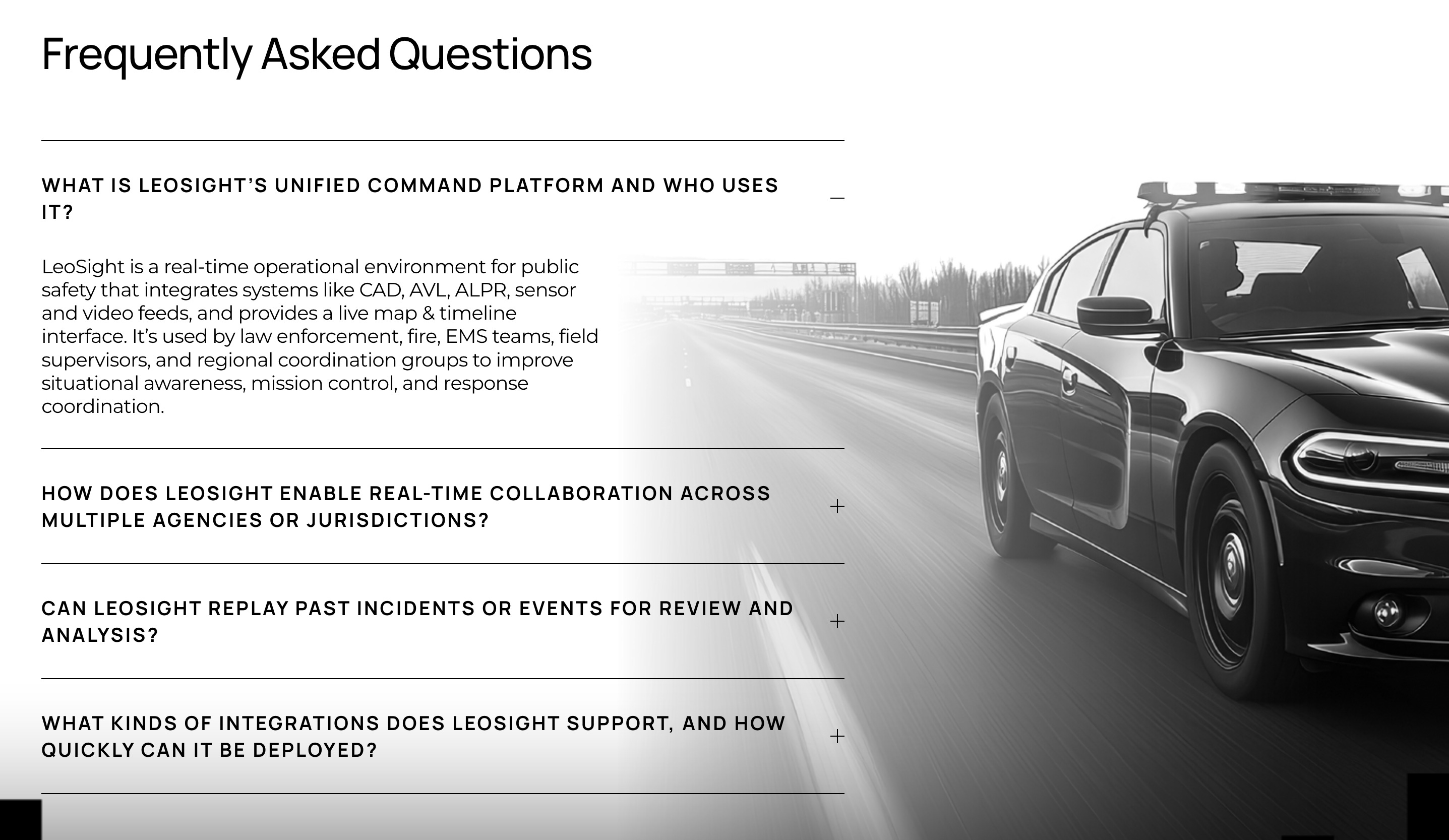
This is, more or less, Fusus with a more somber colorway. Or to be more precise, it is actually a far more all-encompassing video and data integration tool which presents far more questions about oversight and privacy than were raised by prospect of MNPD adopting Fusus.
Will Your Questions Get Answers This Time? Eh… Don’t Count On It.
Council Members: The spin doctoring is already underway.
You will hear things like:
“Yes, but LeoSight doesn’t involve community cameras. That was the problem with Fusus, right? The protestors just didn’t like that the community could send footage to the police more easily [mutters under breath: probably because they like committing crimes in their free time]. But this doesn’t involve privately owned cameras [checks LeoSight’s website], I think...”
I am eager to receive these questions, and happy to discuss these matters with anyone. Much more eager, I’d bet, than the CEO of LeoSight/Former CRO of Fusus.
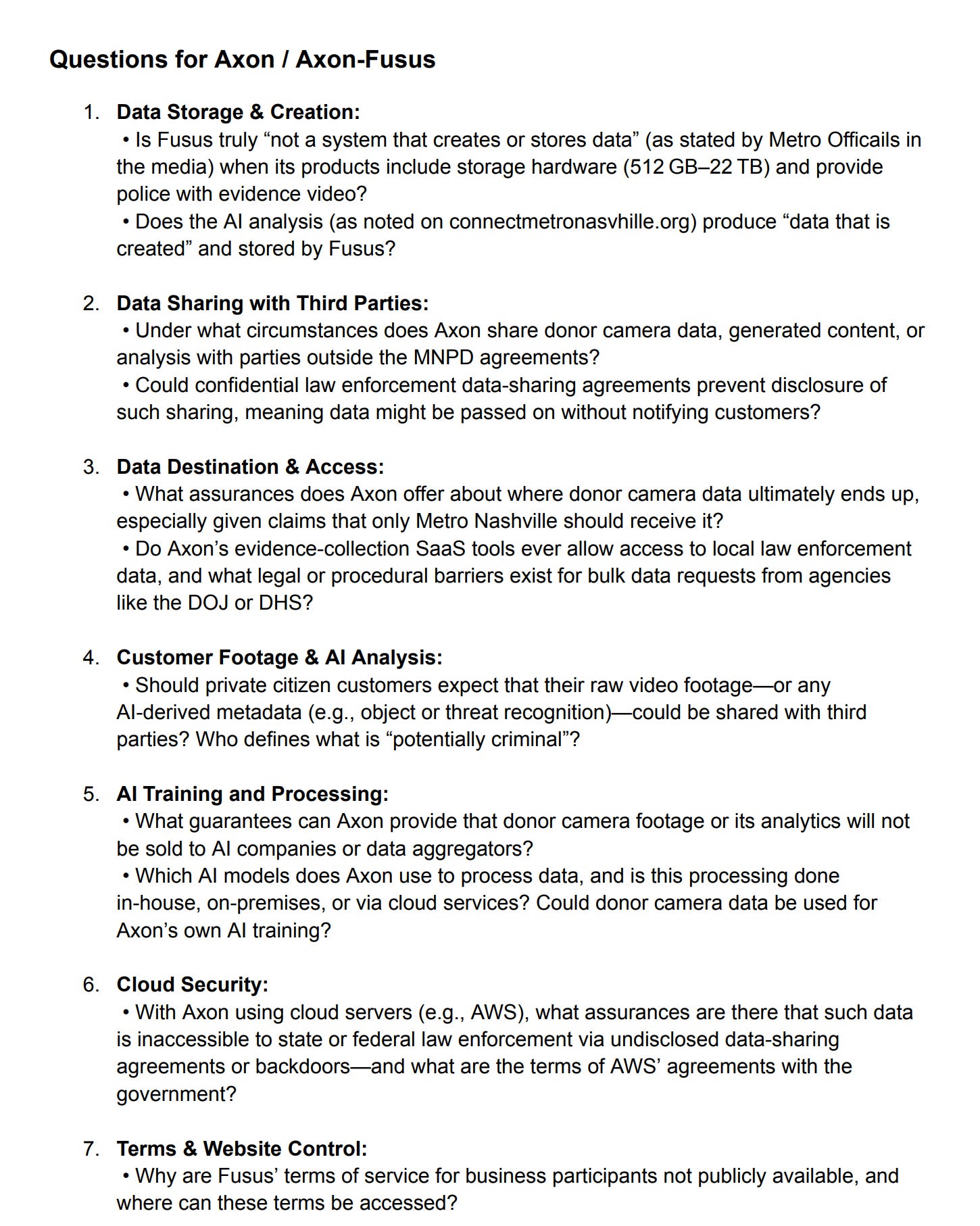
I will remind Council Members and the Mayor’s Office that when Fusus was being debated, I submitted a list of questions to the Axon corporation with Metro Council copied. Axon did not, to my knowledge, answer any of those questions. And in their silence, Council made it clear that they were not enthusiastic about entering into partnership with this organization. I am happy to draft up some questions for LeoSight, if you’d like.
[The one major question I wish I had answered is: what is the correct typography, “FUSUS,” “Fūsus,” or “Fusus”? Because I’ve seen all three in use. Really wish we’d gotten to the bottom of that. @Redacted, can you give some clarity on that?]

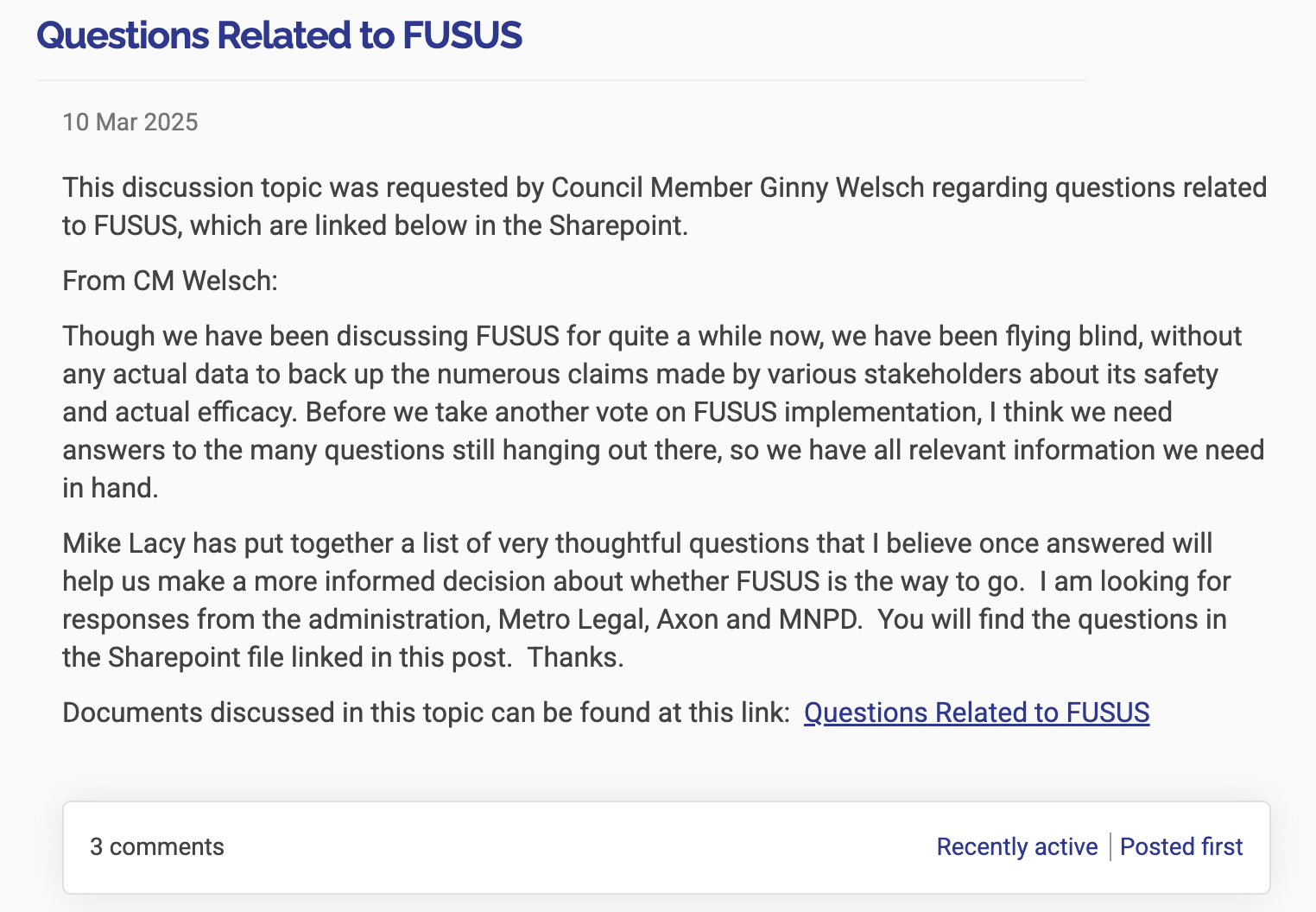
Related Article

Same Unregulated Surveillance, New Letterhead

LeoSight’s marketing doesn’t hide what it is. The platform integrates:
CAD (Computer-Aided Dispatch)
AVL (Automatic Vehicle Location)
LPR (License Plate Recognition)
VMS (Video Management System)
DFR (Drone as First Responder)
All unified into a single real-time map. All accessible to command centers and field units simultaneously. All recorded onto the hard drives of a private corporation to do with what they wish. This enables the exact “persistence tracking” that civil liberties advocates warned about, the problems that made Fusus politically radioactive.
Fusus pitched “officer location, alerts, dispatch data, ALPR overlays and video feeds on a single live map.”
LeoSight pitches “a live, map-based view of units, activity, and alerts.” Sounds pretty similar.
And look.
All of this COULD BE FINE if MNPD asked to buy it and the public consented. That is kinda how democracy works. (Inconvenient, I know! Especially when your friend has a really cool product you think the public would benefit from!)
But I must say, it is quite odd that a non-profit primarily in charge of washing the vomit off of lower broadway every morning is indicating they want to buy these nation state-level tools.
Not to seem naive, but obviously these are tools, if purchased by the NDP, that would likely be leveraged by MNPD, or THP, or the TBI, or Solaren, or whoever else put this deal together.
But the point is, we don’t know who wants this, and once that information is collected in the databases of a private corporation, there is, thanks to the Tennessee Information Protection Act that went into effect in July 2025, virtually no way to hold LeoSight accountable for what they do with that information.
Related Post

The Timeline
In case you’re not tracking the order of events here, this is how it went down.
2019-2024: [Redacted] helps build Fusus into the surveillance platform cities across America adopt as Chief Revenue Officer
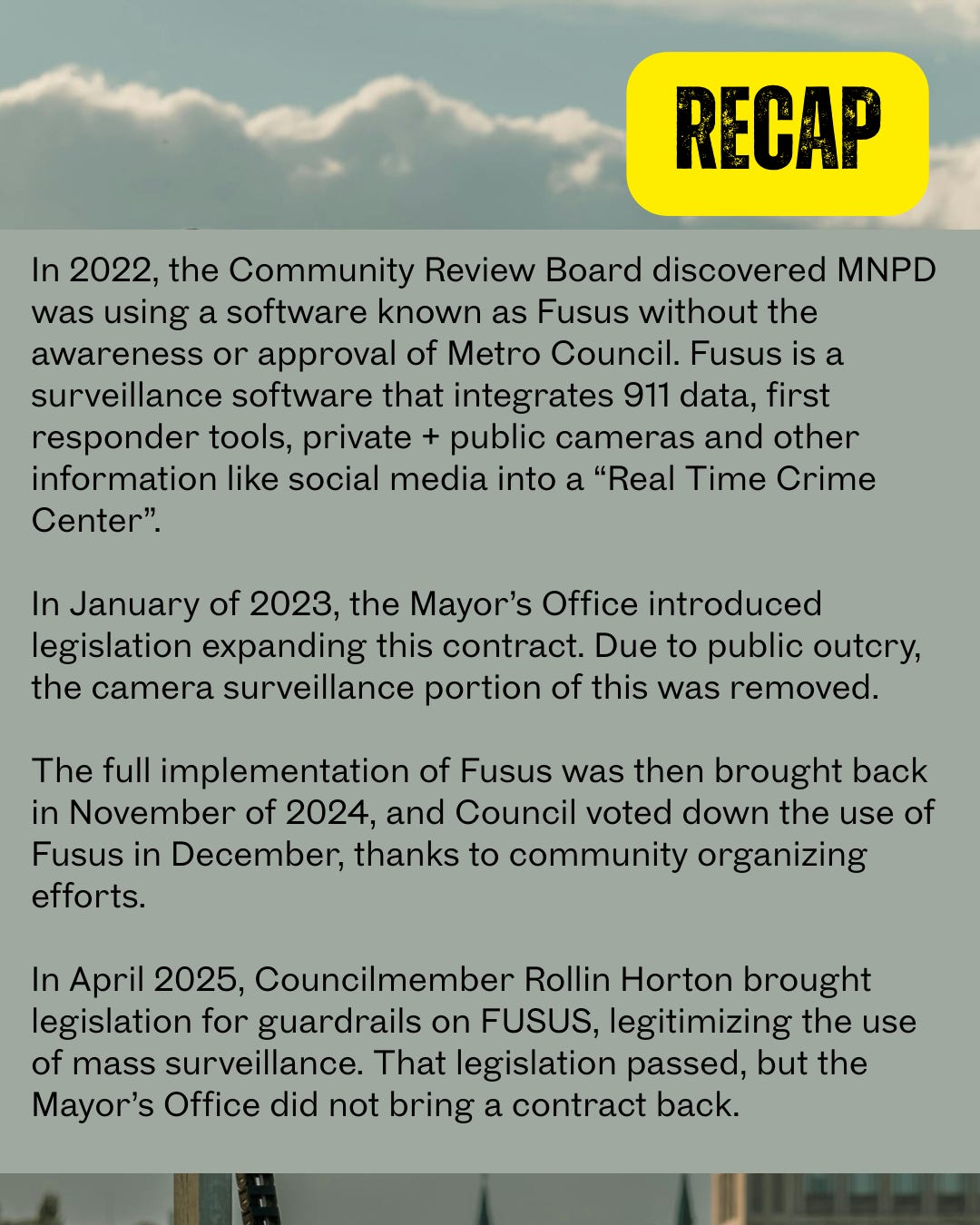
2022: MNPD contracts with Fusus without council approval
2022-2025: Nashville community fights back through multiple council votes
March 2025: [Redacted] is “founding” CEO LeoSight, a rebrand of Live Earth
April 2025: O’Connell abandons Fusus, says guardrails aren’t enough given federal overreach
November 2025: LeoSight appears in Downtown Partnership MOU—filed Friday before Thanksgiving, vote presumed to be December 4
The man who spent three years as a senior exec at the company selling Nashville on Surveillance that Metro Council rejected time and time again watched as community privacy advocates did some serious damage to its brand name (sorry not sorry). He leaves Axon/Fusus, helped rebrand an existing surveillance integration SaaS company, and now appears to be selling Nashville more or less the same thing through a side door that doesn’t require as much oversight.
Why Private Control Makes This Worse
When MNPD tried to deploy Fusus, Metro’s surveillance ordinance applied. Council had oversight. The community had standing to fight.
The Downtown Partnership is a private nonprofit. Once $15 million is transferred:
No public records requests
No council oversight
No surveillance ordinance compliance
No accountability to Nashville voters
Axon and their lobbyists couldn’t get Fusus through Metro’s front door. Now this new company is walking through the Downtown Partnership’s side entrance—and Metro is holding it open. But we’re not going to let them do it.
Is this all a big conspiracy?
No, I don’t think so, not in the cinematic sense. But only because those types of conspiracies are rare, and less damaging than how the world really works.
This, to me, is more of the synchronicity that makes one go: “wow, the simulation is really low on bandwidth this week — it feels like there’s only 25 people in the world right now.” And when you hang around local government scandals for even a little bit, this is a common experience.
This is a conspiracy in the sense that the same few people make decisions for the many on a near constant basis here. This means their names tend to come up again and again. In the past, I’ve been asked who I thought would be good for a high profile job in the government.
Despite my high schools civics teaching me that patronage jobs (aka the spoils system) is how machine politics works, I didn’t understand why I was being asked this.
“I dunno,” I told them, “maybe post it on Indeed or something? Get someone with a PhD.” The face I got to this response showed that I didn’t know how the sausage was made. This was an olive branch (or a monkeys paw, depending how your ethics works). And when favors and backscratching instead of competency and experience determine who winds up getting their name on contracts, the same names tend to keep showing up.
This is a conspiracy in the sense that politically liberal elected officials, with otherwise decent seeming politics and morals, think that putting decisions in the hands of a few people is good. A rich people with deep pockets for lobbyists and product marketing executives can see a sucker with a pool of public funds a mile away.
Why do our liberal leaders do this? Not so often because of anything as glamorous as bribes and out-and-out cronyism (though, as a former resident of New Jersey, I never discount it). With liberals, a lot of the consolidation of power has to do with that most taboo prejudice in America: classism. They have a preference for corporatocratic vibes that selects for people with high outward emotional stability, a trait that more often than not is disguising for low empathy and even lower self esteem. It creates an insular bubble of thin skinned, affable and goofy, but fully unaccountable people who fear, above all else, being unmasked as being, like everyone else, just faking it until the make it.
This kind of detached, “objective” decision making they value, the gospel spread by the priesthood of McKinsey and Bloomberg Philanthropies, has trained a generation of good liberals on how to detach government from the pesky business of actually listening to people’s needs.
A good liberal cannot, of course, say this outright. So they recast this detachment from listening to actual constituents as being “more efficient”, “more democratic” or, most confusingly, “more anti-racist.” Prejudice is from those unenlightened ones out there, and anything so unsanitary as a community board or commission is liable to be tainted by it. Best to keep power insular amongst the few to keep the unenlightened hordes at bay.
Why bother having community oversight on things like surveillance. What could they know about what’s good for them?
There is no reason to believe that bureaucrats and politicians, no matter how well meaning, are better at solving problems than the people on the spot, who have the strongest incentive to get the solution right.
Elinor Ostrom, 2009 Economics Nobel Prize Winner
But, in the final analysis, when it comes to this MOU, it likely really is, I think, just laziness and indifference to the consequences of their actions. “$15M to Tommy T. for some security? Why not? What’s the worst that could happen?” (Might I give you a tour of the Downtown Library Parking Garage as Exhibit A?)
It seems equally possible that the Mayor’s Office failed to thoroughly examine the MOU — including identifying the actual recipients of the $15 million — as it is that they were fully aware this was, in effect, Fusus by another name.
Even for an administration that is preternaturally skilled at walking on rakes, this is so obviously a bad idea that I wonder if they did even the minimal due diligence.
But then again, they did slide it in right before a holiday break with no fanfare and no CM lined up to sponsor it. So maybe they did know how bad this looked, and like a fart on an elevator, thought they could squeak it out unnoticed.
Well, we noticed.
And it stinks.
The Question for December 4
Council members: Did you know the MOU includes surveillance software founded by Fusus’s former Chief Revenue Officer?
Did the Mayor’s Office?
Did anyone think the community that spent three years fighting this technology deserved to know it was coming back—founded by one of the people who tried to sell it to us the first time?
The vote is Thursday Dec 4. Find your council member. Ask what they knew about LeoSight’s Fusus connection—and when they knew it. And if they say “I found out from Mike Lacy’s Substack,” tell them it’s their job to know these things before I do.
Content to post on Social Media
Courtesy of instagram.com/nashcommunitysafetynetwork_