

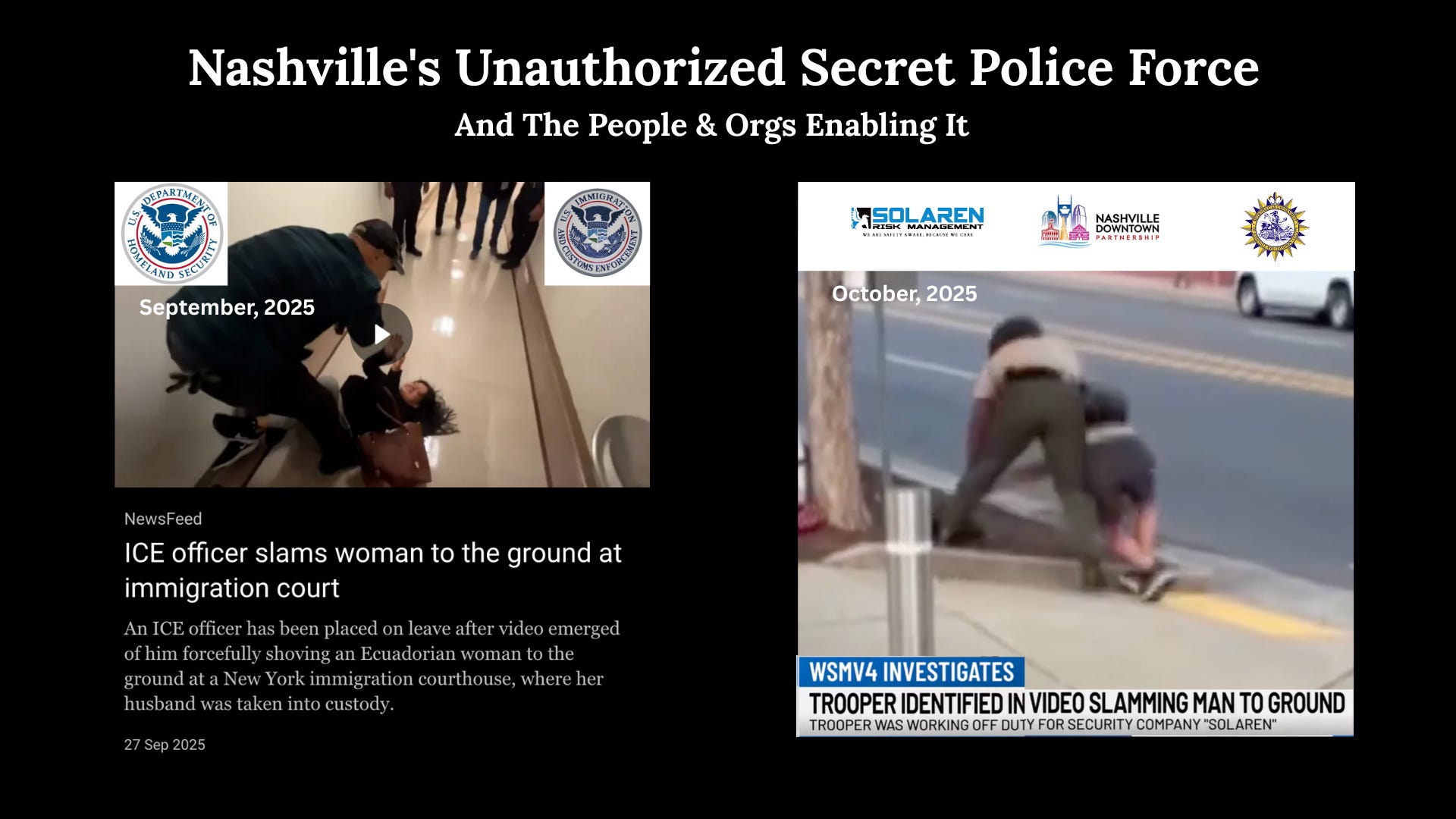
The term “secret police” can sound like a bombastic term, an overreaching allusion to 20th century gestapos disappearing dissidents and undesirables. I mean it here in a very literal sense: the multimillion dollar contract for the policing that happens downtown is, quite literally, a secret. After months of research, and the unfurling of a web of acronyms (NDP, CBID, DMC, NDMC to name a few) it is not even clear which legal entities have entered into the “confidential” contract that governs downtown with off-duty THP officers.
Also, I use the term “unauthorized” in a precise sense too. The millions of dollars flowing into Solaren Risk Management via The District Management Corporation, and thence to The Nashville Downtown Partnership, and somehow involving something called NDMC PSO, LLC, were never authorized by the Nashville Metro Council. Quite literally, they did not have the legally required permission to be given these funds. So I honestly don’t know how to describe what has been happening in downtown Nashville any other way than this: our streets are being patrolled by an “unauthorized secret police” force.

On April 15, the Nashville Downtown Partnership (NDP )¹ must submit its budget to the Metro Council, which is then required to review it, send it back if unacceptable, and approve it. Then, and only then, is NDP supposed to get its money.
Council hasn’t done any of this in twenty-two years.
In the recent past, the non-profit’s president has doubled his salary to over half a million dollars a year and used public money to build a private policing operation — licensed through a shell company he registered with the State of Tennessee in 2022. The outfit is staffed by off-duty Tennessee Highway Patrol troopers — the same pool of officers that conducted the May 2025 ICE raid — through a firm called Solaren Risk Management. Community activists have called it a “shadow police force” that profiles and removes unhoused people from the downtown corridor while leaving rowdy tourists untouched; a whistleblower trooper on the detail confirmed as much to WSMV.
NDP, funded almost exclusively through funds directed to it by Metro Nashville either through special assessment funds or parking garage contracts, has refused to release the contract with Solaren, citing “confidentiality.” It is not even clear what firm holds the contract with Solaren, much less its cost, terms of service, or liability protection.

The State of Tennessee charged Solaren with 62 violations of state law in its implementation of NDP’s private policing, including dispatching unlicensed guards in police-style uniforms and badges and outfitting non-police vehicles with blue lights — charges that resulted in a $64,000 fine from an administrative law judge who found the conduct was intentional. The operation seems beyond the reach of every oversight mechanism Nashville and the state of Tennessee have built. But there are, in fact, checks and balances meant to prevent this type of lawlessness. The Nashville Metro Council has just neglected to enforce them.
NDP’s David Corman — a former MNPD Precinct commander who earned $116,943 in 2024 as Director of Safety Services — directs the operation day-to-day. Until recently, Corman’s son served as Solaren’s Director of Administration, with responsibilities including HR, payroll, accounting, vendor management, compliance, and risk mitigation. The younger Corman graduated from college in 2022 with a degree in Geology; his prior employment was as a team lead at a Regal Cinemas movie theater.
This is not the story of a bad example of private policing that should be replaced with a better firm, one that only hires good apples. Truthfully, there is no good version of this. A “better” privatized police force instead of Solaren will not improve things. A Solaren whistleblower has made it clear that their primary task is to remove the signs of visible homelessness. There are ways to actually reduce chronic homelessness in downtown cores. Arresting people who have nowhere else to live, whether done by a private entity or a public one, is not one of those solutions.
To know where this goes, we only have to look to where it already is. Nashville knows what happens when law enforcement is routed through intermediaries to avoid democratic accountability.
We watched ICE use the Tennessee Highway Patrol, the same pool of officers that work for NDP via Solaren, to wantonly raid immigrant neighborhoods and terrorize families. When the Trump administration wanted ungovernable enforcement officers that voters would never authorize, it found a way around public oversight — it layered intermediaries, diffused responsibility, ensuring no one locally accountable for what happened on the ground.
The NDP policing operation is the same architecture as ICE, but applied to Nashville’s own residents by its business class. Public money flows through a chain of legally distinct entities — from the wallets of property owners to Metro to the DMC to NDP to NDMC PSO to Solaren — until it reaches armed officers on the street. By the time something goes wrong, every entity in the chain points at someone else. The structure is the problem. And no “better vendor” is the solution.
The reality is that is very difficult to hold public law enforcement accountable to public oversight, especially in TN. Yet what the NDP’s private police force demonstrates is that it is virtually impossible to hold private ones accountable. Yesterday I obtained a copy of a document entitled “Human Rights and Public Safety 2025 Q4_FINAL.pdf” which detailed use of force by the Solaren/THP officers patrolling downtown for the 4th quarter of 2025.

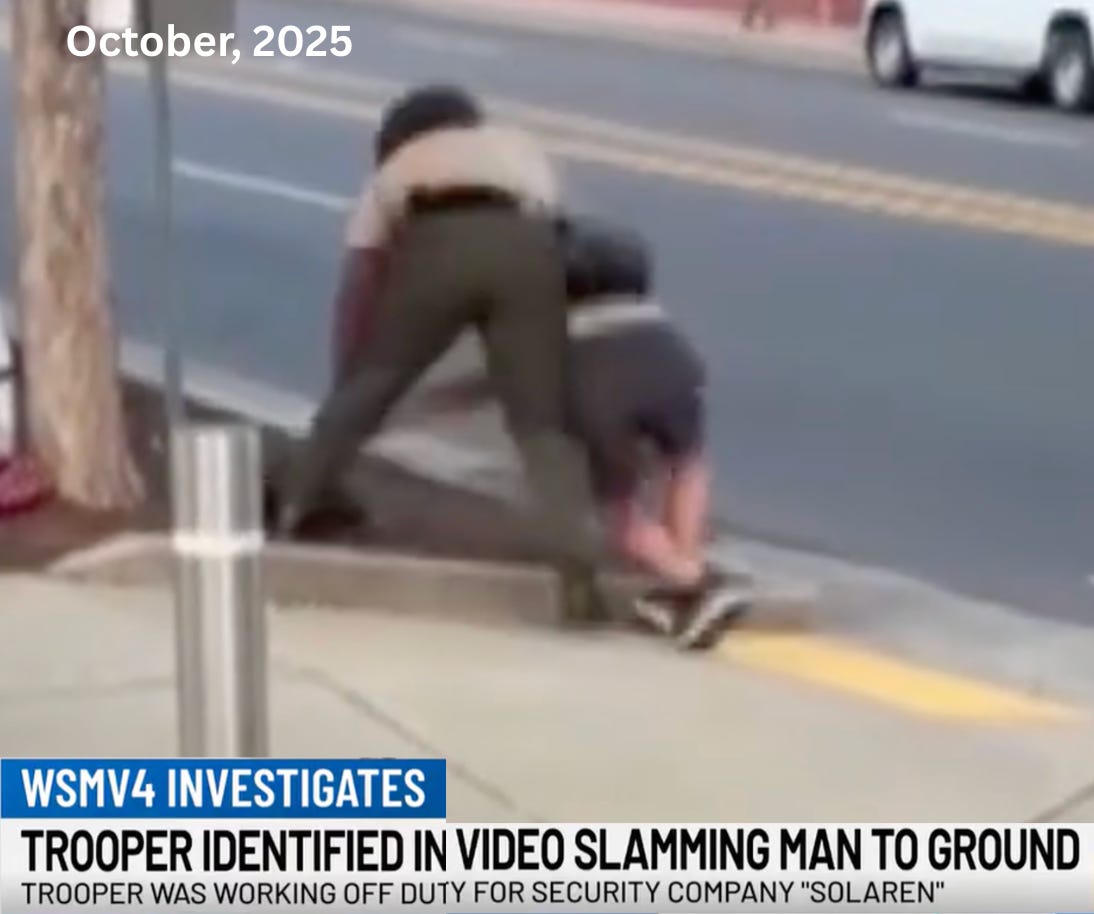
A bullet in the report reads: “No reported use of force incidents.” This is hard to square with the documentary evidence that was presented on the local news in October 2025. This event appears to have taken place in Q4 ‘25, and yet it was not mentioned in the Human Rights and Public Safety report the Mayor’s Office and Metro Council were provided.
What follows is an account of how the machine was built, where the money has gone, who has benefited, and what twenty-two years of silence has cost Nashville. This is the story of the lawmakers and business elites who built this system, benefited from it, and looked the other way while the public suffered.
The Liability
Every dollar the Nashville Downtown Partnership has spent from CBID and GBID funds since the Council last exercised its oversight authority carries what lawyers call procedural ultra vires — action taken beyond lawful authority. In plain terms, these expenditures may lack valid legal authorization. Property owners who paid assessments under the reasonable assumption that Metro Council was reviewing and approving their use could, in theory, seek the return of some or all of those funds — not just what they individually paid, but all of it. If Metro Finance, Metro Legal, Metro Council, the CBID, or NDP were found liable, the judgment could dwarf any figure currently in play. The longer the Council waits to reassert its authority, the larger the window of unauthorized spending — and the larger the potential liability.
But the diffusion of accountability doesn’t diffuse the legal liability — it concentrates it on Metro Nashville and NDP. Tennessee law recognizes a “functional equivalent” doctrine: private entities that effectively function as government agencies can be held to the same transparency and constitutional standards. In the foundational case, Memphis Publishing Co. v. Cherokee Children & Family Services (2002), the Tennessee Supreme Court held that a nonprofit was a functional equivalent of a state agency based on three factors: the level of government funding, the extent of government control, and whether the entity performs a public function.
The policing operation meets all three. NDMC PSO, LLC is wholly owned by the DMC, an entity created by Metro ordinance. The DMC receives over $9 million per year in government-collected assessments — money property owners are legally compelled to pay. It’s other funds come from managing public assets like parking garages and parks. The policing operation performs public safety functions using officers with state arrest powers. The corporate architecture doesn’t weaken the functional equivalent argument. It strengthens it — the policing license sits not with a private vendor but with a subsidiary of the ordinance-created, publicly-funded DMC itself.
The shell company may have been designed to isolate the DMC’s assets from liability — keep the risky policing operation inside a subsidiary with $312 to its name so a lawsuit can’t reach the assessment funds. That’s basic corporate law, and it’s exactly what you’d expect a Waller Lansden tax attorney to recommend. But it solves the wrong problem. The functional equivalent doctrine doesn’t care about the corporate chain. It looks at funding source, government control, and public function. The catastrophic scenario — a use-of-force incident on a crowded Saturday night on Lower Broadway — doesn’t produce a lawsuit against NDMC PSO, LLC. It produces a federal civil rights lawsuit against Metro Nashville and the DMC. The shell company is a shield facing the wrong direction. The only thing it successfully shields is information.
In 2008, the legislature went further: “A governmental entity is prohibited from avoiding its disclosure obligations by contractually delegating its responsibility to a private entity.” If a court applies this doctrine, every constitutional violation committed by the private police — the discriminatory targeting, the unreasonable seizures, the due process failures — becomes actionable against Metro under federal civil rights law. No court has tested this against the DMC or any Tennessee BID. The question is not whether someone will file the case. It’s when.
Who Governs the Secret Police?
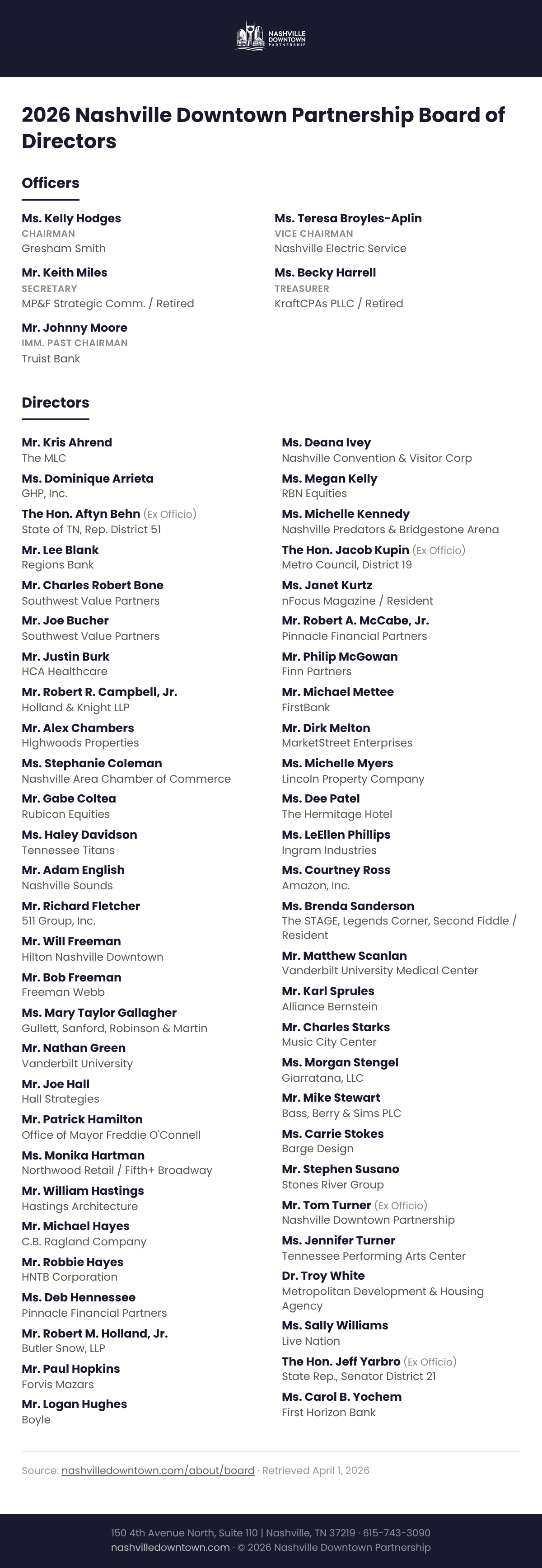
The Nashville Downtown Partnership’s Board of Directors is a who’s who of Nashville power. They are also the people legally responsible for governing a nonprofit that funds a private policing operation staffed by the same Tennessee Highway Patrol unit that conducted Operation Flood the Zone using funds that have not been legally authorized for 22 years.
NDP’s Board of Directors includes Bob Freeman of Freeman Webb, one of Nashville’s largest apartment management firms, and a sitting Democratic state legislator whose MetroCenter building now houses ICE’s legal branch. Freeman was formerly a member of the Nashville Homelessness Commission, appointed to help develop solutions to homelessness in Nashville. His company, Freeman Webb, also owns FW Publishing — the parent company of the Nashville Scene, Nashville Post, and nFocus — three outlets that would normally cover a story like this.
Charles Robert Bone of Southwest Value Partners — the developer behind Nashville Yards, the largest mixed-use development in the district — sits on NDP’s board while the policing operation clears the streets surrounding his investment. Bone is a former Obama fundraiser and former general counsel to the Convention Center Authority. The value of the Nashville Yards development is directly tied to the perception of downtown safety — the same perception the private police force is engineered to produce, seemingly regardless of the consequences.
Patrick Hamilton sits on the board as a representative of Mayor Freddie O’Connell’s office. The Mayor has publicly called for expanded downtown policing and surveillance infrastructure and, last year, worked explicitly to do so in partnership with the NDP. His office’s representative on NDP’s board provides a direct channel for coordination between Metro’s executive branch and an organization that has spent 22 years evading the legislative oversight that Metro’s own ordinance requires. Hamilton’s presence on the board means the Mayor’s office cannot credibly claim distance from NDP’s operations.
Robert R. Campbell, Jr. of Holland & Knight — the successor firm to Waller Lansden, which designed and filed the NDMC PSO, LLC entity through which the policing operation is licensed — holds a board seat at the organization his firm’s predecessor helped structure. Campbell is an attorney at a major firm and cannot claim ignorance of what procedural ultra vires means. Neither can Robert M. Holland, Jr. of Butler Snow.
The board also includes Stephanie Coleman, the new President and CEO of the Nashville Area Chamber of Commerce; Stephen Susano of Stones River Group, the lobbying firm that does PR for Southwest Value Partners; and Joe Hall of Hall Strategies, whose client list overlaps heavily with the NDP board itself. The rest of the board represents Nashville Electric Service, Pinnacle Financial Partners, First Horizon, AllianceBernstein, Regions, FirstBank, the Nashville Convention & Visitors Corp, Music City Center, MDHA, TPAC, the Tennessee Titans, Nashville Predators, Nashville Sounds, Live Nation, HCA Healthcare, Amazon, Vanderbilt University, VUMC, Highwoods Properties, Giarratana, Ingram Industries, Bass Berry & Sims, and dozens more.
Any crisis consultant would tell NDP’s Board of Directors and the institutions they represent the same thing: the legal liability is a problem, but the association with an ungovernable private police force is an existential reputational risk. Every member of NDP’s Board of Directors has their name attached to an organization that funds a private police force cited for impersonating officers, directed to profile homeless people, and staffed by the same agency that carried out immigration raids that traumatized thousands of Nashville families. This page will continue to report on the relationship between each board member’s institutional role and the policing operation their board seat governs — including whether they act on what is now public knowledge, or choose not to.
Previous efforts to bring NDP into compliance have been directed at CEO Tom Turner, COO Ben Simpson, the organization’s 3rd party lobbyist, and Council Member for the downtown district and NDP board member, Jacob Kupin. Those efforts have not produced results. A growing number of stakeholders are asking whether holding NDP’s Board and the institutions they represent publicly accountable is the only remaining way to close the liability gap.
The Machine
There is an oversight mechanism for the Central Business Improvement District (CBID). Technically, the entity that receives the “special assessment” funds and must submit the budget is not NDP itself but a separate organization called the District Management Corporation (DMC). It is easy to confuse this fact. NDP’s CEO Tom Turner runs both, they share an address and a website, and NDP’s leadership has represented the two as interchangeable when convenient and distinct when useful. It is the DMC’s budget that the Metro Council is required to review and approve on a yearly basis.
The District Management Corporation shall annually submit to the Metropolitan Council a financial report and a written report of its activities for the preceding year together with a proposed budget for the next year. The annual budget shall include a projection of revenues from the special assessment and a projection of expenditures for projects, services and activities of the District Management Corporation and shall be reviewed and approved by the Metropolitan Council, or if not approved shall be returned to the Board of Directors for revision and resubmission until the Metropolitan Council shall approve the annual budget.
— Nashville Metro Council Ordinance 98-1037
Here is the staggering thing: The District Management Corporations budget hasn’t been approved, or even brought for review to Metro Council, since 2004. Yet over $42M has flowed to NDP since just 2019. IRS forms indicate the total dating back to 2004 could be as much as $60M.
At a July 14, 2025 Budget and Finance Committee meeting, Metro Council Special Counsel Margaret Darby confirmed that the code requires annual budget submission and approval. “It looks to me like at some point in 2003, 2004, the budget stopped being submitted to the council for approval,” she said. When asked why, Darby was blunt: “I cannot find any legislative documentation that kind of demonstrates what happened. So it’s up to everybody to kind of guess what happened.” Nobody changed the law. Nobody voted to stop the process. It just stopped, and the Council’s own special counsel cannot account for it.
Since 1998, property owners within the CBID have paid special assessments — obligatory fees collected under the force of law — that flow through the DMC to the Nashville Downtown Partnership.
NDP CEO Tom Turner told the Budget and Finance Committee last year that this was all a big confusion. “We think it’s going to Metro, so we send it to Metro Finance, but that’s obviously not the Metro Council.” It is not. And Turner, a paid Metro Council lobbyist for NDP, hopefully knows the difference.
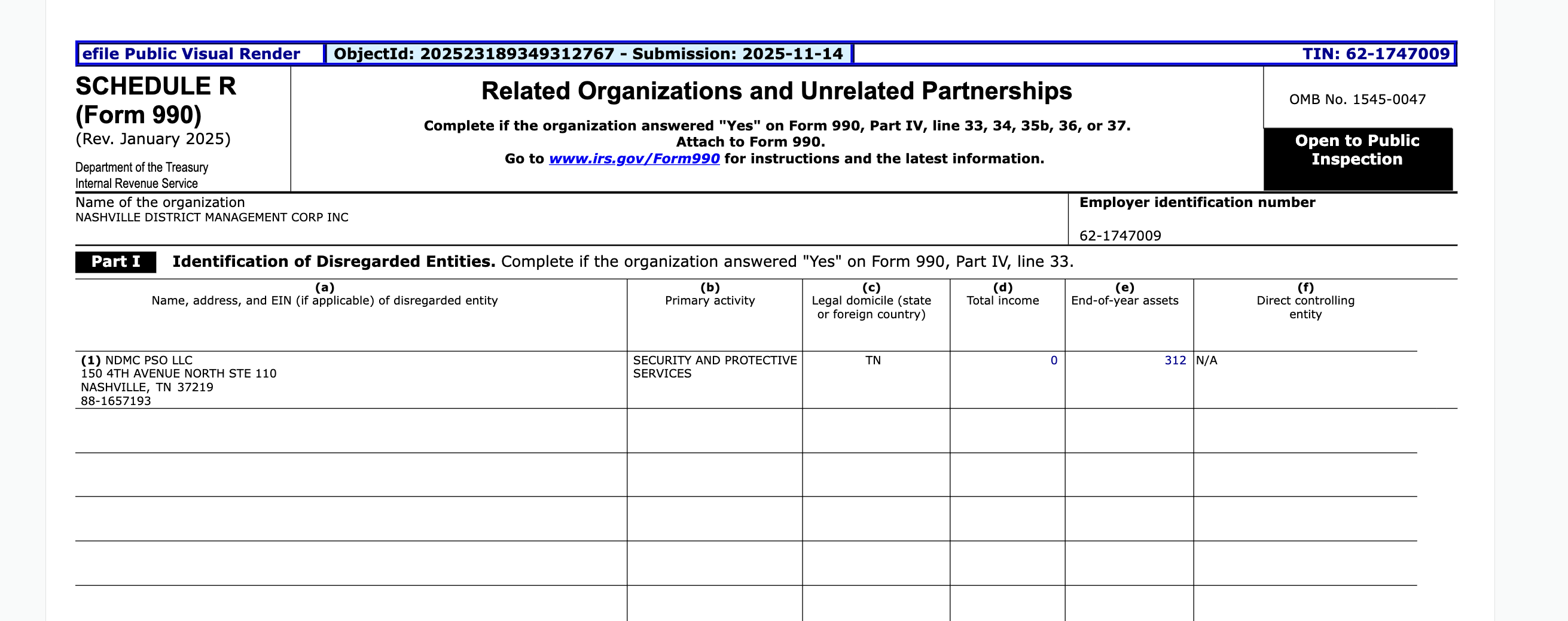
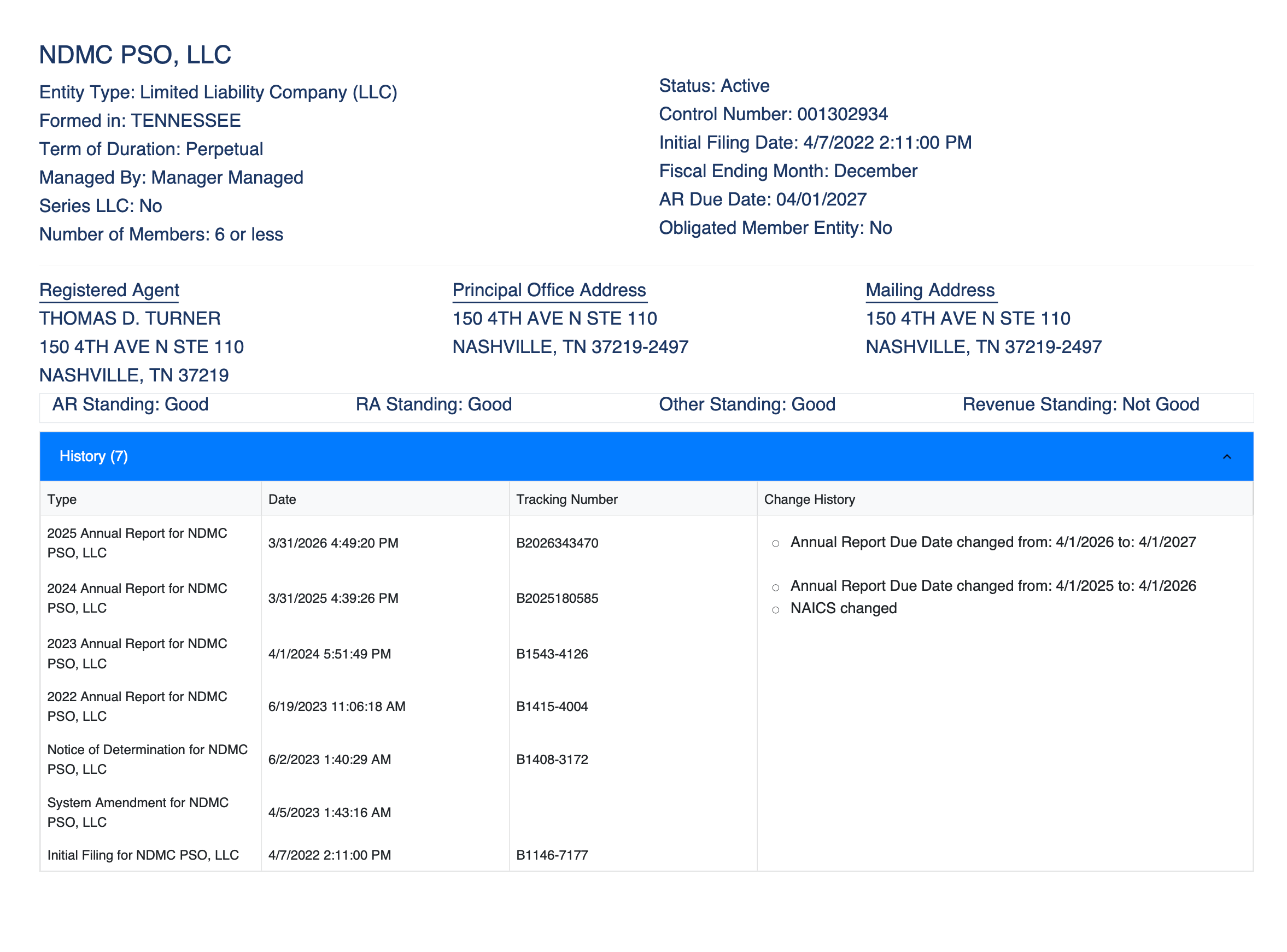
Turner is not merely NDP’s CEO. He is the principal officer on the DMC’s own IRS Form 990 and the registered agent of NDMC PSO, LLC — a $312 shell company through which the policing operation is licensed. Three legally distinct organizations, one man listed on the filings of all of them, operating from the same address. The DMC’s 990 even lists nashvilledowntown.com — NDP’s website — as its own.
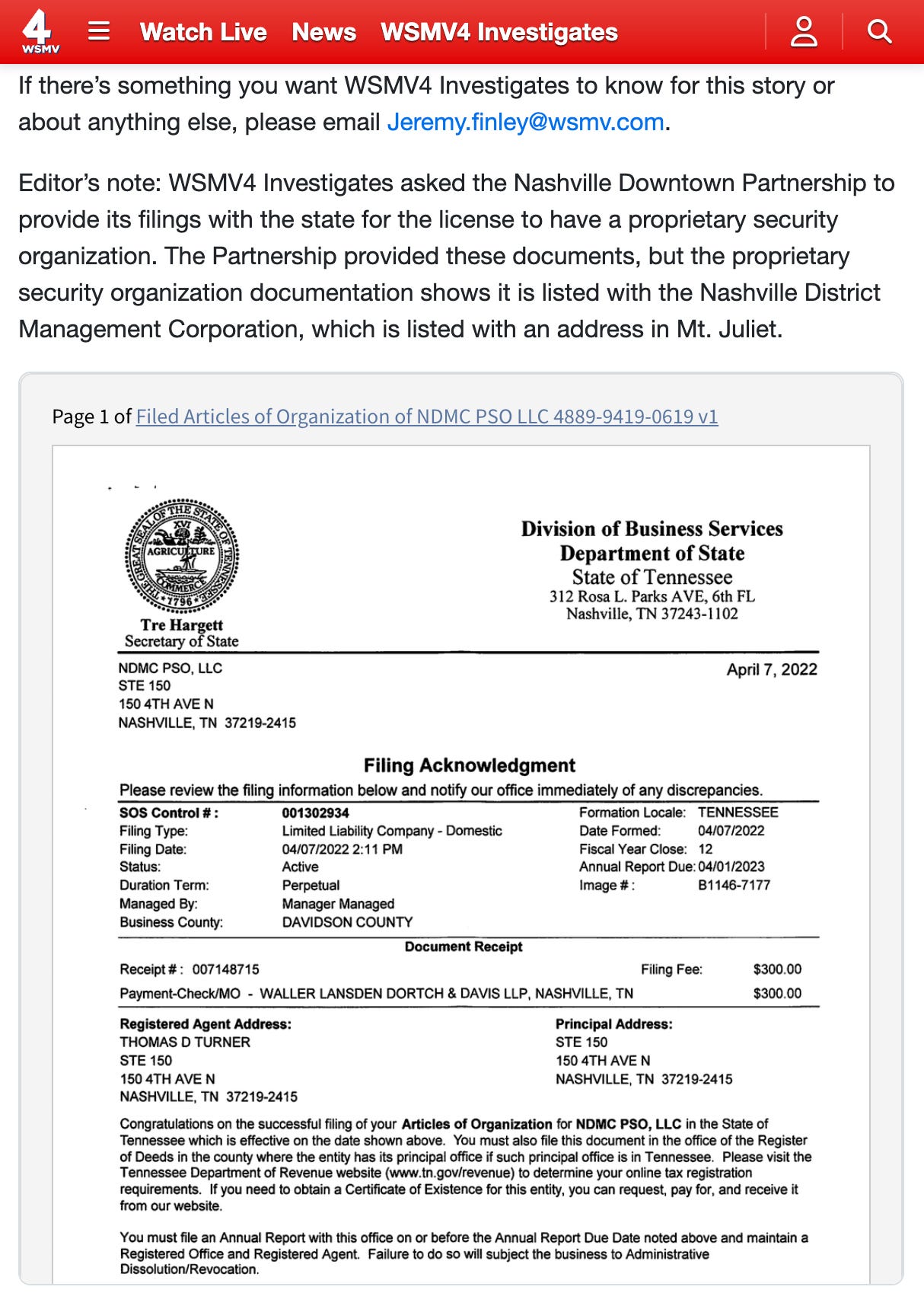
NDP is not licensed to operate an armed police force. In April 2022, Turner registered NDMC PSO, LLC to hold that license, potentially to shield NDP from liability for the actions of the officers it funds. The resulting structure is opaque, perhaps intentionally so: the license is held by one entity, the operation is directed by staff at another, the guards are supplied by a third, and no single public filing shows who is paying whom, who bears liability, or what the policing operation actually costs.
The contract governing the operation has never been publicly produced. When WSMV requested it, NDP cited a confidentiality clause and refused. It is not publicly known which entities are parties to the agreement, when it was signed, what it costs, what services it authorizes, who carries liability, or what insurance requirements apply. Nothing about the foundational terms of an armed policing operation — staffed by officers with arrest power, patrolling Tennessee’s most profitable commercial corridor — is part of the public record.
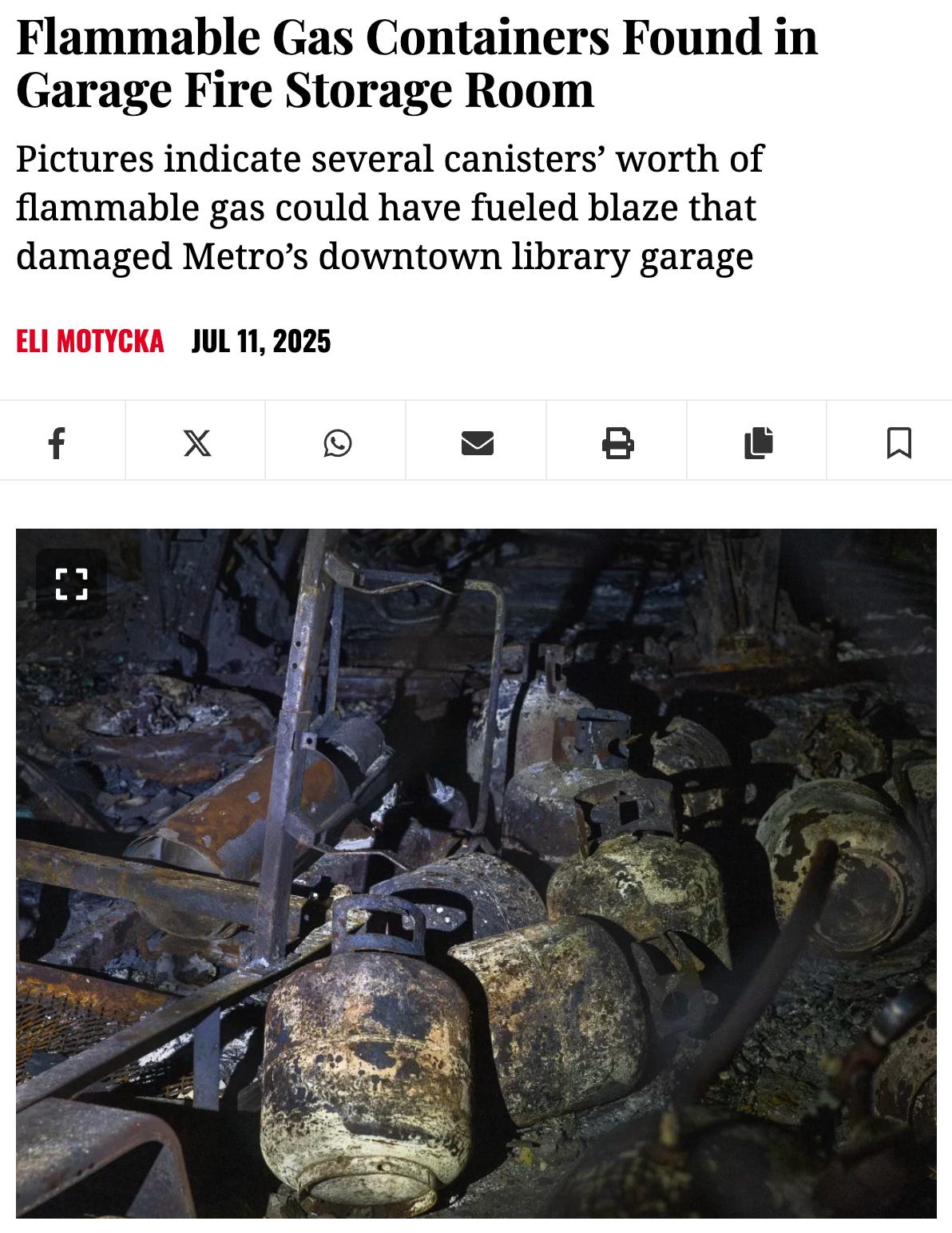
NDP is the same organization that contracted Block by Block to manage the Downtown Public Library parking garage, where the vendor stored unknown materials at the fire’s point of origin, destroying an entire floor of the structure and closing the library for months. If the terms of that contract were as opaque as the Solaren arrangement, no one outside NDP would have known what was being stored on public property until it exploded. The pattern is consistent: vendors operating on public infrastructure, funded by public money, with contract terms hidden from the public and from Metro Council.
The corporate architecture tells its own story. On April 7, 2022, articles of organization were filed with the Tennessee Secretary of State for NDMC PSO, LLC. The filing fee was paid by Waller Lansden Dortch & Davis, one of Nashville’s most prominent law firms. The articles were signed by Jon P. Gaston, a Waller Lansden partner specializing in tax structuring and business formations. The entity’s sole member is the DMC. Its registered agent is Tom Turner, using his NDP email address: tturner@nashvilledowntown.com. Its stated purpose: “to provide additional security and protective services within the Nashville Central Business Improvement District” as a “proprietary security organization” under Tennessee law. The entity is organized as a 501(c)(3) — claiming that a policing operation which felony-arrests people for sleeping is operated “exclusively for charitable and all other exempt purposes.”
Less than a month later, on May 4, 2022, NDMC PSO, LLC received Proprietary Security Organization License No. 13682 from the Tennessee Private Protective Services program. Under Tennessee law, a “proprietary security organization” employs security guards “solely for such person in an employer/employee relationship” — in plain terms: in-house security, your own guards, on your own payroll.
But the PSO license tells a different story. The main address, business address, and qualifying manager listed on the license are all at 1000 Pleasant Grove Place, Mt. Juliet, Wilson County — which, according to both Solaren’s own website and its Tennessee Secretary of State registration, is the registered office of Solaren Risk Management, LLC.
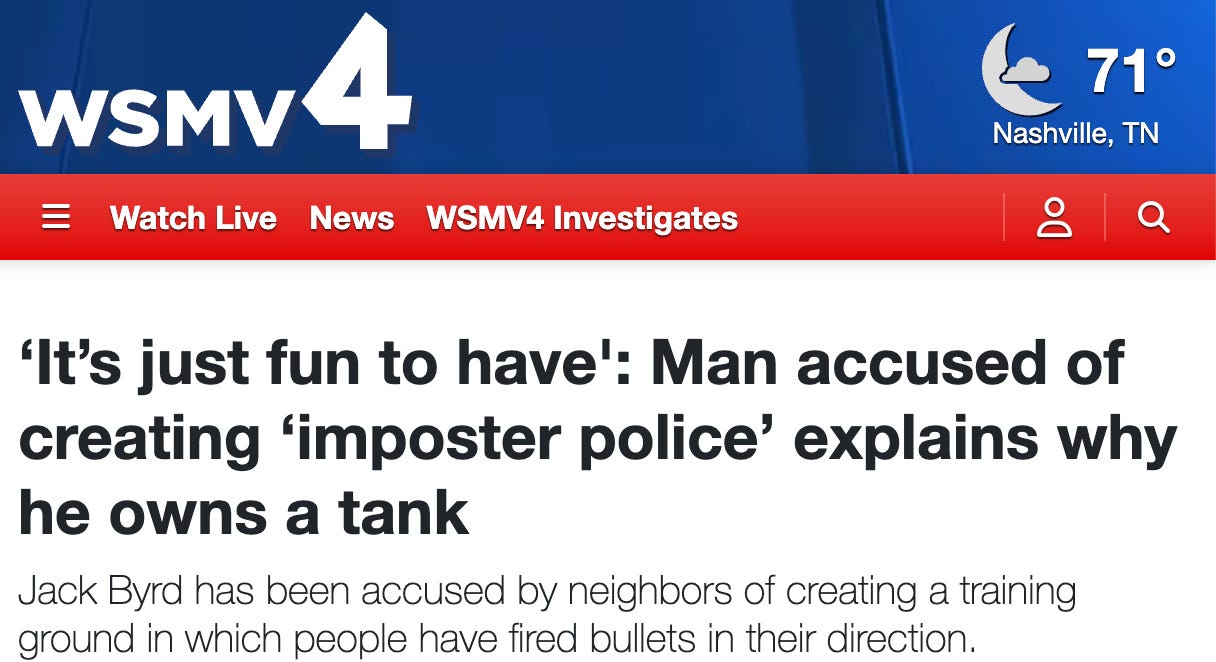
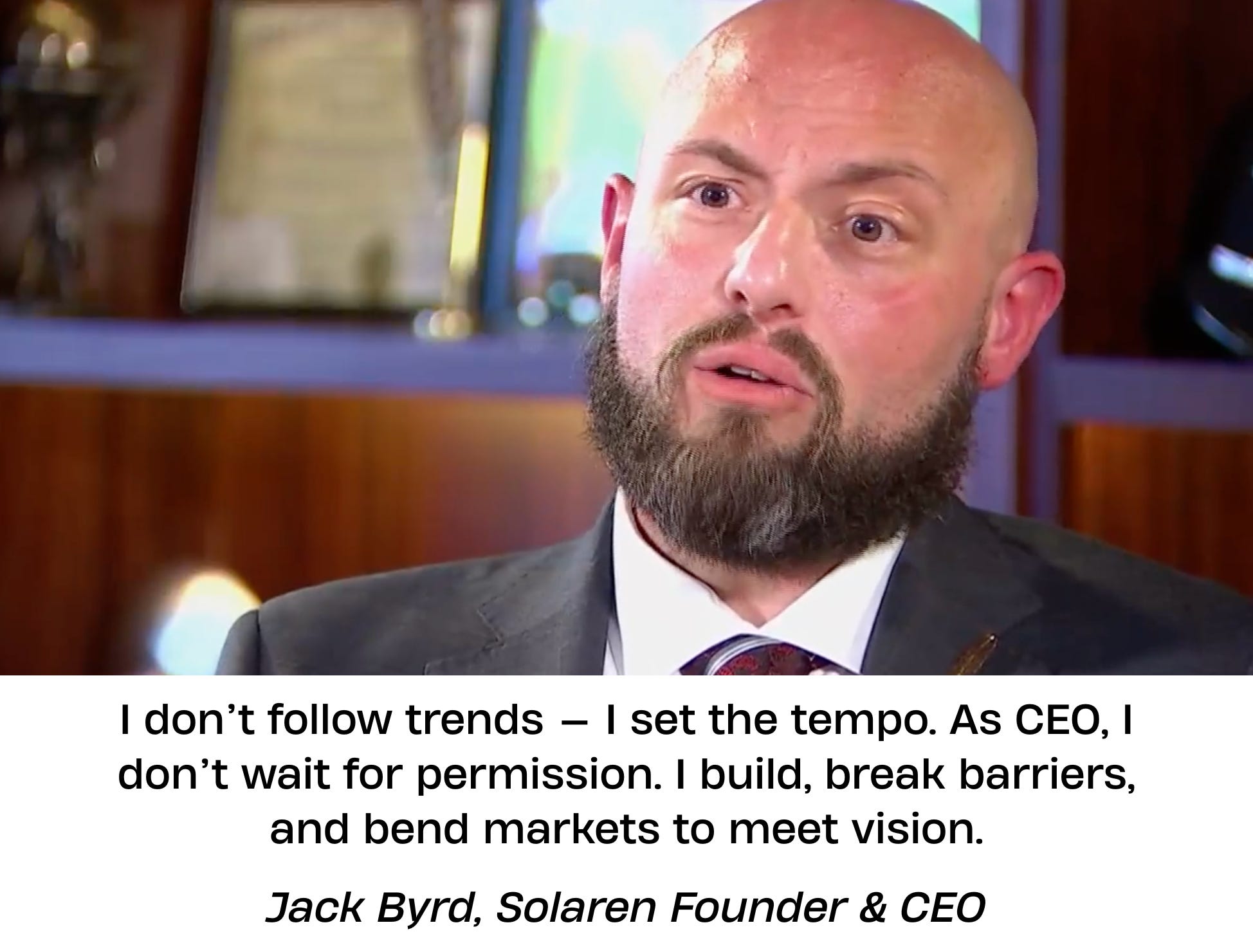
Solaren is Jack Byrd’s company. He co-founded it in 2017 and serves as its registered agent. His company describes itself as “a leading provider of Security & Police Personnel” — a contract security vendor, not an employer of in-house guards. Since launching from a two-person mall office in 2017, Byrd has grown Solaren into a 1,200-person operation spanning five states and a recognized U.S. Defense Contractor. As he stated in his 2025 Titan 100 profile: “I don’t follow trends — I set the tempo. As CEO, I don’t wait for permission. I build, break barriers, and bend markets to meet vision.”
So the entity that tells the State of Tennessee it operates its own in-house police force has no independent operational presence, reported zero income, and holds $312 in assets. Its articles list NDP’s Nashville address; its state license points to Byrd’s office in Mt. Juliet. The guards are off-duty THP troopers managed through Byrd’s company. One might imagine it couldn’t get any stranger, that no more red flags could be raised. One would be wrong.
NDP’s David Corman — a former MNPD Precinct commander who earned $116,943 in 2024 as Director of Safety Services — directs the operation day-to-day. Until recently, Corman’s son served as Solaren’s Director of Administration, with responsibilities including HR, payroll, accounting, vendor management, compliance, and risk mitigation. The younger Corman graduated from college in 2022 with a degree in Geology; his prior employment was as a team lead at a Regal Cinemas movie theater.
Under Tennessee law, the proprietary security organization classification is reserved for entities that employ their own guards in an employer/employee relationship. Whether NDMC PSO, LLC actually functions as an employer or simply exists to hold a license classification is a question its own financial disclosures do not resolve.
It is not publicly known when the Solaren contract began, what it costs, or even which entity signed it. The contract could be between Solaren and the DMC, Solaren and NDMC PSO, LLC, or Solaren and NDP — three entities at the same address, run by the same people, and no public record resolves which one is the actual contracting party.
NDP refused to produce the contract but cited a confidentiality clause. NewsChannel 5 described the deal in May 2023 as one between “Byrd’s company” and “the Nashville District Management Corporation.” The Nashville Banner reported that the contract expires in April 2026. The public is funding a policing operation whose foundational contract has never been disclosed.
When I asked Metro for records about NDP fund transfers, it provided documents from 2019 onward — totaling over $42 million — but refused to produce any documents for the 2004–2018 period and declined to explain why.
The resulting accountability structure is a hall of mirrors. When arrests occur, NDP says officers exercise “sole discretion.” Byrd refers all questions to NDP and THP. THP says officers are working “an approved off-duty assignment.” Metro Police says it had no knowledge. Metro Council says it was unaware. No single entity accepts responsibility for what, by any functional measure, is a publicly funded law enforcement operation. And behind all of it sits a purpose-built LLC, created by sophisticated legal counsel, that exists to hold a security license at Byrd’s Mt. Juliet address while being run by NDP staff from a downtown Nashville office.
What the corporate filings make clear is the chain: Turner set up the entity, Byrd provides the operational infrastructure, the administration of Solaren was until recently overseen by the young son of NDP’s Director of Safety. The net result is an armed force accountable to neither the public oversight that governs Metro nor the regulatory scrutiny that governs contract security companies.
Where the Money Goes
NDP has been managing the CBID since 1998, but even the window visible through publicly available 990 filings tells the story: revenue tripled from $6.4 million in 2010 to $19.1 million in 2024, with zero additional oversight.
Tom Turner’s total compensation for leading the nonprofit grew from $207,627 to $511,164 over the same period — a 146% raise that nobody at Metro Council voted to approve.
Meanwhile, NDP’s in-house payroll dropped from $3.57 million in 2019 to $1.30 million in 2024, even as revenue grew — meaning the organization shifted massively toward contractor spending, routing public money through Solaren and Block by Block, where it becomes even harder to track.
The policing expenditures are particularly hard to trace. NDMC PSO, LLC is listed on the DMC’s 2024 Schedule R as a disregarded entity—an IRS classification that means the LLC has no independent tax filing; all its finances flow through the DMC’s return. Its primary activity is described as “security and protective services.” Its reported total income: $0. Its end-of-year assets: $312. That is the entire financial footprint of the entity licensed to run an armed policing operation in Tennessee’s most profitable commercial corridor.
Among the DMC, NDP, and NDMC PSO, LLC, the policing operation’s costs are distributed across filings in a way that no single public document reveals the operation's costs, which entity pays Solaren, or where the money ultimately goes. A Council member reviewing the DMC’s budget for the first time in twenty-two years would need to know the shell company exists, understand its relationship to the other entities, and then figure out which line items in which filings correspond to the policing operation. The structure does not make this easy.
According to NDP’s 2024 IRS 990, actual private donations to the organization totaled only $15,125 — not $15 million, but $15,125. Metro’s own payment records show $9.2 million in government-collected assessment money flowed to NDP that year. The rest of NDP’s revenue comes from parking operations, events, and other services that exist only because of the BID structure. This is not a nonprofit sustained by voluntary support or corporate donations. NDP is, for all practical purposes, a publicly created and publicly sustained operation running without public oversight.
What the Policing Operation Produces
Like most in the private policing industry, Solaren hires off-duty law enforcement officers who retain their arrest powers while working the downtown detail. WSMV’s investigation documented 337 arrests between 2023 and 2024, with 209 targeting people who listed their address as homeless or a shelter. Most charges were ultimately dismissed by prosecutors, suggesting the arrests functioned as harassment rather than legitimate enforcement.
A whistleblower THP trooper who worked the downtown detail told WSMV: “Our job is to police the homeless community. Profiling is what it is.” The trooper described explicit targeting instructions: leave tourists alone, because they bring in revenue. Leave an attractive woman sitting on the sidewalk alone. Only deal with the homeless.
In November 2024, off-duty troopers on the downtown detail arrested 10 to 11 unhoused individuals under Tennessee’s felony unauthorized camping law. A woman was arrested at 10:30 PM under the pedestrian bridge for sleeping with bedding and pillows. A man was arrested about an hour later in Riverfront Park for sleeping on blankets. Metro Nashville Police said the Central Precinct had no knowledge of the arrests until after the fact. Most charges were subsequently dismissed. Council Member Jacob Kupin: “We shouldn’t be felony arresting people for trying to exist.”
Kupin is an ex officio board member of the Nashville Downtown Partnership.
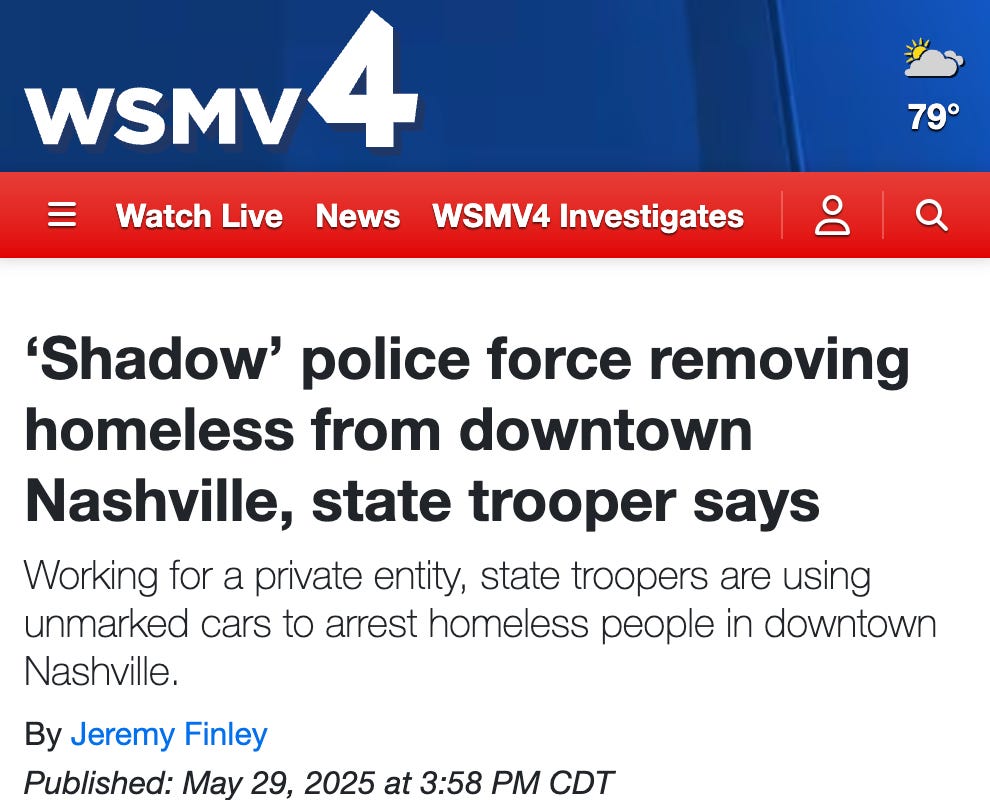
WSMV4: Shadow police force removing homeless from downtown Nashville, state trooper says
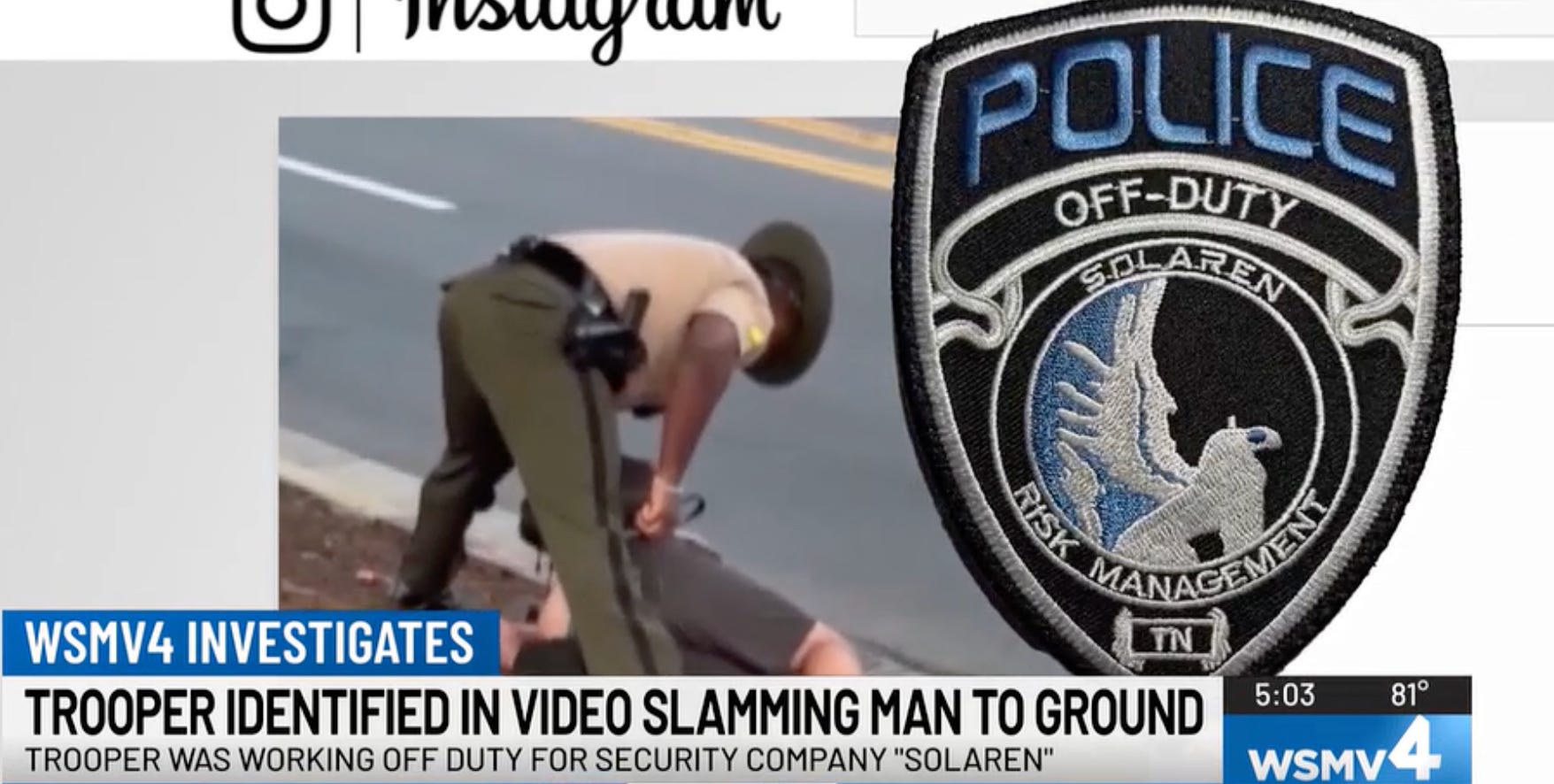
An October 2025 incident reported by WSMV encapsulates the accountability crisis. A uniformed, off-duty THP officer working for Solaren threw a man with outstretched arms to the ground after he allegedly kicked his vehicle. A mental health co-response team would likely have responded differently to a shirtless man kicking cars who posed no apparent threat.
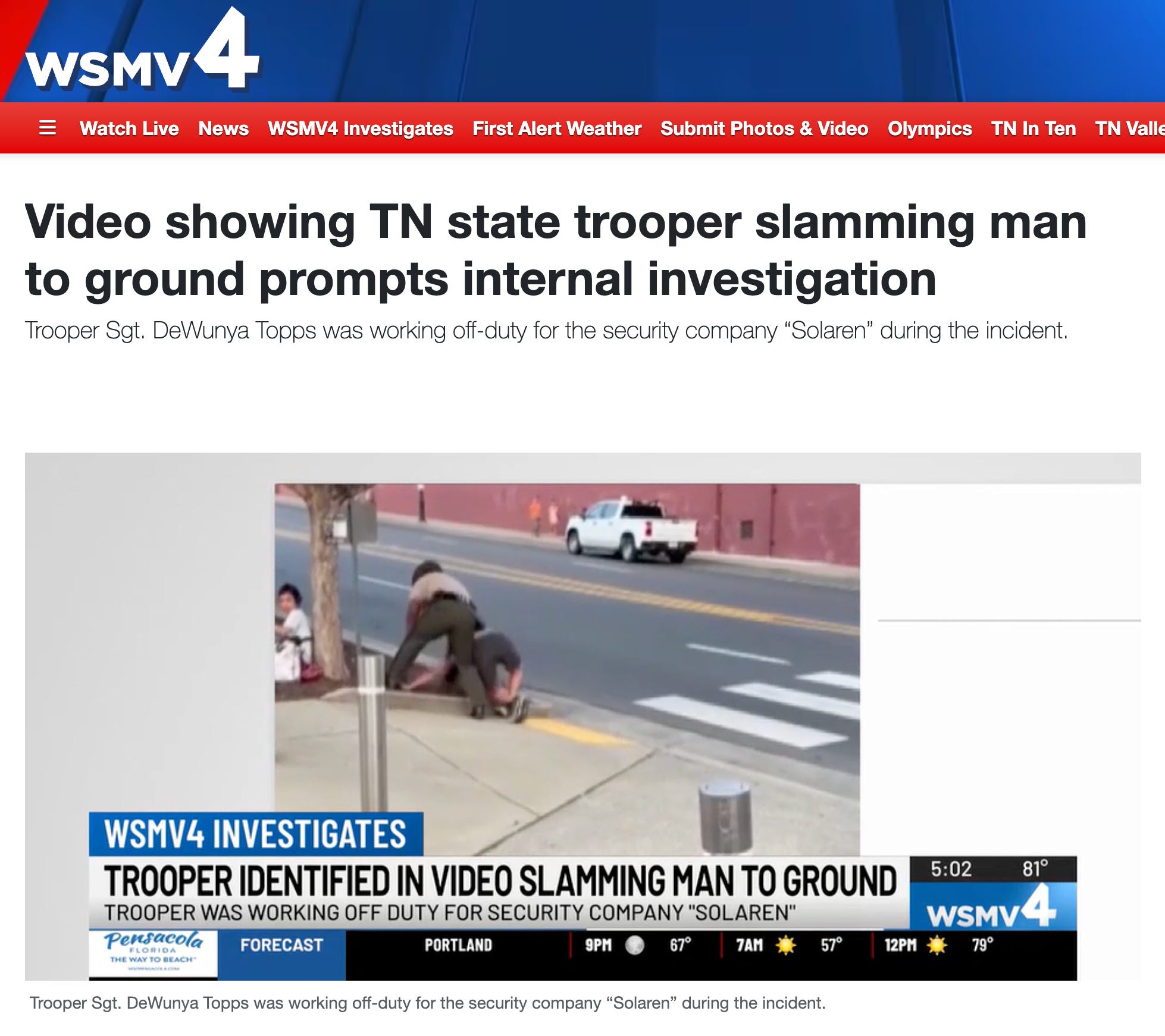
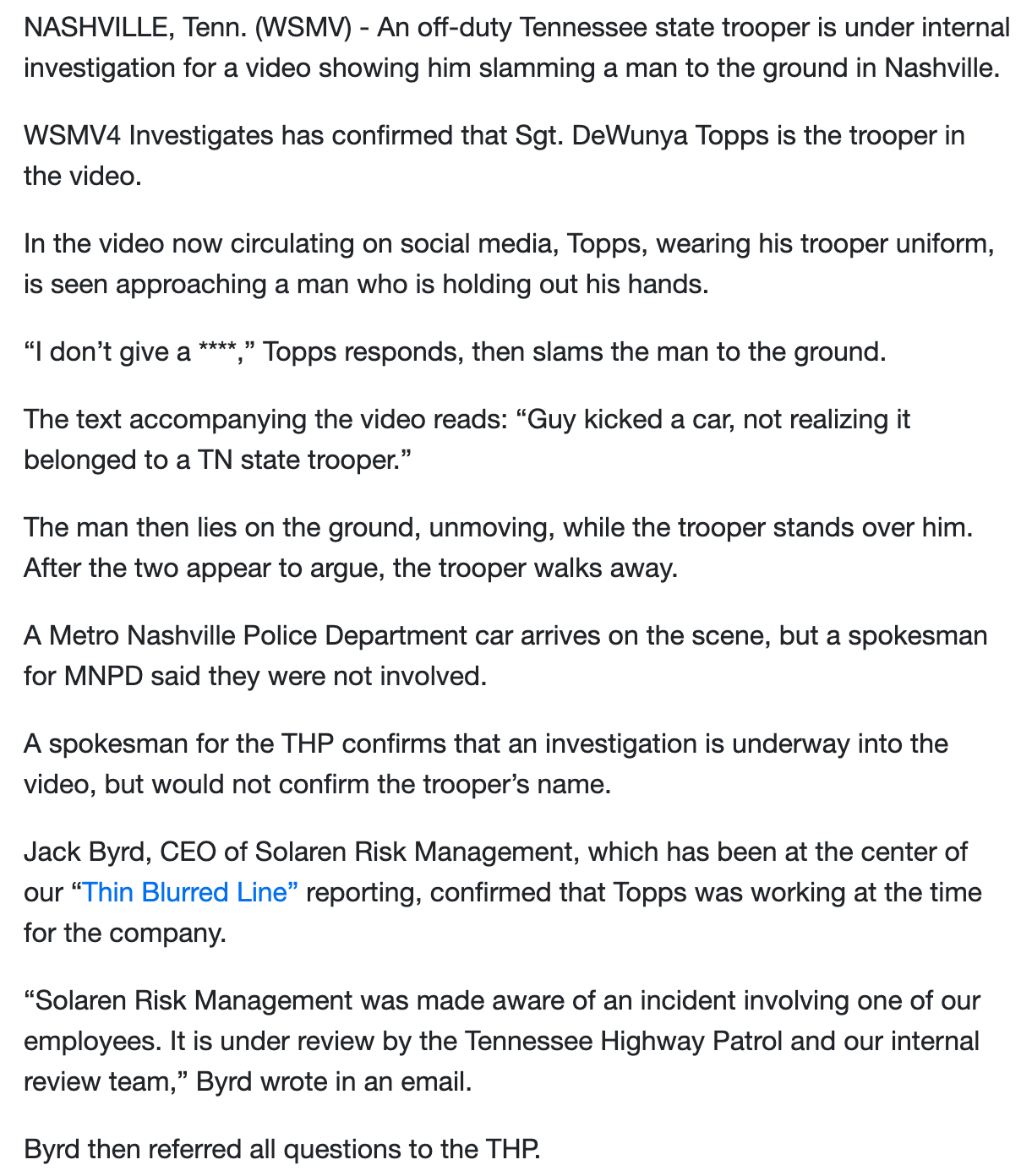
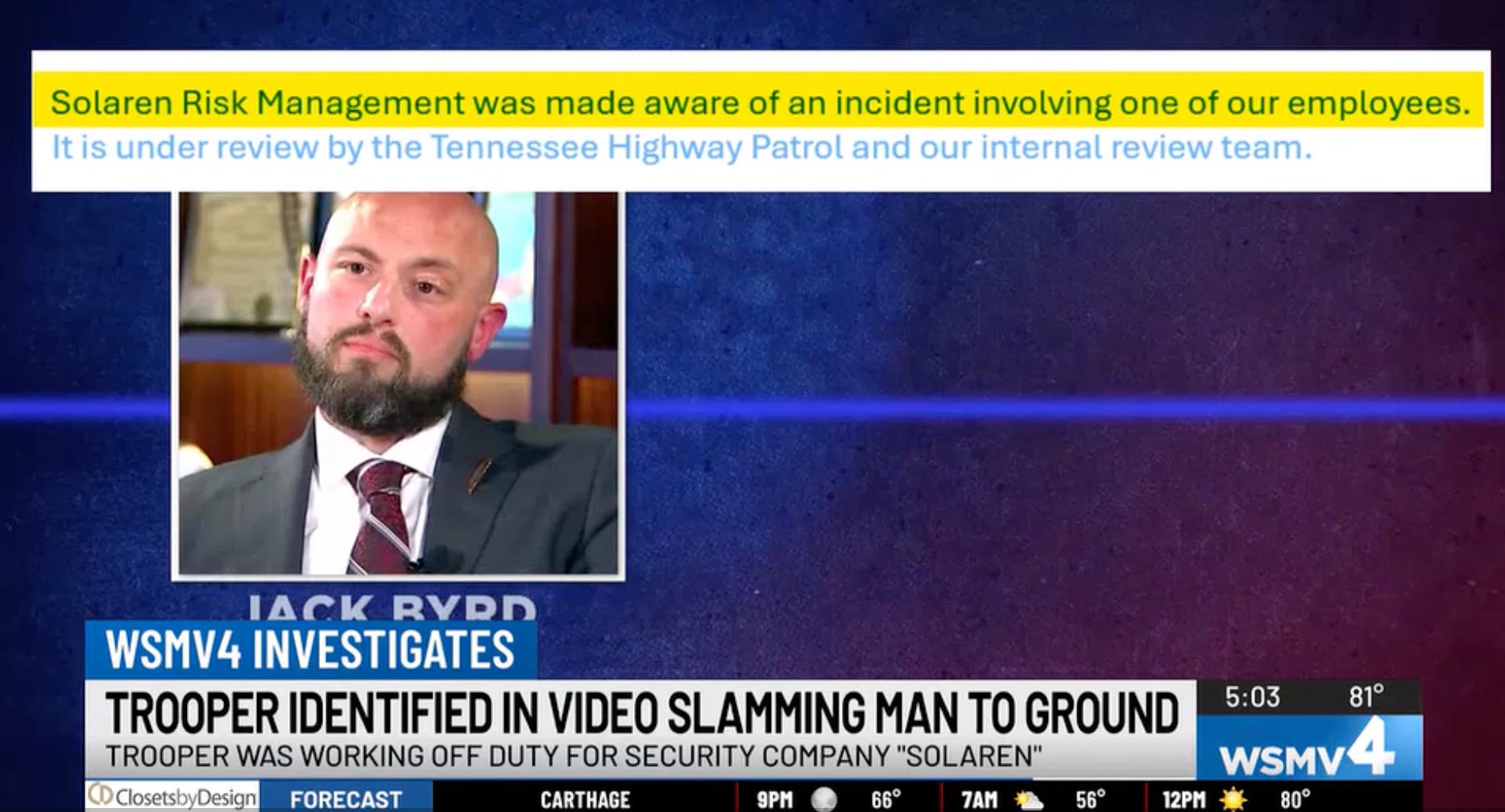
Solaren’s CEO steered questions to THP and said it was under review by his “internal team.”
He did not reveal that his Director of Administration, presumably tasked with overseeing these “internal investigations,” was the son the Director of Security at NDP and, we repeat, was a recent college graduate with a degree in Geology and whose previous job as “Team Lead” at a Regal Cinemas.
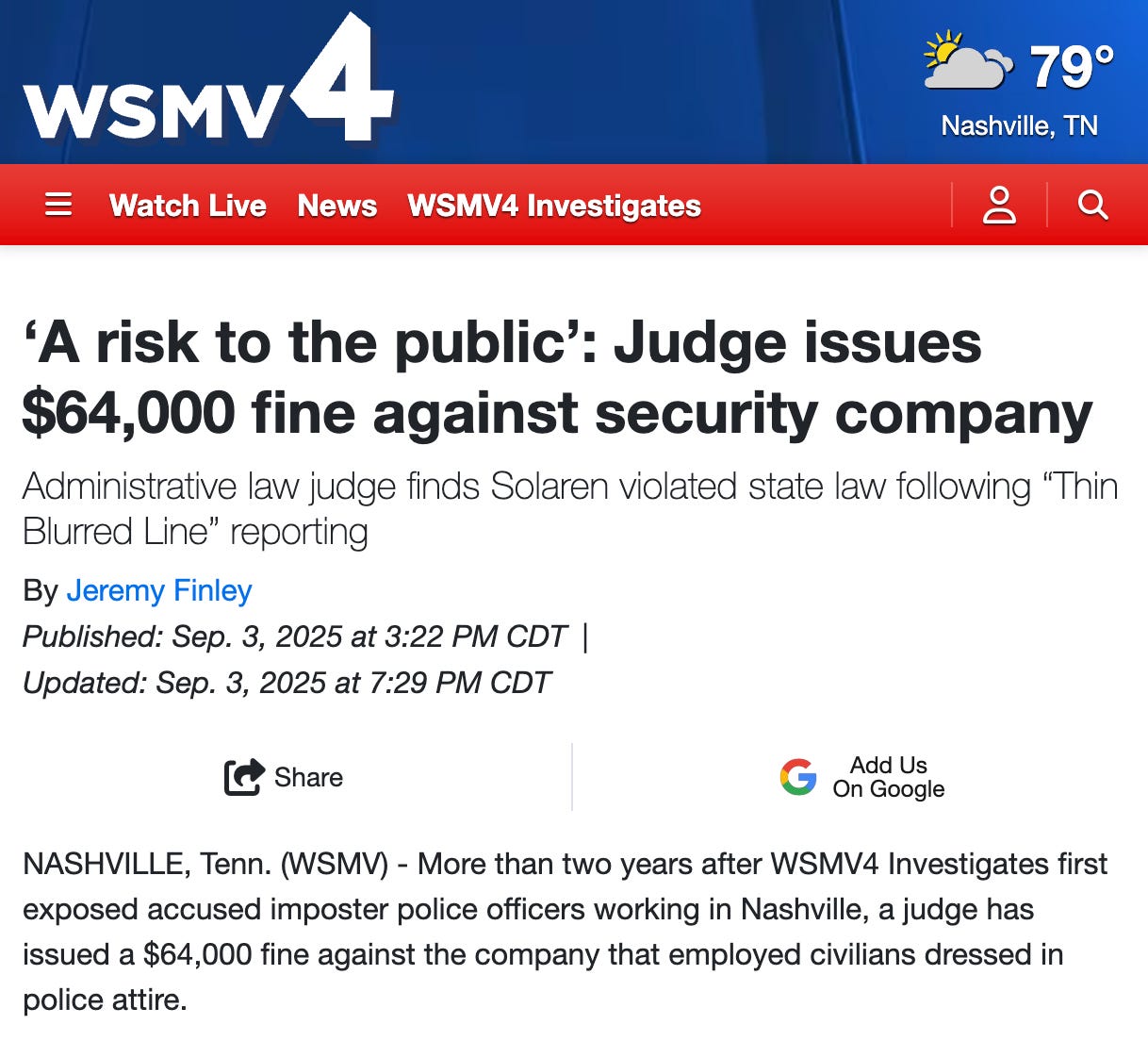
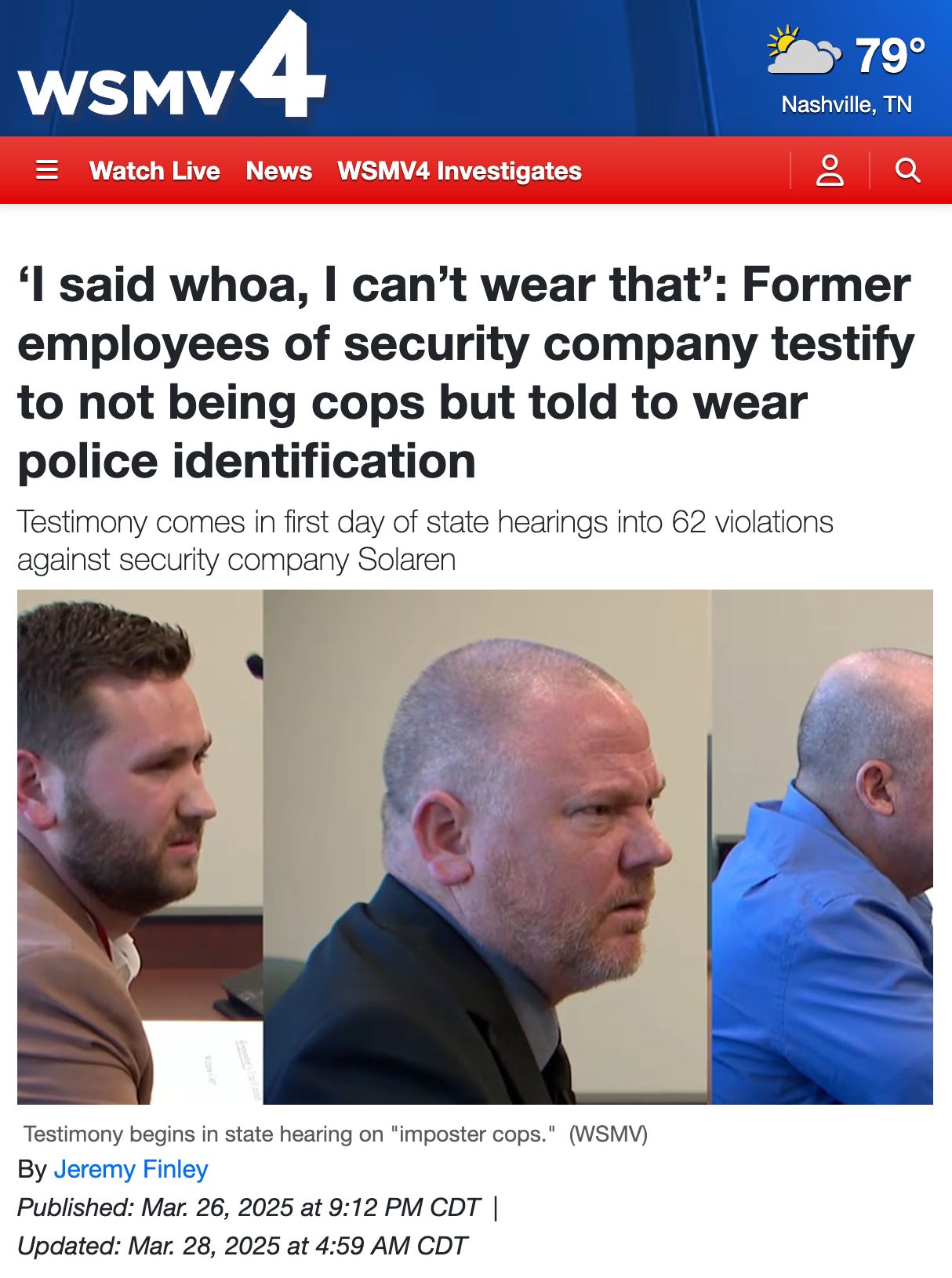
In July 2024, the State of Tennessee filed 62 civil violations against Solaren for allowing uncertified security guards to identify as police officers. WSMV’s investigation found that of 50 people Solaren allowed to wear police badges and uniforms, only 5 were actually off-duty officers. An administrative law judge found the conduct was “intentional” and fined the company $64,000, though she declined to revoke its license.
The investigation also revealed that at least one convicted felon had been given police identification by Solaren, and allegations surfaced of forged or backdated training certificates — forms dated 2024 that appeared to have been created to look as though they were from 2022.
But Solaren is the symptom, not the disease. A growth-focused private security company with no civilian oversight, no public records obligations, and no independent review of its conduct will behave exactly as Solaren has — because nothing in the surrounding structure prevents it. Replacing Solaren with a different firm changes nothing. The 62 violations, the convicted felon wearing a badge, the forged training certificates — these are not aberrations. They are the predictable output of a policing operation that exists beyond the reach of every oversight mechanism Nashville has built. No contract change fixes this. No vendor swap fixes this. The structure itself is the problem.
And the human cost compounds the financial one. Every arrest costs taxpayers. People taken into custody enter the public system — booking, processing, and court time. In most cases involving unhoused individuals, charges are dropped. The cycle traumatizes people without connecting them to services.
When felony camping charges are actually prosecuted, the math gets catastrophic. Sleeping on public property is a Class E felony in Tennessee — up to 6 years in prison and loss of voting rights for the crime of having nowhere to go. The cost of prosecuting and incarcerating someone for the offense far exceeds the cost of delivering permanent supportive housing — the intervention that actually works. Nashville pays twice: once for the private police who make the arrest, and again for the public system that processes and releases the same person, over and over, solving nothing.
“One Incident Away”
Council Member Jordan Huffman has repeatedly warned that Nashville is “one incident away from having the money turn off.” He and Mayor O’Connell have argued that downtown public safety requires a different posture, different tools — perhaps even the surveillance infrastructure and militarized vehicles that have been the subject of recent debate.
Huffman may be right that Nashville is one incident away. But the incident he should be worried about isn’t a hypothetical mass casualty event that would have been prevented by nation-state surveillance software overseen by local cops. The incident most likely to generate catastrophic legal liability and the largest payout is one carried out by a private police force — unaccountable, unsupervised, funded by public money without legal authorization — set loose on tourists and Nashville residents alike on a crowded Saturday night on Lower Broadway.
The off-duty THP officers who staff Solaren aren’t drawn from some broad, anonymous pool. NDP’s David Corman told the Nashville Banner that the program “only hires Tennessee Highway Patrol right now, so there’s no question that they are an official law enforcement officer.” This is not incidental — it’s a deliberate choice, and it has consequences that extend well beyond downtown.
These are officers from the same agency that carried out the May 2025 immigration enforcement sweep in South Nashville — what Border Czar Tom Homan called “[flooding] the zone.” A six-newsroom investigation found that DHS had inflated its arrest numbers — claiming 196 when the data showed a maximum of 159 — and inflated criminal history claims, with 75% of those detained having no criminal record at all. When the Tennessee Immigrant & Refugee Rights Coalition filed public records requests to understand what THP did during that operation, THP stonewalled them for over 100 days. TIRRC had to sue in Davidson County Chancery Court just to get bodycam footage released — and even then, Chancellor Perkins only secured videos from a single night of the operation. Footage from the remaining five nights is still being fought over in court.
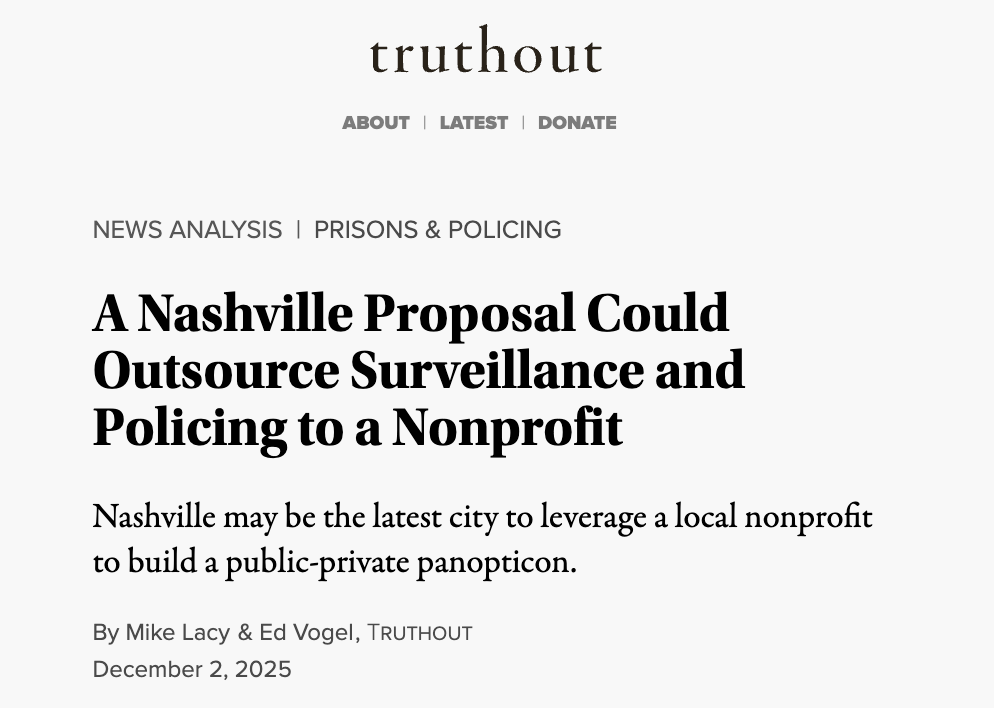
Truthout: A Nashville Proposal Could Outsource Surveillance and Policing to a Nonprofit
That’s how THP responds to records requests when it is a public agency subject to the Tennessee Public Records Act. Now consider what happens when those same officers clock out of their state shifts and clock into the downtown private detail. The records obligations disappear entirely. No public records requests. No bodycam disclosure requirements. No civilian oversight. The very agency that fought for months to hide what it did on the public clock operates with total opacity on the private one.
The connection between the ICE operation and the downtown policing operation goes beyond the fact that they involve officers from the very same agency, the Tennessee Highway Patrol. Both are armed law enforcement accountable to no one but the unelected executive above them. ICE officers working in Nashville answer to a federal appointee, not a mayor or a council. Solaren officers working downtown answer to Tom Turner and Jack Byrd, not to anyone Nashville voted for. Both target vulnerable populations. Both resist every transparency mechanism available under state law. And both rely on the same structural trick that has kept the checks coming for ICE agents even as federal legislators have tried to hold DHS accountable: the entity that funds the operation and the entity that carries it out are separated by just enough organizational distance so that, when something goes wrong, everyone can point elsewhere.
Nashville didn’t just fail to prevent this architecture from being used against it. It built one of its own.
Nashville has spent years building oversight infrastructure for MNPD — the Community Review Board, use-of-force policies, and body camera requirements. None of it applies to the officers patrolling downtown. The oversight gap isn’t incidental. It’s structural — and the corporate architecture behind the policing operation suggests it was built that way deliberately.
If the money turns off in Nashville because of what happens downtown, it won’t be because the council failed to buy enough surveillance cameras. It will be because the Council and the NDP Board of Directors allowed downtown to operate as a privatized city-within-a-city for two decades by ignoring the oversight responsibility written into law in 1998.
April 15
The District Management Corporation’s budget is due to the Metro Council on April 15. For the first time in twenty-two years, Council is required to actually review and approve it. NDP’s own 990 filing shows the organization ran a $307,602 deficit in 2024 — spending more than it took in, with no one at Metro reviewing the books.
The board governs NDP. The council governs the budget. These are not separate problems — they are two ends of the same accountability chain. If Council approves the budget without demanding answers, it ratifies twenty-two years of board governance that produced a shadow police force, a $312 shell company for private policing licensure, and a CEO whose salary doubled while Metro property was so mismanaged it eventually exploded under his watch. If the board refuses to reform, Council has the statutory power to reject the budget until it does. Neither body can resolve this by pointing at the other.
That power exists precisely for moments like this. When Council reviews the budget, it should demand answers to questions that have never been asked: What is NDMC PSO, LLC, and why was it created? Why does the entity licensed to provide security for the CBID report zero income and $312 in total assets? Which entity actually pays Solaren, and how much? Why does the security license list Solaren’s Mt. Juliet office rather than any address in Nashville? What is the employment relationship between NDMC PSO, LLC, and the officers making arrests downtown? And why did NDP’s CEO, one of Nashville’s most prominent law firms, and every attorney on NDP’s Board of Directors allow this structure to operate for years without disclosure to the Council that funds it?
But the most important question is not about Solaren. It is whether public money should fund private policing downtown at all — and if Council concludes it should, what oversight structure would prevent every problem documented in this article from recurring with the next contractor.
Council Members who claim to stand for the rule of law, fiscal stewardship, accountable policing, and the dignity of Nashville’s most vulnerable residents have, for the first time in a generation, a concrete mechanism to act on those values.
Review the budget. Demand transparency about private policing contracts — not just the current ones, but the structural arrangement that makes any such contract an accountability void. End Council’s complicity in a shadow law enforcement operation that serves the interests of downtown’s corporate leadership at the expense of the people who live, work, and visit here.
Nashville deserves public safety that is actually public.
Every Council Member’s vote on this budget will be published. Every board member’s continued service will be noted. Silence, at this point, is a position — and it will be recorded as one.
¹ This author is keenly aware that The District Management Corporation and The Gulch District Management Corporation are distinct entities from the Nashville Downtown Partnership, each ostensibly with its own board. To be precise, it is the District Management Corporations that need to submit the budget for approval.
In practice, the separation is a legal fiction. Turner is simultaneously the CEO of NDP, the principal officer of the DMC (as listed on its IRS Form 990), and the registered agent of NDMC PSO, LLC. The DMC’s Form 990 lists nashvilledowntown.com — NDP’s website — as its own. Board memberships overlap significantly. The distinction has mattered most when it was convenient — during the Mayor’s Office’s coordination with MNPD, NDP, and the State of Tennessee to purchase surveillance technology using funding tied to Stephen Miller and Cameron Sexton’s anti-immigration legislative push, the technical separation effectively shielded NDP’s Board of Directors from public consequences. Future efforts to use this structure to surveil and police Nashville without democratic consent are unlikely to afford the same cover.