

TL/DR
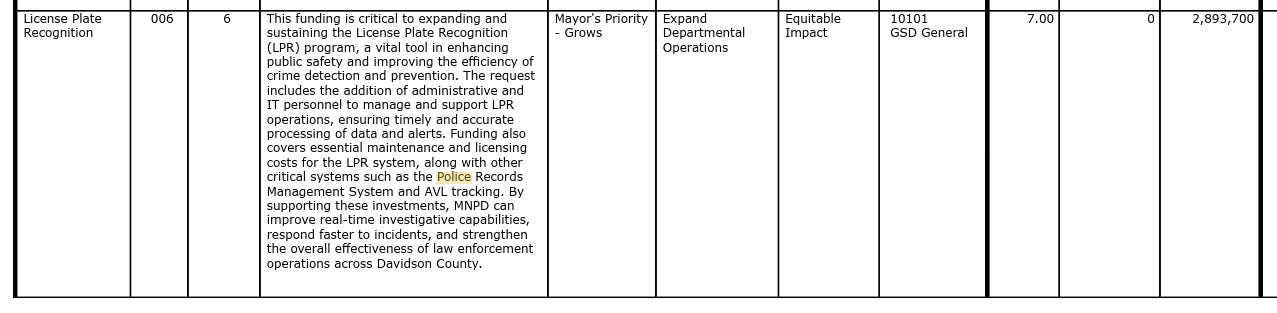
MNPD is requesting $2.8 million for license plate readers (LPRs) in the FY27 budget — to solve a problem that is, by its own account, already in historic decline. Violent crime fell 14 percent in 2025. Homicides hit their lowest since 2014. Robberies dropped to levels not seen since 1969.
Yesterday’s Vanderbilt Poll shows 56 percent of Nashvillians think the city is on the wrong track, and 71 percent say the city spends too little time on their neighborhoods. The Mayor’s approval rating has cratered, 12 points amongst Democrats.
And a push for LPRs seems like the last thing the city's leadership needs. LPRs, innocuous to some, are not a standalone technology. They are an intake valve for a larger, AI-driven surveillance infrastructure — Flock’s LPF database is often searchable nationwide, and has been used by ICE, and can flow into platforms like Palantir, an arrangement that seems inevitable given that they are funded by the same parties. These are not popular public safety solutions with the general public. Nationally, 57 percent of voters say AI’s risks outweigh its benefits, and 69 percent say the government isn’t doing enough to regulate it.
The man building his global headquarters on the East Bank, Oracle's Larry Ellison, told investors that AI-powered surveillance would ensure citizens are "constantly recorded" and "on their best behavior." That's not a warning. That's a business plan — and LPRs are the on-ramp. The money would flow to companies like Flock Safety, a $7.5 billion firm whose investors openly describe police departments as market channels and your movement data as the product.
Nashville has already fought off FUSUS and stripped LeoSight and Fivecast from a $15 million surveillance MOU — but the budget requests keep coming. The only tool the public has is procurement oversight, and the administration keeps finding ways around it.
The latest in an unending pursuit of invasive surveillance technology in Nashville, MNPD’s current budget request includes approximately $2.8 million for its License Plate Recognition program — submitted to align with the Mayor’s Priority to “Grow” Nashville. Departments seeking expanded budget were required to list if their proposed expansion was aligned with the priorities of “Grows”, “Moves,” or “Works.”
Added surveillance is indeed “growing” something in Nashville, but it has more to do with the increasing profits of those collecting that surveillance data than the safety of the people being monitored.
The funds would assuredly go to a vendor such as Flock, an organization that an entire movement called “Deflock” fighting its predatory expansion across the united states.

Let me be abundantly clear: as a former staffer of the Mayor’s Office of Community Safety who studied this, there is no evidence that surveillance technology makes any meaningful positive impact on community safety. There are, however, many demonstrated dangers it introduces, and it is a net negative for the communities subjected to it.
But also as a former manager at a digital demand generation marketing company, I can tell you that tracking the whereabouts of millions of Americans does have one demonstrated benefit: it makes billionaires a tremendous amount of money.
Amongst researchers, Nashville is entering the national discourse as THE case study of how procurement is being circumvented to eliminate public consent over their own surveillance. That its taking place during the tenure of Nashville’s former fiercest data privacy advocate, Freddie O’Connell, is an irony not lost on academics studying our city.
But don’t take my word for it. Ask them:
When Andreessen Horowitz general partner David George explained why his firm led Flock Safety’s latest funding round — $275 million, bringing the company’s valuation to $7.5 billion — he didn’t talk about community safety. He talked about market penetration. Their ability to get into police departments and achieve “very high market share,” he said, is what creates a “venture-scale outcome.”
Read that again. The product isn’t safety. The product is access, access to police departments, to public infrastructure, to the movement data of every person who drives past a camera. The police department is the warehouse. You are the inventory.
Flock now operates in over 5,000 municipalities across 49 states, scanning more than 20 billion vehicles per month. Its investors include Founders Fund, Y Combinator, Tiger Global, and Kleiner Perkins — the same firms that funded Facebook, Uber, and Palantir.
Records obtained by 404 Media showed local officers running over 4,000 nationwide lookups for immigration-related purposes on behalf of DHS, CBP and ICE. Flock is now plugging into commercial data brokers to let police “jump from LPR to person” — connecting plates to names, addresses, and personal records through an internal product called Nova. It is building a “Business Network” where private corporations can add vehicles to shared hotlists and alert each other — a corporate blacklisting infrastructure with no public oversight.

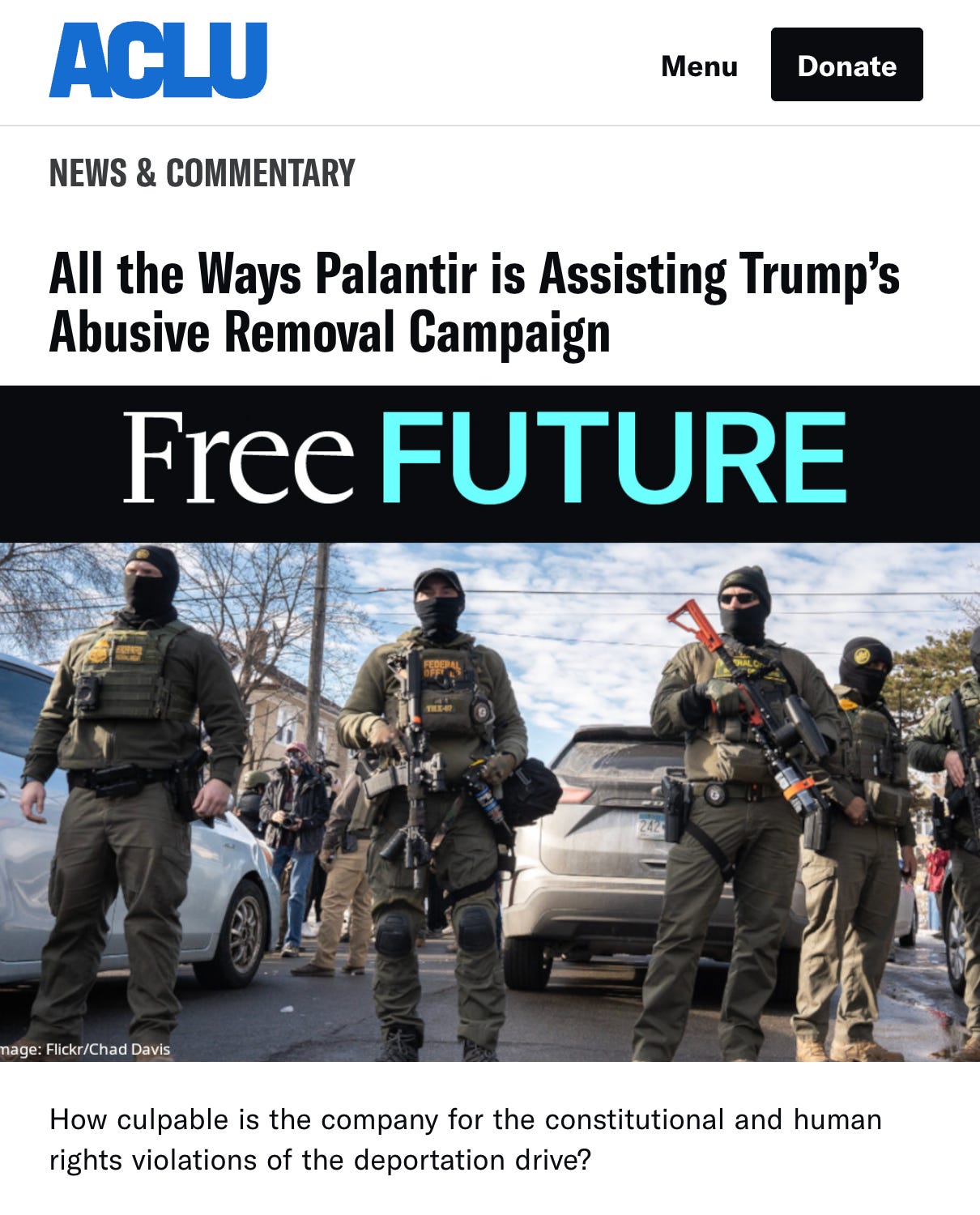
And the data feeds upward into platforms like Palantir — the data-mining company co-founded by Peter Thiel, whose earliest major customer was the CIA through its venture arm In-Q-Tel, and which now operates under a $29.8 million contract with ICE for its ImmigrationOS platform.
Under TIPA — Tennessee’s own privacy law, which took effect July 1, 2025 — there is literally nothing a municipality can do to stop any of this, besides not purchasing and installing the technology.
What the Billionaires Say
If you want to know what these systems are for, don’t read the marketing copy. Listen to the people who fund them.
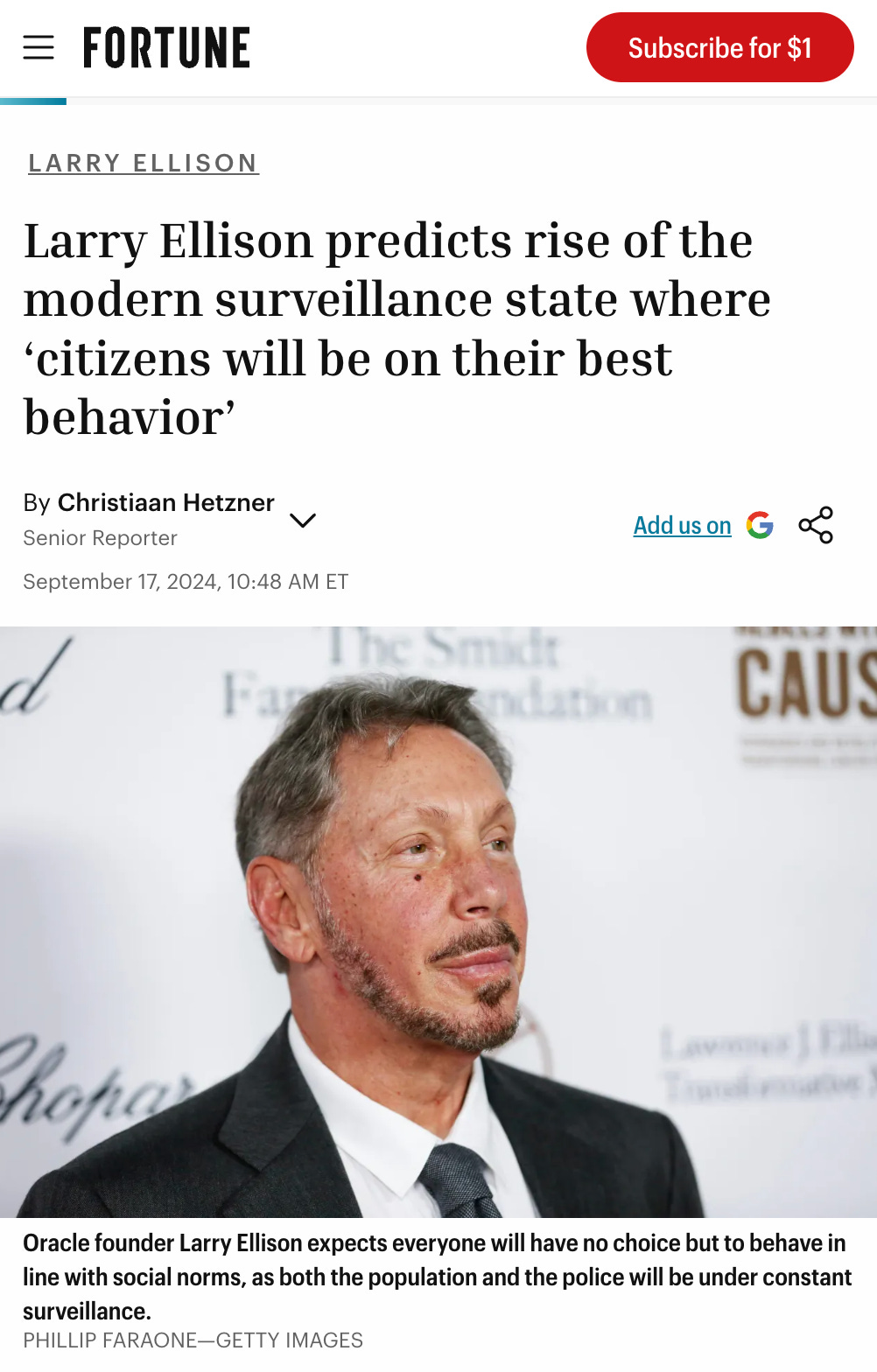
Larry Ellison, founder of Oracle and one of the world’s richest men, told investors at Oracle’s Financial Analyst Meeting in September 2024 that AI-powered surveillance would ensure “citizens will be on their best behavior, because we’re constantly recording and reporting everything that is going on.” Every police officer, he said, would be monitored at all times by AI. So would the rest of us.
He described police body cameras that could never be turned off — even requesting a bathroom break only meant the footage would require a subpoena to access, not that the recording ever stopped. He said drones should replace police cars in chases. Five months later, at the World Government Summit in Dubai, Ellison called for governments to unify all national data — health records, electronic health records, genomic data, everything — into a database “easily consumable by the AI model.” “That’s the missing link,” he said.
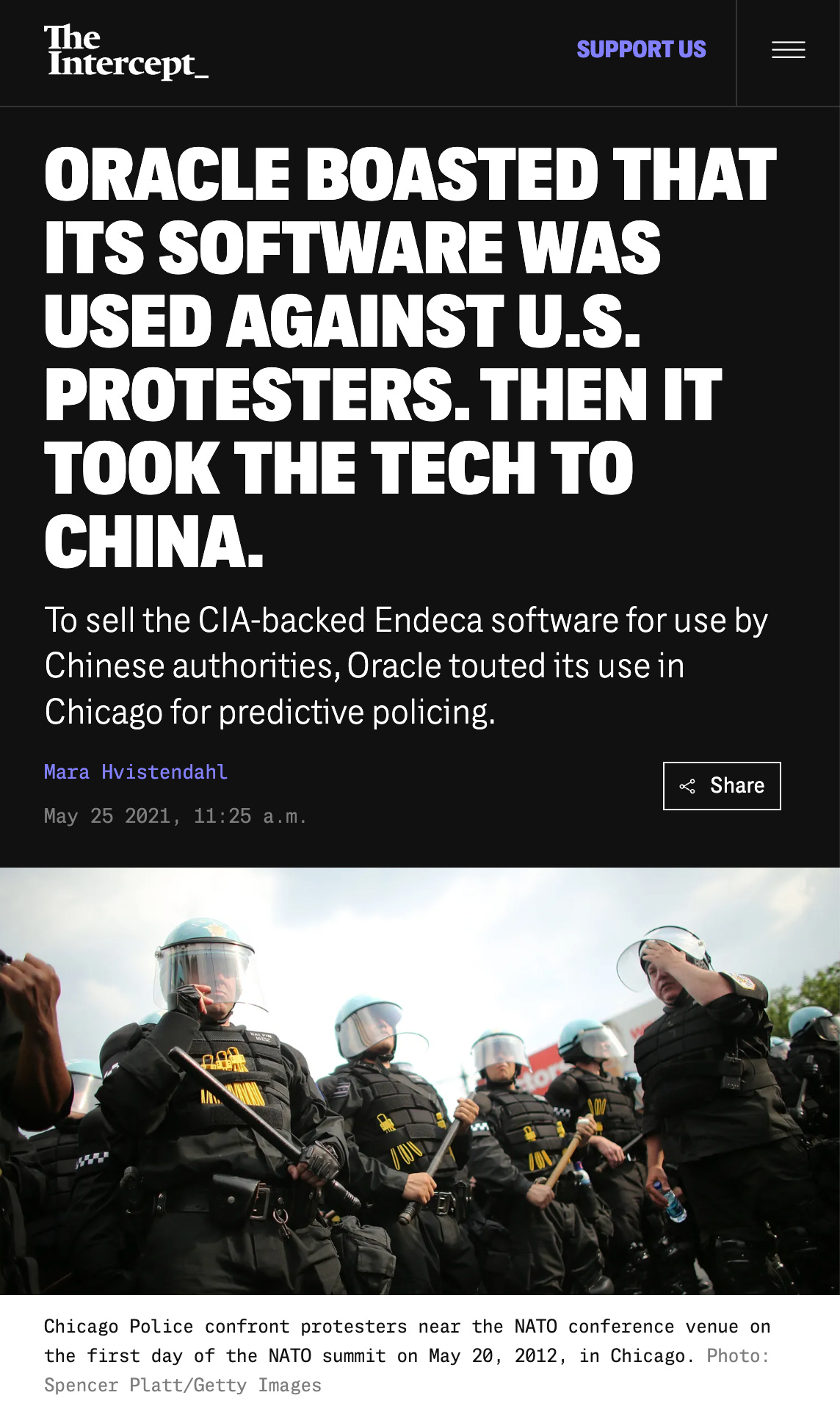
This is not a man who is embarrassed by what he’s describing. This is a man who sees a market. And he is building his global headquarters here.
Oracle announced in April 2024 that it is moving its world headquarters to Nashville — a campus on the East Bank originally estimated at $1.2 billion but since revised upward to $1.35 billion or more, backed by $65 million in state incentives. The man who told a room full of investors that the future is one where citizens are “constantly recorded” and AI ensures everyone is “on their best behavior” chose Nashville as the center of that future.
When Ellison said “it’s the center of our future,” he was talking about healthcare, about swallowing up entire nations’ genomic datasets and feeding them to AI. But the infrastructure he is building — the databases, the cloud systems, the AI that processes surveillance footage — does not stay in one industry. Oracle already provides cloud infrastructure for the Defense Department and the intelligence community. The company that wants to unify all national data into one AI-consumable system is about to be Nashville’s largest corporate resident.
Peter Thiel, co-founder of Palantir and a Flock investor through Founders Fund, argued in a 2011 Bloomberg interview that civil libertarians should embrace mass data mining because it was less repressive than the “crazy abuses and draconian policies” proposed after September 11. Palantir’s CEO, Alex Karp, put it more bluntly in a 2020 interview with Axios on HBO: “Our product is used, on occasion, to kill people.”
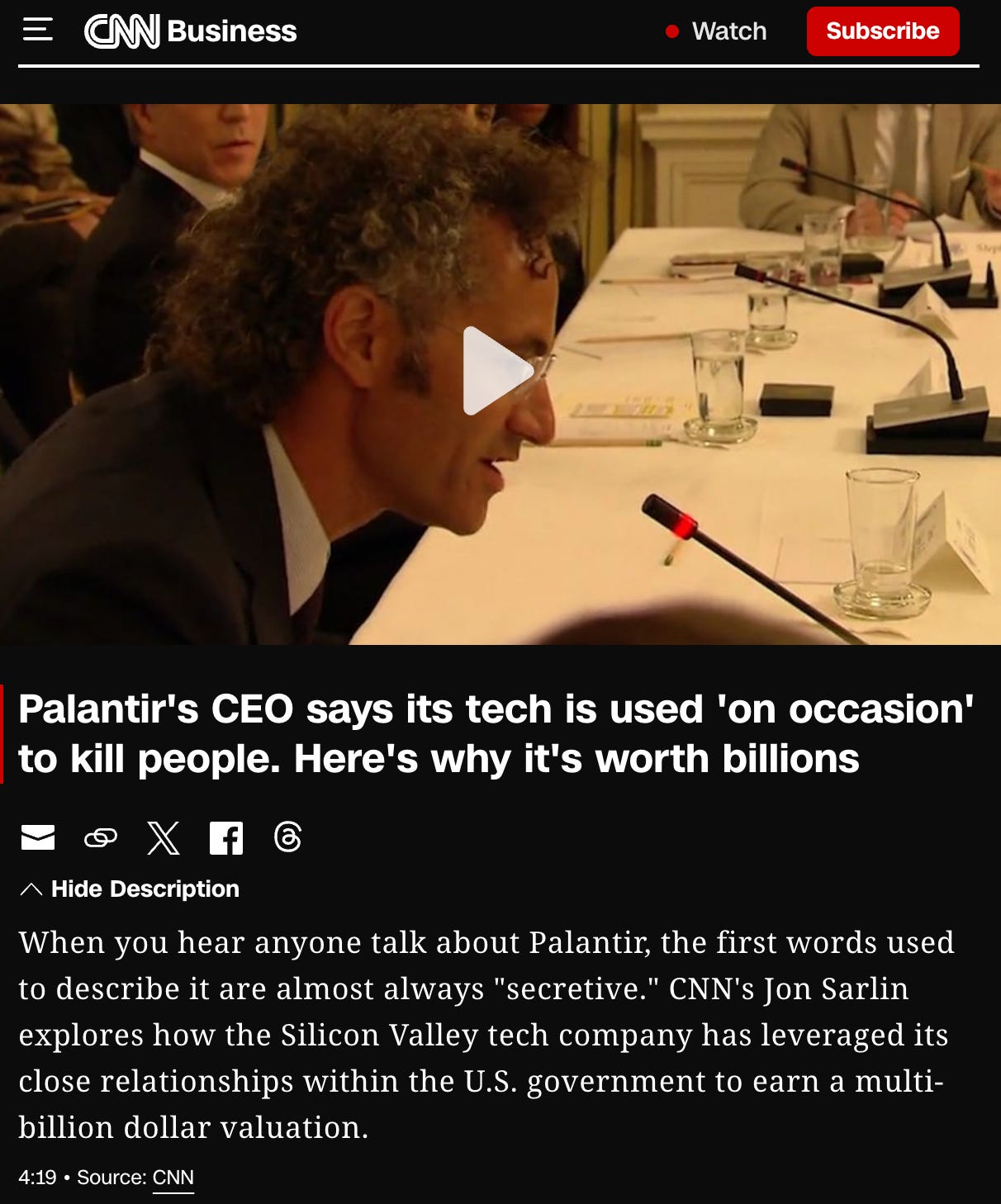
These are not leaks. These are the builders describing the world they are constructing on purpose. Ellison wants everyone watched so everyone behaves. Thiel’s company provides the analytics platform that turns raw surveillance data into actionable intelligence for police, military, and immigration enforcement. And the cameras feeding all may soon be going up on your street, sold to your city council as a tool to catch car thieves.
Cops as Sales Reps
Axon, the company behind the Taser and the owner of FUSUS — having acquired the remaining 79.7% stake for approximately $240 million in January 2024 — runs the same playbook from the other direction. As the EFF documented in April 2025, Axon’s business model is built on bundling: sell a police department body cameras, then leverage that relationship to push real-time crime center software, drone integration, AI-generated police reports, and a platform that funnels footage from public and private cameras into a centralized surveillance hub. One product gets your foot in the door. The rest colonize the house.
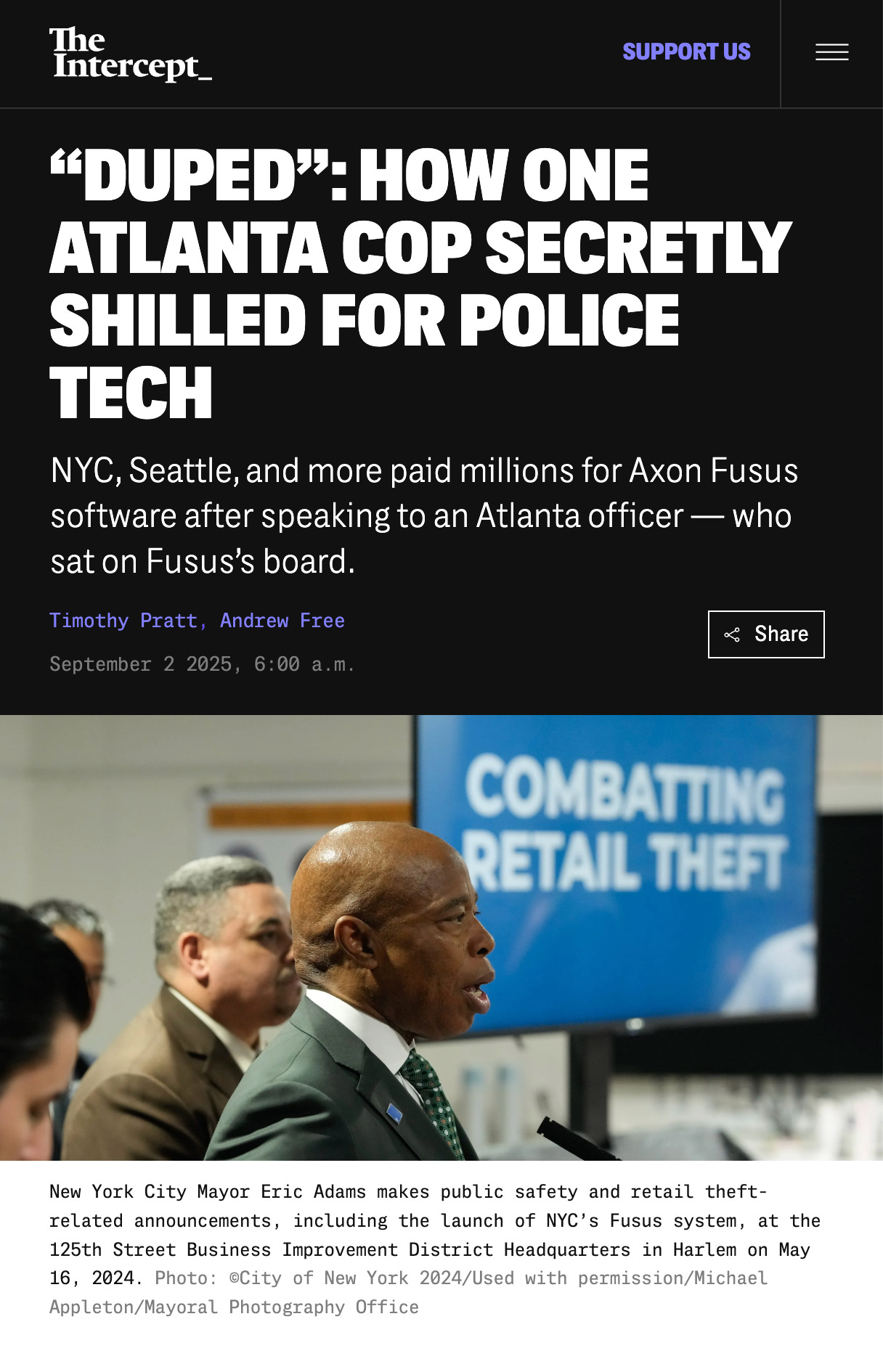
In September 2025, The Intercept revealed that Marshall Freeman, a chief administrative officer of the Atlanta Police Department, had been serving on the board of directors of FUSUS while simultaneously pitching the company's products to at least fourteen other cities as a public employee. Nine went on to sign contracts worth millions. The Atlanta Ethics Office found he failed to disclose his financial interest in at least fifteen separate FUSUS-related matters. He was presented to potential client cities as a fellow government official. He never disclosed his role with the company.
What We’re Seeing in Nashville
Here in Nashville, the Nashville Downtown Partnership (NDP) — a nonporift — has served as the procurement vehicle for a $15 million state grant from Governor Lee’s Downtown Public Safety Grant Fund. Of that total, roughly $9M was carved out through a private meeting with the Mayor’s Office, NDP and MNPD for surveillance and policing equipment.
As originally written, NDP would get all the money, but they would be required to buy things that could be “used” by MNPD, such as surveillance technology and equipment — cameras, a mobile command post, an armored vehicle, and software platforms including LeoSight and Fivecast — while approximately $6 million funded NDP operations including staffing, downtown ambassadors, and homeless outreach.
When pressed, the Mayor’s Office claimed that any acceptance of gifts from NDP would have gone through the proper channels and subsequent surveillance ordinance required public hearings. But the Mayor’s Office gave no indication that this was their intent. The submission of the $15M MOU to Council wasn’t accompanied by so much as a press release.
The arrangement appeared tailor-made to bypass the democratic oversight that would normally govern how a city watches its residents. The residents, however, did watch.

Amongst researchers, Nashville is entering the national discourse as THE case study of how procurement is being circumvented to eliminate public consent over their own surveillance. That its taking place during the tenure of Nashville’s former fiercest data privacy advocate, Freddie O’Connell, is an irony not lost on academics studying our city.
And now MNPD is asking for approximately $2.8 million more for LPRs — filed under the Mayor’s Priority of “Grows.”
Grows what? Not public safety outcomes. Not community trust. Not oversight. It grows the surveillance infrastructure. It grows the data pipeline. And it grows the revenue of the corporations providing the technology. Every dollar Nashville puts into LPR licensing and maintenance is a dollar of recurring revenue for a surveillance company — a subscription fee paid with public money for a system whose data can flow into networks the city doesn’t control.
The request comes from an administration led by a mayor who, as a Metro Council Member, was one of the city’s most outspoken surveillance critics. Freddie O’Connell called New Orleans’ integrated police traffic cameras “spying” and “security theater.” He voted for the 2017 surveillance oversight ordinance (BL2017-646).
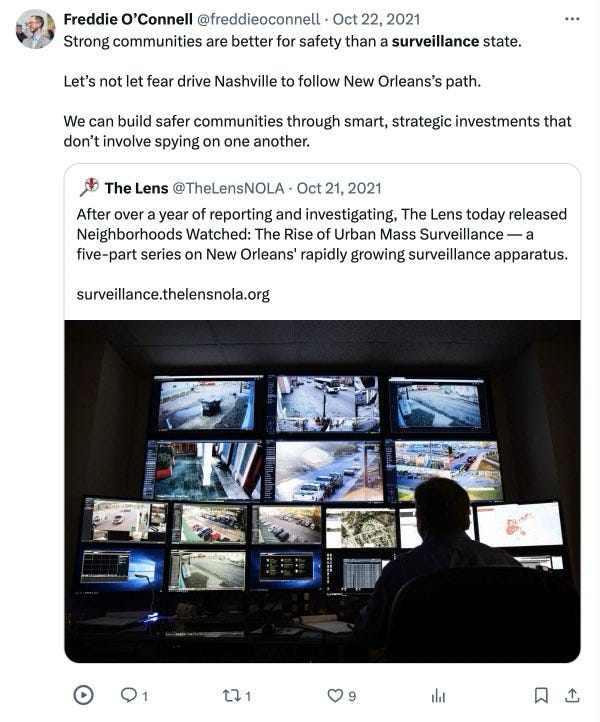
Then he became mayor, and became FUSUS’s most dogged champion, pushing the contract through multiple deferrals, public hearings, and organized community resistance. When asked about residents’ privacy concerns, O’Connell glanced out his office window toward the Cumberland River and told the Nashville Scene: “If you’re worried about that, just throw your phone in the river.”
That is the sound of a public official who has stopped thinking about you as a constituent and started thinking about you as a data point.

Meanwhile, Nashville’s Chief of Operations, Kristin Wilson, came to Metro government after managing the $4.1 billion acquisition of ChoicePoint by LexisNexis — one of the largest data-brokerage mergers in history, one that created one of the most comprehensive personal data surveillance platforms ever assembled. It has grown into a $22.1M contract between LexisNexis and ICE. This is the professional background shaping Nashville’s infrastructure decisions.
And here is the deeper irony: the companies selling this technology to police departments are simultaneously selling the vision of replacing them. Flock’s CEO, Garrett Langley, told Forbes that within ten years, Flock’s cameras and drones would “eradicate almost all crime in the U.S.” Flock markets itself as a “force multiplier” — doing the same job with fewer officers. In July 2025, the ACLU warned that Flock’s newest AI tools crossed a critical line: the system is no longer just recording our movements and waiting for police to query it. It is actively evaluating all of us, deciding which movement patterns are “suspicious,” and reporting us to law enforcement automatically.
The companies are selling police departments the tools of their own obsolescence — and billing them for it annually.
The Misuse Isn’t a Bug
In Milwaukee, police officer Josue Ayala was charged in February 2026 with using Flock’s system to track a woman he was dating and her ex-boyfriend more than 170 times for personal reasons. In Mountain View, California, the police chief shut down the city’s entire Flock camera network after discovering that Flock had enabled statewide data-sharing on 29 of 30 cameras — and nationwide sharing on one — without the department’s knowledge or authorization. The council subsequently voted unanimously to end its Flock contract.
The EFF found in November 2025 that more than 50 law enforcement agencies had used Flock’s network to run hundreds of searches connected to protest activity — officers querying the system with protest-related terms like “DxE Protest Suspect Vehicle,” “No Kings,” “Hands Off,” and other references to political demonstrations, without identifying an actual crime.
Cities across the country discovered their Flock data was being searched by ICE, sometimes through local officers running queries on ICE’s behalf. A Virginia circuit court in Commonwealth v. Bell (May 2024) ruled that a dense network of 172 Flock cameras constituted a warrantless “dragnet” — but this ruling was effectively overturned when the Virginia Court of Appeals ruled in Commonwealth v. Church (October 2025) that ALPR technology does not require a warrant, and a federal court reached a similar conclusion in Schmidt v. City of Norfolk (January 2026).
The constitutional question remains unsettled as these cases work through the system. A class action lawsuit was filed against Flock in San Francisco Superior Court in February 2026 by Gibbs Mura and Milberg, alleging the company violated California’s ALPR Privacy Act by sharing plate data with out-of-state and federal agencies without authorization.
These are not edge cases. They are the system operating as built.
The One Tool We Have
Across the country, surveillance researchers and civil liberties advocates are converging on one theme: the fundamental tool to hold public money accountable to the public is procurement. Procurement is the process by which governments buy things — competitive bidding, public hearings, council votes — and it exists precisely so that the public can see what is being purchased, from whom, at what cost, and under what terms. It is the mechanism through which democratic oversight enters the marketplace. When procurement is followed, the public gets a voice. When it is sidestepped, the public gets surveilled.
Nashville is entering the national discourse as a case study in how procurement is being circumvented to eliminate that voice.
The original FUSUS contract was executed in September 2022 as a sole-source agreement — no competitive bidding, no public hearing, no council approval — even though Metro Code requires council review for surveillance technology. The contract was structured at $175,000, just below the $250,000 threshold that would have triggered mandatory council approval for sole-source contracts. Metro staff later acknowledged it should have followed those rules.
When the administration tried to expand the contract in early 2024, the public hearing it had initially avoided finally happened — and dozens of residents packed the chamber in opposition. The contract was withdrawn, reintroduced, fought over for nearly a year, and ultimately rejected by council on December 3, 2024, by a vote of 20–18 — one vote short of the 21 needed to pass, with two members absent. The fight turned even some of the mayor's longest supporters against him.

Then came the Surveillance MOU. Filed the Friday before Thanksgiving — November 21, 2025 — the resolution proposed routing $15 million in state grant funding through the Nashville Downtown Partnership for surveillance equipment and technology. The mayor’s office seemed to believe that because the money came from a grant they were allowing a 3rd party to obtain that it did not require a public hearing under the 2017 surveillance ordinance. Community advocates disagreed, pointing to the plain letter of the law — an ordinance sponsored by Dave Rosenberg, who by then was serving as the mayor’s own Director of Legislative Affairs.

The original MOU included line items for two technologies that deserve attention.
The first is LeoSight, a surveillance integration platform that functions much like FUSUS — integrating cameras, license plate readers, drones, gunshot detection, and dispatch systems into a single real-time dashboard.
LeoSight’s CEO, Mark Wood, was previously the Chief Revenue Officer of FUSUS. He left FUSUS in February 2024 and took over LeoSight in March 2025 — the same month Nashville’s community advocates finally killed the FUSUS contract for good. The rejected surveillance platform walked out the front door and came back through the side entrance with a new name and a new logo.
The second is Fivecast, an Adelaide-based AI intelligence-collection tool built “in consultation” with the Five Eyes intelligence agencies — the intelligence-sharing alliance of the United States, the United Kingdom, Canada, Australia, and New Zealand. Fivecast’s ONYX platform conducts automated, continuous data collection across social media, news, marketplaces, the dark web, and more.
Fivecast can build what it calls “digital footprints” from biographical data, “track shifts in sentiment and emotion,” and assess the level of risk associated with an individual. It advertises access to over eight billion personal records. The Department of Homeland Security already uses it — ICE holds a $4.2 million contract for ONYX. And it was listed as a line item in a grant-funded MOU for downtown Nashville.
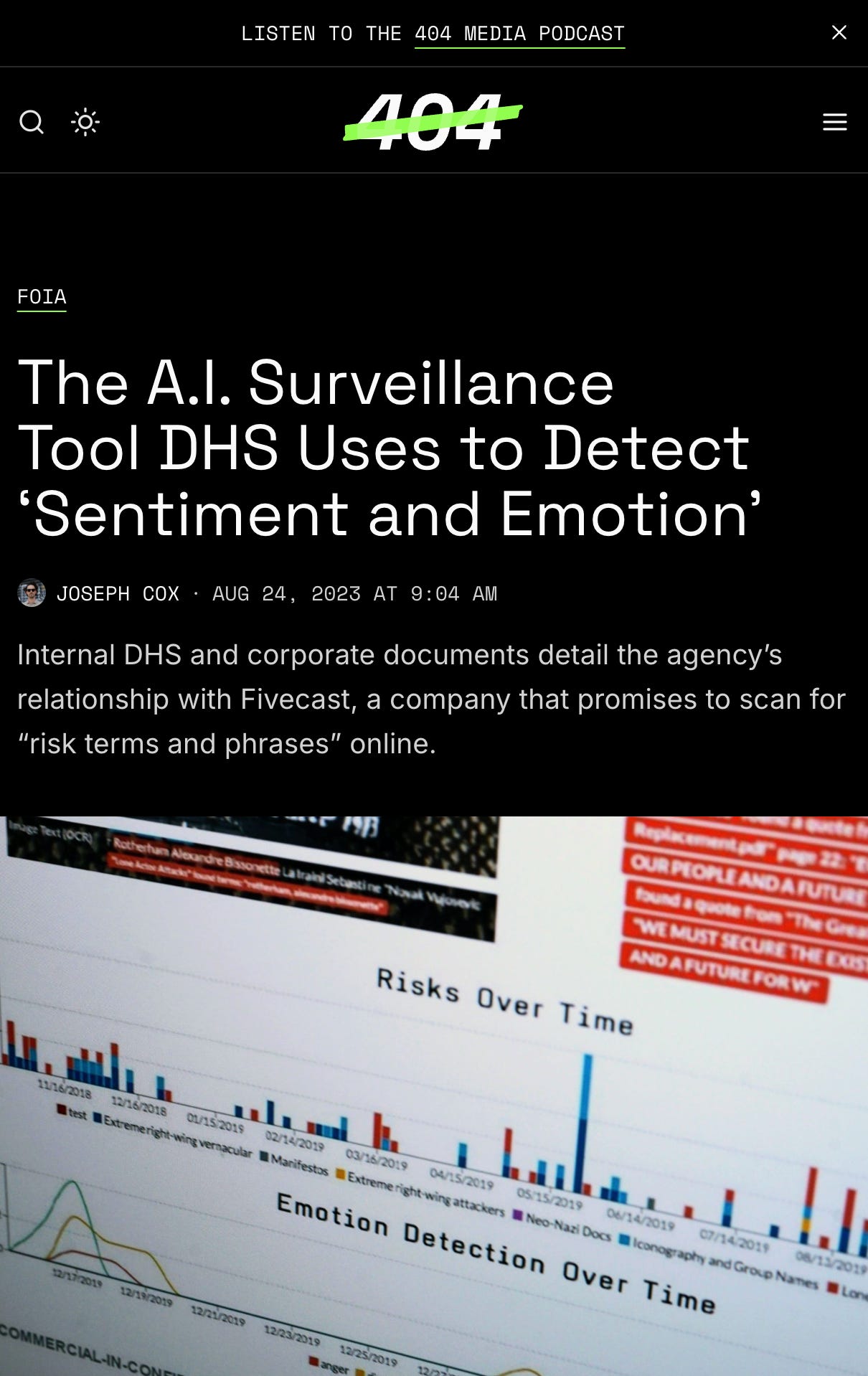
Both LeoSight and Fivecast were removed from the MOU after public exposure — much of it driven by local advocates and reporting in this publication. The cameras were stripped after the Mayor’s Office agreed to let them be considered surveillance technology under the 2017 ordinance, which triggered a public hearing. The hearing was fiery. Acquiring the tech became politically untenable. They backed down.
But the other elements of the MOU — the ones the administration chose not to classify as surveillance, against the plain reading of the ordinance — passed without issue. And that is the deeper problem. The power of the powerful to define what is and is not surveillance, when to enforce the very laws they wrote, and whether to enforce them at all — that, apparently, is what constitutes “good governance” in their minds.
The fact that LeoSight and Fivecast were there at all tells you everything about the procurement strategy: route the money through a private entity, avoid the public hearing, and install the technology before anyone notices.
The procurement sidestepping is very Silicon Valley. Very “move fast and break things.” Like all venture-backed corporate worldviews, it is shortsighted. It creates tremendous legal liability for municipalities. These are sole-source contracts from vendors who cultivate a revolving door between law enforcement and their sales operations.
It is one thing when the school district’s chicken nugget vendor is a friend of a friend, and they get a sweetheart deal. It is another entirely when the civil rights violations that are liable — and truly inevitable — to occur land at the feet of a municipality that will not be shielded by terms of service it likely never read in the first place.
We cannot control what Flock, Axon, LeoSight, Fivecast, or Palantir do with the data they collect.
What we can control is procurement. City councils can require competitive bidding. They can demand public hearings. They can impose data retention limits. They can refuse to let grant-funded technology bypass the rules that exist for tax-funded technology. They can say no — but only if the process requires them to be asked in the first place.
The Choice
There is a growing resistance, and it is encouraging. Austin let its Flock contract expire. Denver’s city council rejected a contract extension unanimously. The DeFlock movement now includes at least 30 organized local groups. The ACLU and EFF are litigating in multiple states.
But the companies are, thus far, growing faster than the resistance. Flock’s revenue grew 70% last year, surpassing $300 million in annual recurring revenue. Axon acquired drone manufacturer Sky-Hero and the counter-drone defense contractor Dedrone. FUSUS is expanding into the UK, opening a London office in Canary Wharf and approaching multiple British councils and police forces. The infrastructure is being installed while the debate about whether to install it is still happening. That is by design.
Safety is not the product. You are the product. Your neighbors are the product. The tourists walking down Broadway are the product. And the companies building this system have told you so themselves if you listen to what their investors say rather than what their marketing says.
But here is what I have come to believe: there is no losing this fight. We either challenge the next round of encroachment on the Fourth Amendment and win — or we lose publicly, making far more sense and showing far more care for our neighbors than our leaders do. And every time that happens, we win more supporters, more solidarity, more voters, more future leaders. On the side of community safety that values the community's actual safety over the unending demands of billionaires for security theater, there is only solidarity and peace to be won.
On their side, the only thing to win is profit, and as He said in the Gospel of Mark: “What does it profit a man to gain the whole world and lose his own soul?”
Privacy is not a luxury. It is the structural foundation of a free society, and it is being dismantled — one camera, one contract, one data-sharing agreement at a time.