

THE “SURVEILLANCE MOU” IS BACK
on the docket for Tuesday, December 16. Various Council Members have drafted amendments attempting to “fix” RS2025-1659. Despite their best efforts, none remedy the fundamental problems—and the attempts are making things worse.
Whether these Council Members haven’t taken time to understand what’s actually happening, or are deliberately helping the administration reduce their own oversight power, the result is the same: they’re throwing themselves needlessly into a mess of the Mayor’s making.
Even just one of these 7 issues requires immediate deferral with a public hearing—or a flat NO vote. The administration and sponsors are aware of these objections and likely have prepared counter-arguments. And if they haven’t bothered writing those counter-arguments, I’ve gone ahead and written it for them. Along with the responses to those rebuttals. My responses cite Metro code and public documents. Most of what the administration has offered is “so I’ve been told” and “take our word for it.”
This is not how you govern. Especially not with things as serious as surveillance technology in today’s political climate and the laws on the books that explicitly ban local governments from implementing guard rails on what private companies can do with data they collect about citizens.
The Tennessee Information Protection Act (TIPA) went into effect in July 2025 and bans jurisdictions from limiting how 3rd parties like LeoSight and Fivecast share data with law enforcement of their own volition. I doubt any of the sponsors of this legislation have actually read TIPA. I would be surprised if the Mayor’s Office, which is so eager to help steer funding to specific private companies to perform surveillance services through funding to 3rd parties have read the regulations around TIPA. But ignorance of the law is no excuse for passing bad legislation that harms your constituents.


If these tools are so unproblematic and good for our citizens, then their implementation can survive following the codes established to implement these — the codes the very people sneaking these tools onto Council docket wrote themselves when they were the ones trying to restrain unchecked power. Now that they are the ones in power, it seems like they think these rules do not apply to them. Unfortunately, that is not how democracy works.
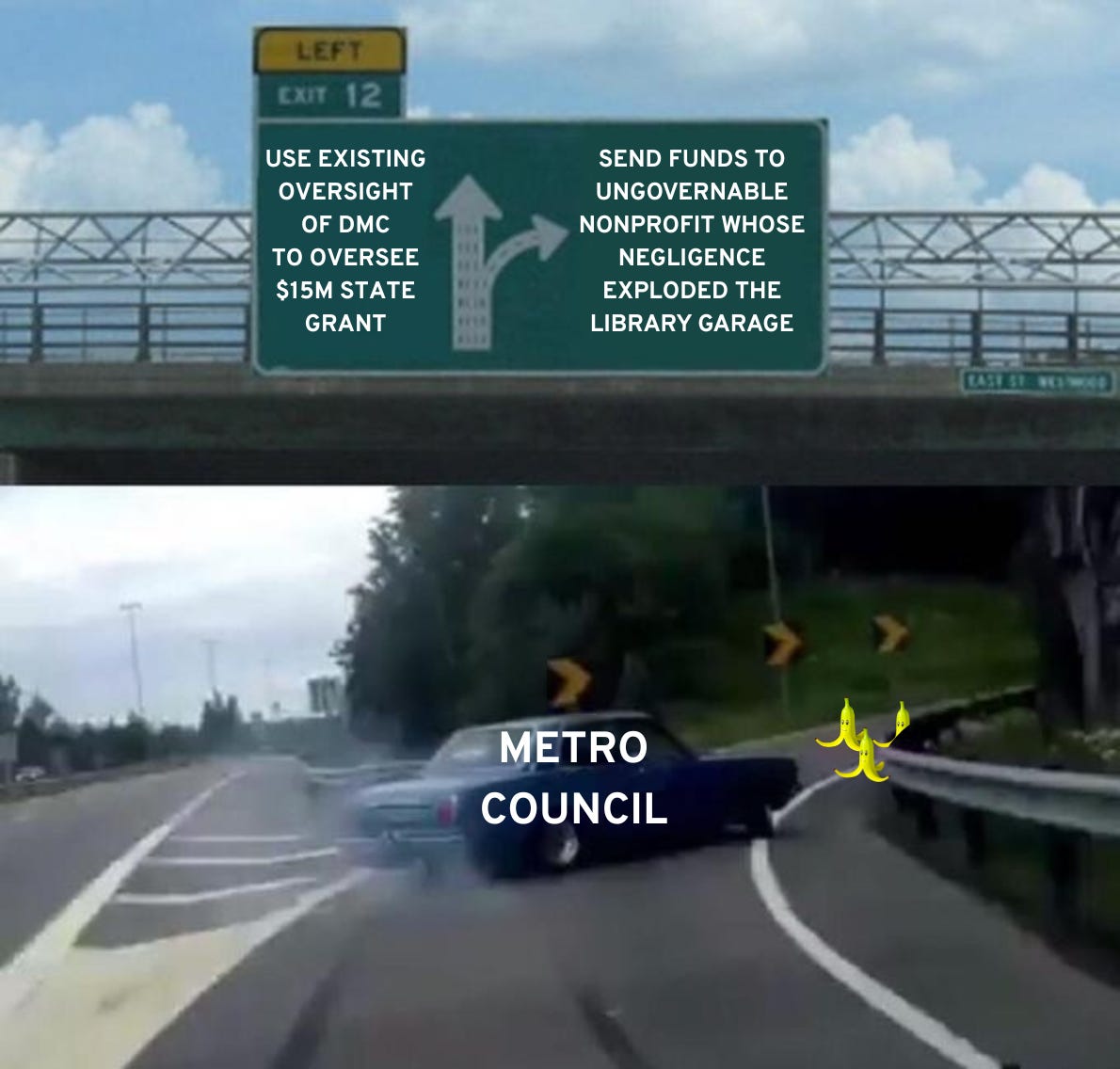
If you are a Metro Council member and you don’t want to get something that very much feels like Fusus all over your hands (which as we’ve all seen is a very sticky political substance) READ CAREFULLY. And, taking a cue from the meme above, choose how you move your political career carefully.
Here are the issues with attempts to “fix” this resolution:
This MOU is explicitly for surveillance technology and obviously requires a public hearing—none has yet been scheduled.
Council already has complete control over the actual grant recipient, the Nashville District Management Corporation. This resolution would reduce oversight.
This whitewashes the Mayor’s blatant end-run around Council.
Privatization eliminates accountability and oversight.
Tennessee law allows 3rd party warrantless data sharing—and bans local guardrails.
No “donation” is needed for informal law enforcement access.
Amendments to the resolution can’t change the MOU.
1. THIS REQUIRES A PUBLIC HEARING—NONE HAS BEEN SCHEDULED
Metro Code 13.08.080(C) requires Council approval “by a resolution adopted after a public hearing” before:
Entering agreements with private entities to use surveillance technology
Accepting state funds for surveillance technology
Acquiring new surveillance technology
What qualifies as “surveillance technology”?
Any electronic device, hardware, or software capable of collecting, recording, analyzing, or sharing information associated with specific individuals or groups.
This explicitly includes:
Video/audio monitoring technology and surveillance cameras
Software and hardware tools (like LeoSight and Fivecast)
Social media monitoring software
This MOU triggers all three requirements:
✓ Private entity (NDP)
✓ State funds ($15 million)
✓ New surveillance software (LeoSight, Fivecast, noise cameras)
No public hearing has been scheduled. This isn’t rocket science.
WHAT THEY’LL SAY:
“We’ll hold the public hearing when NDP actually purchases the technology and donates it to Metro.”
THE REBUTTAL:
This MOU already triggers three separate public hearing requirements:
(C)(2) Entering into an agreement with a private entity to use surveillance technology (the MOU itself); (C)(3) Accepting state funds for surveillance technology (the $15M grant); (C)(4) Acquiring new surveillance technology (LeoSight, Fivecast, noise cameras listed in Exhibit A)
The statute requires the hearing “prior to” these actions—not after.
Additionally: There’s no guarantee NDP will formally “donate” anything. In New Orleans, surveillance purchased by private entities was shared informally with police through access agreements—no formal donation ever occurred. The cameras never appeared on city property rolls, avoiding accountability requirements.
Council cannot approve surveillance funding now on the promise of a hearing later.
WHAT THEY’LL SAY:
“The public hearing happened during the December 4 meeting when people spoke during public comment.”
THE REBUTTAL:
Public comment ≠ public hearing.
BL2017-646 requires a formal public hearing noticed as such, not general public comment. Council held a formal public hearing for FUSUS (software platform, similar to LeoSight) in November 2024 before the December 3 vote. That’s the precedent.
Council’s own practice proves a public hearing is required.
WHAT THEY’LL SAY:
“The title of 13.08.080 says ‘onto public rights-of-way’—this doesn’t apply because it’s not physical cameras on poles.”
THE REBUTTAL:
Contradicted by Council’s own precedent.
FUSUS was a software platform integrating existing cameras—not physical deployment. Council still required a public hearing under 13.08.080(C). If it applied to FUSUS software, it applies to LeoSight/Fivecast software.
Council cannot selectively enforce its own surveillance ordinance.
WHAT THEY’LL SAY:
“We can hold the public hearing later, after approval.”
THE REBUTTAL:
Legally impossible.
BL2017-646: “approval...by a resolution adopted after a public hearing, shall be required prior to...”
The statute requires hearing → then vote. Not vote → then hearing. This isn’t discretionary timing—it’s mandatory sequencing.
2. COUNCIL ALREADY HAS COMPLETE CONTROL OVER THE ACTUAL GRANT RECIPIENT
The grant was awarded to Nashville District Management Corporation (NDMC), not NDP. These are two separate entities. They have different EIN numbers and their budgets work very differently in a way that is extremely important here.
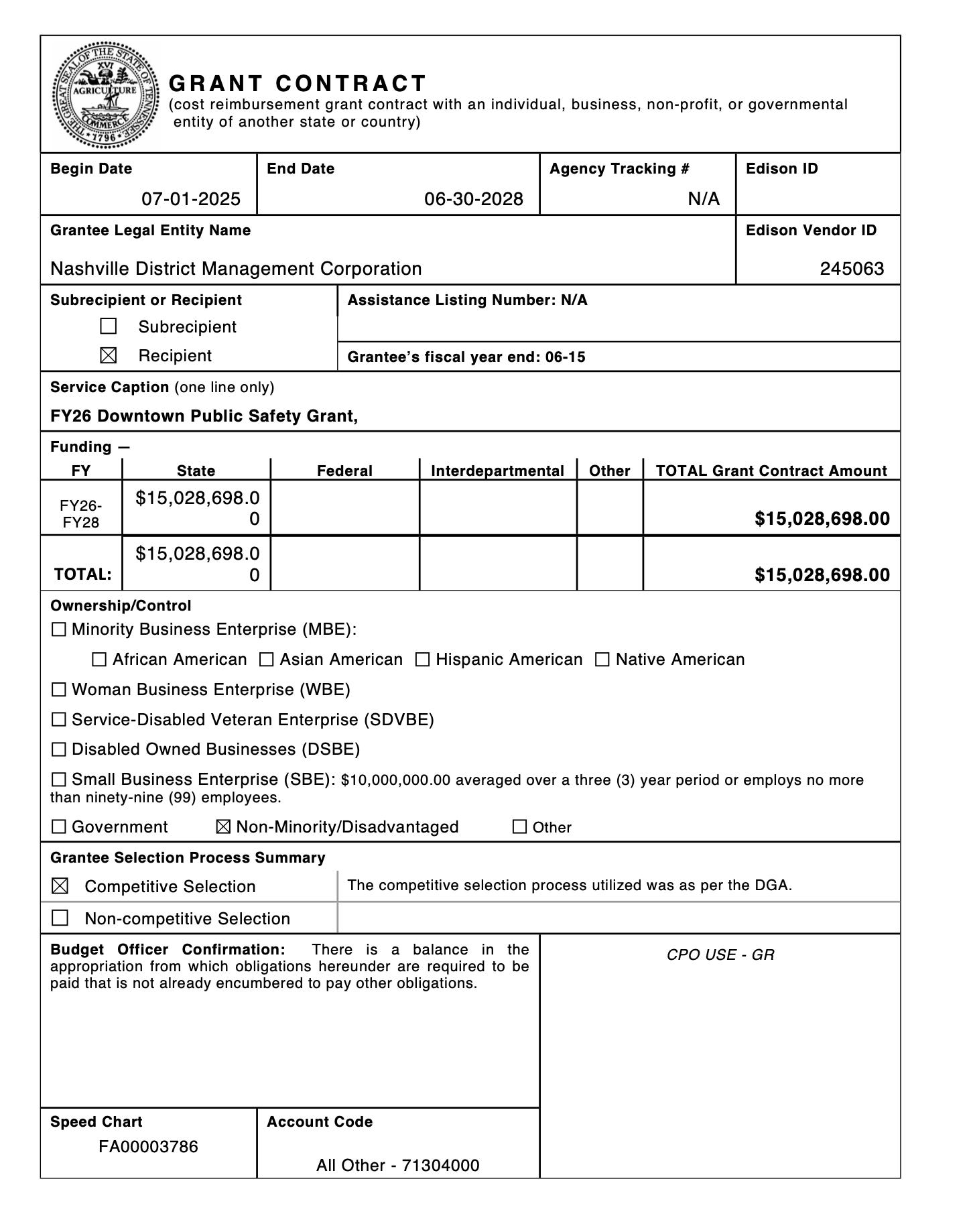
Metro Ordinance BL2017-580 explicitly requires: “The annual budget [of NDMC] shall be reviewed and approved by the Metropolitan Council”
Council already has line-item budget control over NDMC:
✓ Can reject specific surveillance purchases
✓ Can require policy changes before approving expenditures
✓ Can withhold funds until compliance
✓ Can vote down entire budget and demand revisions
No MOU is necessary to restrict how NDMC spends this grant—Council already possesses that statutory authority.
The only reason to route funds through NDP instead of the actual grant recipient is to eliminate Council’s existing oversight.
WHAT THEY’LL SAY:
“We need the MOU to add restrictions because we don’t currently have oversight.”
THE REBUTTAL:
Backwards logic.
Council currently has 100% budget control over NDMC (the grant recipient) via BL2017-580.
This MOU eliminates that control by routing funds through NDP (private 501(c)(6)) instead of NDMC (quasi-governmental entity).
You’re trading statutory oversight for a voluntary agreement that can be amended without Council approval. The goal is not oversight, its streamlining surveillance outside of public approval processes.
WHAT THEY’LL SAY:
“The state grant requires collaboration with the BID, so we have to use NDP.”
THE REBUTTAL:
Missing the point. The problem isn’t if NDP gets the money. No one doubts that is who the DMC will give it to (they have the same President/CEO). The question is whether the money goes straight to NDP or through the DMC first.
“Collaboration” ≠ “routing 100% of funds through the private entity.”
NDMC is the BID entity. Funds should flow to NDMC (where Council has budget authority), with NDP providing services as a vendor under NDMC supervision.
Every other Tennessee city receiving these grants maintained governmental control. Only Nashville is privatizing it.
Ask the sponsors: “If your goal is to limit how these funds are used, why bypass the entity where you already have 100% budget approval authority?”
3. THIS WHITEWASHES THE MAYOR’S BLATANT END-RUN AROUND COUNCIL
Timeline proves bad faith:
December 3, 2024: Council rejects FUSUS after year of community opposition
March 2025: Mark Wood (FUSUS Chief Revenue Officer) founds LeoSight (rebranding Live Earth)
April 2025: O’Connell abandons FUSUS, citing federal “erosions in rule of law”
November 21, 2025: Mayor files MOU the Friday before Thanksgiving—minimal time for public awareness before originally scheduled December 4 vote
What’s in Exhibit A? LeoSight—led by former FUSUS chief revenue officer who was there when first MNPD contract signed.
Pattern of evasion runs deeper:
For 21 consecutive years, NDMC/NDP never submitted budgets to Council despite ordinance O98-1037 requiring Council approval.
Only discovered when Council questioned July 2025 BID expansion.
This MOU continues the same pattern: structure funding to avoid required oversight.
WHAT THEY’LL SAY:
“LeoSight is completely different from FUSUS—different company, different technology.”
THE REBUTTAL:
Functionally identical on the law enforcement side, with the exception of donor cameras (though nothing would limit LeoSight from integrating these).
FUSUS capabilities: CAD integration, AVL integration, LPR integration, VMS integration, real-time feeds
LeoSight capabilities: CAD integration, AVL integration, LPR integration, VMS integration, real-time feeds
Same surveillance integration capabilities Council rejected. Same executive who sold FUSUS to Nashville. Just a different brand name.
The Mayor’s Office fact sheet claims “this MOU does not approve...a contract for such a use” of FUSUS. Technically true. It approves a contract for LeoSight instead—which does the exact same thing.
WHAT THEY’LL SAY:
“We filed early to give Council plenty of time to review.”
THE REBUTTAL:
Demonstrably false.
Filed: Friday, November 21 (day before Thanksgiving)
Originally scheduled vote: December 4
Business days to review before first vote: 7 working days (including Thanksgiving week)
This was designed to minimize scrutiny, not maximize it.
4. PRIVATIZATION ELIMINATES ACCOUNTABILITY AND OVERSIGHT
The MOU routes 100% of grant funds to NDP—a private 501(c)(6) contractor—instead of NDMC, the quasi-governmental grant recipient.
If NDMC spends funds:
✓ Council budget approval: REQUIRED
✓ Public records requests: Likely subject
✓ Surveillance ordinance (BL2017-646): APPLIES
✓ Procurement rules: Metro rules apply
✓ Fourth Amendment constraints: Strong state actor argument
If NDP spends funds:
✗ Council budget approval: NOT REQUIRED
✗ Public records requests: Can claim private exemption
✗ Surveillance ordinance (BL2017-646): Can claim exemption
✗ Procurement rules: Private contracting
✗ Fourth Amendment constraints: Can claim private search doctrine
NDP’s current contractors include:
Solaren Risk Management—fined $64,000 for 32 upheld counts of police impersonation (62 charged, 30 dismissed)
Block by Block—whose equipment storage negligence caused downtown library parking garage explosion (June 2025)
These entities would operate Nashville’s surveillance infrastructure.
Bottom line: Metro Council has 100% oversight over NDMC funds. It has 0% oversight over NDP funds.
WHAT THEY’LL SAY:
“NDP is more efficient and better positioned to manage this quickly.”
THE REBUTTAL:
“Efficiency” = avoiding oversight.
NDP’s current contractors include Solaren (police impersonation violations) and Block by Block (library garage fire).
Is this the “efficiency” Council wants managing surveillance infrastructure?
WHAT THEY’LL SAY:
“The MOU has restrictions that NDP must follow.”
THE REBUTTAL:
Unenforceable without legal authority.
✗ NDP is private 501(c)(6)—not subject to Metro Code
✗ MOU is voluntary agreement—can be amended by executives without Council vote
✗ No penalties specified for violations
✗ Council has no audit authority over NDP expenditures
Contrast with NDMC: Council can reject the entire annual budget if conditions aren’t met.
Real restrictions require legal authority. This MOU provides none.
5. TENNESSEE LAW ALLOWS WARRANTLESS DATA SHARING—AND BANS LOCAL GUARDRAILS
Tennessee Information Protection Act (TIPA) § 47-18-3208(a)(3), effective July 1, 2025:
Allows data controllers/processors to “cooperate with law enforcement agencies concerning conduct or activity that the controller or processor reasonably and in good faith believes may violate federal, state, or local laws”
No warrant, no subpoena, no oversight required.
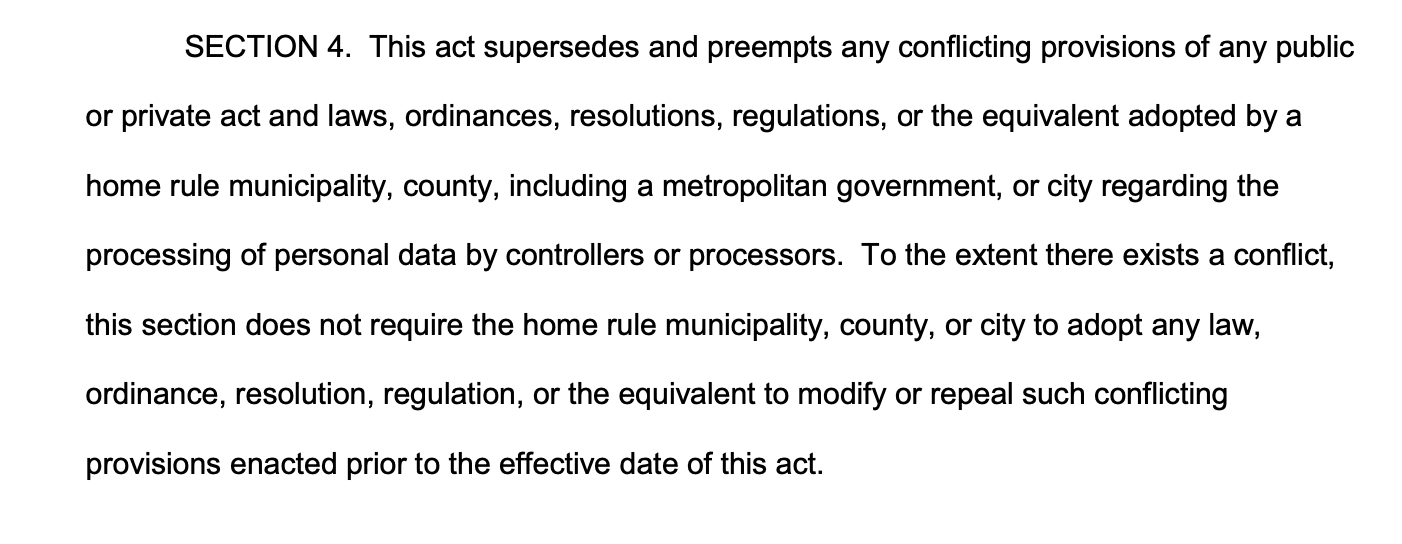
TIPA includes preemption clause: Local municipalities are explicitly banned from creating guardrails to prevent this data sharing.
TIPA Section 4:
“This act supersedes and preempts any conflicting provisions of any public or private act and laws, ordinances, resolutions, regulations, or the equivalent adopted by a home rule municipality, county, including a metropolitan government, or city regarding the processing of personal data by controllers or processors.”
This means: Third-party surveillance tools like Fivecast and LeoSight can share data with law enforcement of their own volition, and Tennessee law prevents Council from stopping it.
Even if Council adds restrictions to the resolution, state law allows vendors to ignore them when sharing with law enforcement.
WHAT THEY’LL SAY:
“We’ll add language to the resolution prohibiting data sharing without Council approval.”
THE REBUTTAL:
State law preempts local restrictions.
Even if Council adds restrictions to RS2025-1659, vendors (LeoSight, Fivecast) can invoke TIPA § 47-18-3208(a)(3) to share data with law enforcement anyway.
State law explicitly prohibits local governments from restricting this data sharing.
Council cannot override state statute with a resolution.
WHAT THEY’LL SAY:
“We’ll require contractual restrictions in the vendor agreements.”
THE REBUTTAL:
NDP writes those contracts, not Council.
Under this MOU:
Funds go to NDP (private entity)
NDP selects vendors
NDP negotiates contracts
Council has no approval authority over vendor agreements
You’re trusting NDP to voluntarily impose restrictions that harm their vendors’ business models.
6. NO “DONATION” IS NEEDED FOR INFORMAL LAW ENFORCEMENT ACCESS
LeoSight and Fivecast are surveillance integration platforms—not physical equipment:
LeoSight (Exhibit A): “Public Safety software allowing all partners to have situational awareness and communicate via mapping and talk channels”
✓ Integrates CAD, AVL, LPR, VMS, DFR (drone) capabilities
✓ Platform designed for integration with federal law enforcement agencies like ICE and CBP
✓ Founded March 2025 by Mark Wood, former FUSUS Chief Revenue Officer who signed the original FUSUS contract with Chief Drake
Fivecast ONYX: Platform to “de-anonymize individuals,” monitor “Surface, Deep and Dark Web,” detect “problematic emotions”
✓ Federal contracts: ICE ($4.2M), CBP ($3.4M), DCSA ($9.1M)
✓ Claims database of 8 billion people
The danger: Once data flows into these shared platforms, any law enforcement agency with platform access can use it—no formal donation, no agreement, no Council vote required.
NDP doesn’t need to “donate” anything for MNPD or ICE to access surveillance feeds—the platforms ARE the access mechanism.
WHAT THEY’LL SAY:
“The MOU requires NDP to donate equipment to Metro, so we control access.”
THE REBUTTAL:
Platforms don’t need “donation” for access.
Traditional model: Physical camera → donated to MNPD → MNPD controls access ✓
Platform model:
✗ Data flows into cloud platform
✗ Multiple agencies have platform accounts
✗ Access control is vendor discretion, not asset ownership
Once surveillance data enters LeoSight/Fivecast platforms, any credentialed user can access it. “Donation” of platform access rights is meaningless.
WHAT THEY’LL SAY:
“MNPD will have strict policies about who can access the data.”
THE REBUTTAL:
MNPD doesn’t control vendor platforms.
MNPD can control:
✓ Who in MNPD accesses the system
✓ MNPD’s own policies
MNPD cannot control:
✗ Whether LeoSight/Fivecast share data with other agencies under TIPA
✗ What federal agencies already have platform accounts
✗ Vendor compliance with data sharing restrictions (no enforcement mechanism)
Platform vendors, not MNPD, control the infrastructure.
7. AMENDMENTS TO THE RESOLUTION CAN’T CHANGE THE MOU
The MOU is a binding legal agreement already signed by Mayor O’Connell and Tom Turner (NDP CEO).
The MOU text cannot be changed without both parties signing a new version.
By reports, there has been no movement on securing new signatures.
Any amendment to the resolution that doesn’t also amend the MOU itself is legally meaningless—it only changes Metro’s authorization language while leaving the operative agreement unchanged.
This inverts proper democratic process: Executives should negotiate agreements under Council direction, not sign them first and ask permission later.
WHAT THEY’LL SAY:
“We’ve added strong amendments to the resolution that address these concerns.”
THE REBUTTAL:
The resolution isn’t the operative document.
The MOU is the binding legal agreement between Metro and NDP.
The resolution is Metro Council’s authorization to enter that agreement.
Amending the authorization doesn’t change the agreement.
Example:
Resolution amendment: “NDP shall not purchase LeoSight”
MOU Exhibit A: “LeoSight - $X amount”
Which governs? The signed MOU between the parties.
WHAT THEY’LL SAY:
“The Mayor will sign an amended MOU if we pass amendments.”
THE REBUTTAL:
No evidence of new signatures.
Ask sponsors: “Do you have a signed amended MOU reflecting your changes?”
If not, you’re voting on hope, not binding agreement.
Proper process:
Council negotiates terms
Executives draft MOU reflecting those terms
Both parties sign
Council votes on the actual signed agreement
This process inverted all of that.
IF YOU WANT TO “FIX IT”
The simplest fix: Vote NO on the MOU and let the grant flow directly to NDMC.
The grant was awarded to Nashville District Management Corporation (NDMC). Council already has 100% budget control over NDMC under BL2017-580.
No MOU is necessary. You already possess the statutory authority to:
✓ Review NDMC’s annual budget line by line
✓ Reject specific surveillance purchases
✓ Require policy changes before approval
✓ Withhold funds until compliance
✓ Vote down the entire budget if needed
Just let NDMC receive the grant. Then exercise your existing budget authority when they submit their annual budget for approval.
This eliminates every problem with the current MOU:
✓ No routing funds through private NDP (accountability maintained)
✓ No need for public hearing on MOU (NDMC budget process is already established)
✓ No unenforceable voluntary agreement (BL2017-580 gives Council statutory control)
✓ No risk of LeoSight/Fivecast without approval (Council reviews every line item)
✓ No executive end-run (Council exercises direct oversight)
IF SPONSORS CLAIM “WE FIXED IT”
Ask these five questions:
“Has a public hearing been formally scheduled and noticed under BL2017-646?”
“Why are we routing funds through NDP instead of using our existing budget authority over NDMC?”
“Do you have a newly signed MOU reflecting your amendments, or are we voting on the document signed by the Mayor in November?”
“How do your restrictions survive TIPA’s preemption of local data protection laws?”
“Can you show me where in Tennessee law NDMC is prohibited from receiving these funds directly?”
If they cannot answer all five, the “fixes” are illusory.
THE BOTTOM LINE
Seven independent grounds for rejection. Pick any one.
✗ No public hearing (BL2017-646 violation)
✗ Bypasses existing Council budget authority (BL2017-580)
✗ Resurrects rejected FUSUS under new brand
✗ Eliminates governmental accountability
✗ Cannot restrict data sharing (TIPA preemption)
✗ Platform access model defeats “donation” concept
✗ Amendments don’t change signed MOU
Each issue independently requires immediate deferral or rejection.
If there is no public hearing, the only acceptable vote is NO.
The vote is Tuesday, December 16, 2025.
Contact your Council Member: nashville.gov/council/districts
WHAT TO SAY WHEN YOU EMAIL YOUR COUNCIL MEMBER
“I’m writing to you about RS2025-1659, the surveillance MOU. This requires a public hearing under BL2017-646—the same ordinance that required a hearing for FUSUS. Council cannot selectively enforce its own surveillance law. Vote NO or defer until a proper public hearing is held.”
If they say “we fixed it with amendments”:
“Has the Mayor signed an amended MOU? If not, you’re voting on the document signed in November, and amendments to the resolution are legally meaningless.”
FINAL NOTE TO COUNCIL MEMBERS
You know these arguments. The administration knows you know them.
They’re counting on you to accept “good enough” fixes rather than demand actual compliance with Metro Code.
✗ A resolution amendment isn’t a public hearing
✗ Voluntary MOU language isn’t statutory budget authority
✗ Different branding isn’t different surveillance technology
✗ Private entity “efficiency” isn’t governmental accountability
The question is simple:
Will you enforce BL2017-646 and BL2017-580—the ordinances you passed—or will you waive them because it’s politically convenient?
If these ordinances don’t apply when the Mayor wants to avoid them, they don’t apply at all.
Vote accordingly.