

Learn everything here at this website.
Metro Council is set to vote on this MOU Dec 16, 2025 at 6:30 pm.
WE NOW HAVE MORE CLARITY ON MNPD’S RELATIONSHIP
with the surveillance vendor that would receive funding even under Council members’ proposed amendments to the Mayor’s MOU.
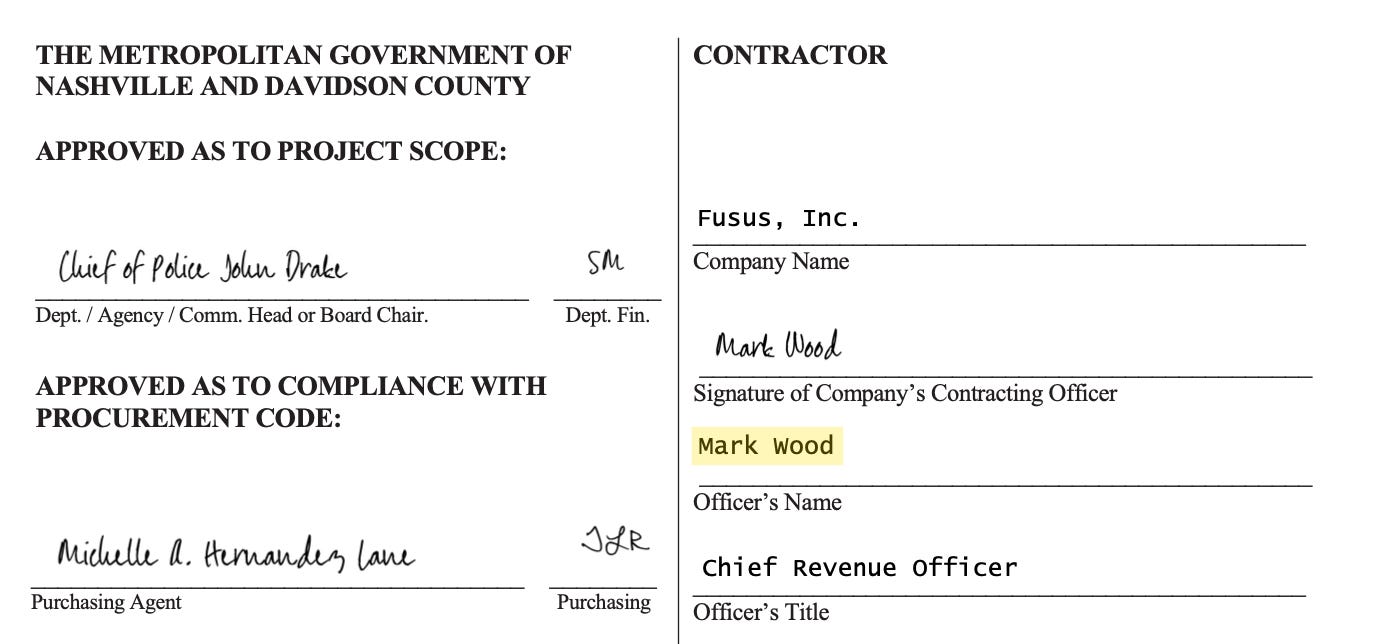
Chief Drake previously signed Fusus contracts directly with Mark Wood—Fusus’s Chief Revenue Officer until February 2024. Wood became CEO of LeoSight in March 2025. Despite being a company that is only 7 months old and doesn’t have much of a marketshare to speak of, LeoSight appears in Exhibit A of the $15 million MOU as technology NDP would purchase and “donate” to MNPD.
LeoSight’s (formerly LiveEarth) annual revenue is less than $4M and has fewer than 30 employees, yet somehow they beat our every other firm to end up winning an ear mark in Mayor O’Connell’s MOU to supply highly sensitive surveillance integration software.
Mark Wood’s connection to this MOU has been dismissed as inconsequential. Public documents show otherwise.
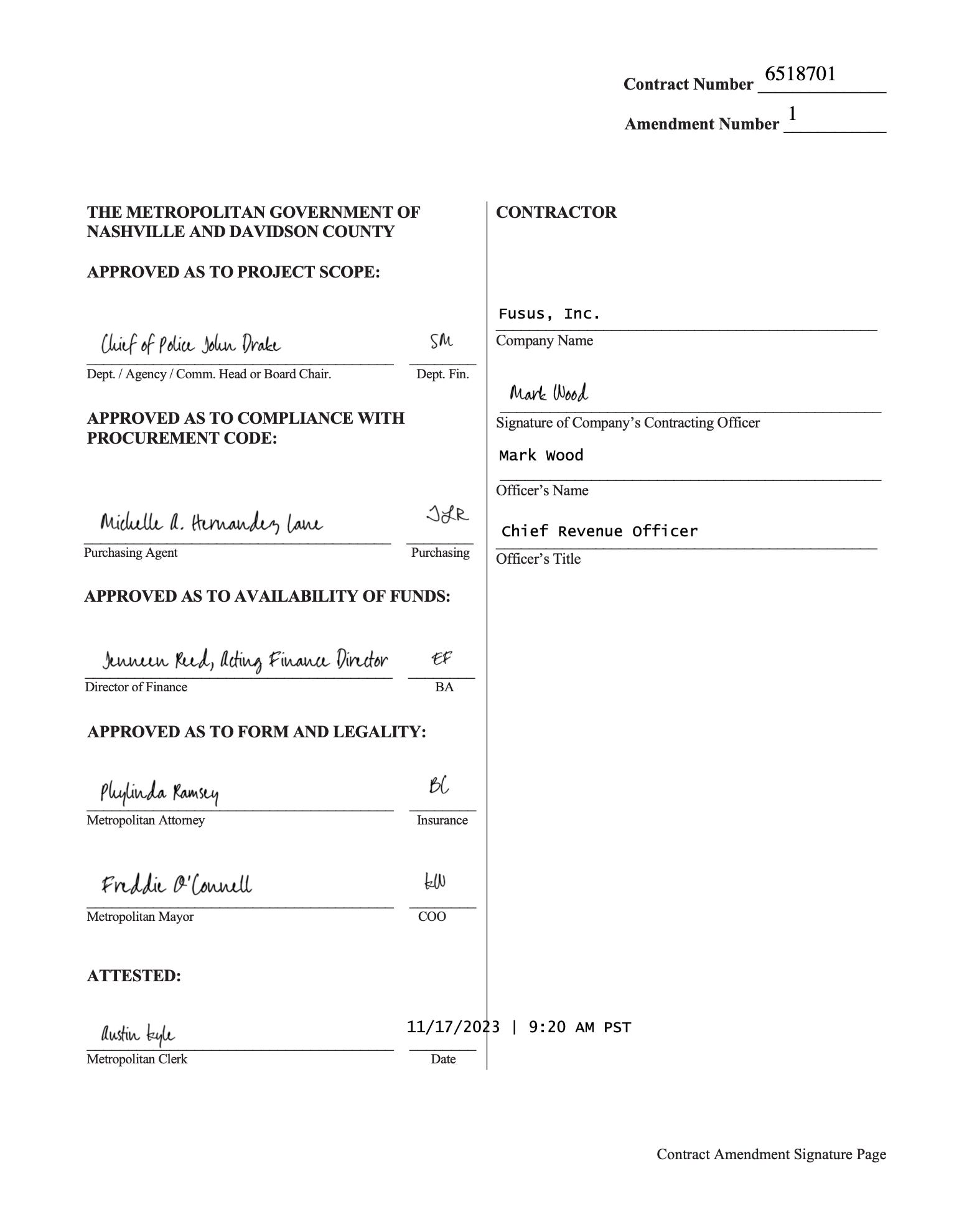
Wood’s signature appears on the original Fusus contracts directly next to Chief Drake’s—contracts that violated procurement limits and surveillance public hearing requirements. Seven months after founding LeoSight in March 2025, Wood’s firm appears in Exhibit A of the $15 million MOU. According to Deputy Chief Gilder’s testimony, MNPD drafted that equipment list.
Timeline:
December 2024: Council rejects Fusus
March 2025: Mark Wood founds LeoSight (left Fusus as Chief Revenue Officer in February 2024)
November 2025: LeoSight appears in MOU equipment list
MNPD signed non-compliant contracts with Wood at Fusus, expanding it beyond procurement limits. Now the same agency has placed his new company on the MOU equipment list—steering state funds to his firm without competitive bidding, procurement documentation, or vendor justification.
The ‘donation’ mechanism allows LeoSight to receive state funding without the oversight Council established by rejecting Fusus. If the MOU passes Dec. 16, $15 million flows through NDP to purchase equipment MNPD selected—including Wood’s company.
This sets a dangerous precedent: vendors whose principals violated Metro’s procurement rules don’t warrant additional scrutiny in future awards. If Wood’s non-compliant Fusus contracts don’t trigger competitive bidding or documented evaluation, what does? Past violations don’t raise red flags—they’re ignored.
Why create a roadmap for bad actors? “Run afoul of procurement rules? Get MNPD to put your company on a ‘donation’ list.”
The Mayor’s Office insists this funding is coming regardless. So what’s the rush? The money goes to the Nashville District Management Corporation, whose budget requires 100% Council review and approval. If LeoSight is the best tool for Nashville, that will remain true after the public has time to examine what it is and who’s selling it.
Council amendments attempting to add oversight won’t change the actual MOU document—LeoSight remains in the spending plan regardless. There are serious questions about how this product wound up on that list and what it has to do with who was selling Fusus in his previous job.
Council votes Tuesday, December 16.
For clarity — LeoSight is a rebrand of a company that was called LiveEarth that existed for a decade. It is enough of a reboot that Wood has titled himself “co-founder” of the organization.



More About LeoSight and the MOU
In the previous Public Health and Safety Committee of the Nashville Metro Council, Deputy Chief Gilder was asked to explain how an MOU between Metro Nashville and the Nashville Downtown Partnership ended up with highly sensitive surveillance software added to its shopping list. This is the Deputy Chief who was previously presented with a trophy for helping destroy Nashville’s Community Oversight Board.


View on Youtube
In his comments to the Metro Council, Gilder explained LeoSight ended up in the MOU because MNPD was essentially asked what they wanted to buy with their portion of $15M, and these tools were what they asked for. It portrays the conversation about how these $15M would be spent on public safety with the casualness of an unexpected gift card, and naturally enough, it seems, the choice would be to buy surveillance technology from a familiar source. Gilder described LeoSight’s software as essentially just connecting two emergency services facilities, nothing much to see here. He did not make it sound very sexy or controversial. LeoSight is not so reserved in how it describes its technology.
“Yeah, sure. So, the, the LeoSight software is like a unified, unified, command platform. It connects us with the NFD, an OEM. They run a command out of their operation center. We have our community safety center, which I believe you been to, down at our police headquarters. And that basically allows for a virtual connection of those facilities.”
LeoSight’s marketing doesn’t hide what it is. The platform integrates:
CAD (Computer-Aided Dispatch)
AVL (Automatic Vehicle Location)
LPR (License Plate Recognition)
VMS (Video Management System)
DFR (Drone as First Responder)

All surveillance feeds unified into a single real-time map. All accessible to command centers and field units simultaneously. All recorded onto the hard drives of a private corporation. Could be used for good. Could be problematic. Definitely worth talking about publicly as required by Metro code.
What surveillance nihilists say, the “just throw you phone in the river” types, the “are you saying we should get rid of all the security cameras?” types don’t get are pretending they don’t get is that no one is saying public safety technology is inherently bad. What we are saying is that we should follow the actual policies we have established as a community to evaluate whether these are tools we want add to our tech stack.
Via LeoSight’s product marketing website.
The concerns people have are that tools like this enable the exact “persistence tracking” that civil liberties advocates warned about, the problems that made Fusus politically radioactive.
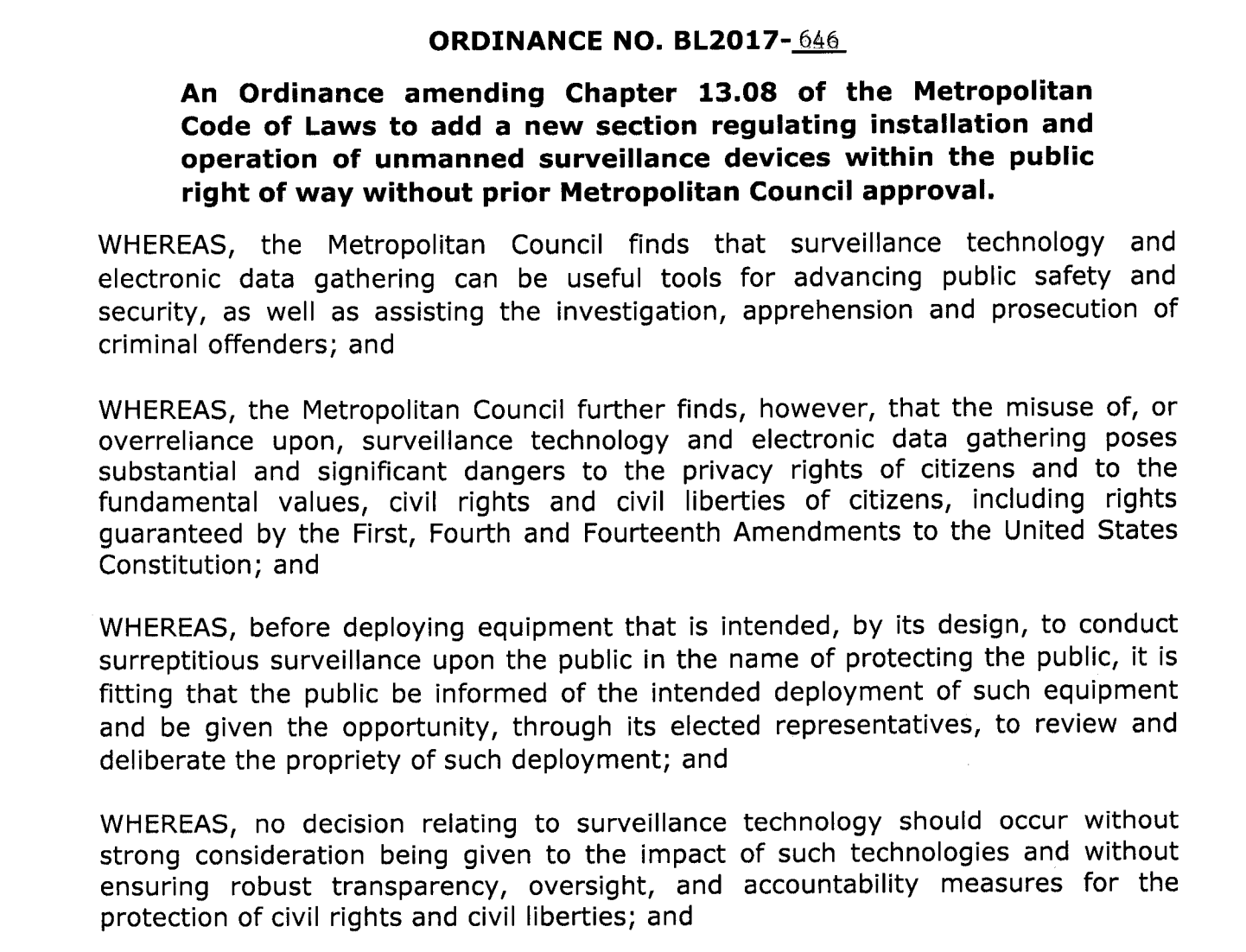
This was once understood by members of Metro Council. So much so that former Council Member Dave Rosenberg entered it into Metro Code. In his 2017 ordinance on surveillance he wrote:
WHEREAS, the Metropolitan Council finds that surveillance technology and electronic data gathering can be useful tools for advancing public safety and security, as well as assisting the investigation, apprehension and prosecution of criminal offenders…
WHEREAS, before deploying equipment that is intended, by its design, to conduct surreptitious surveillance upon the public in the name of protecting the public, it is fitting that the public be informed of the intended deployment of such equipment and be given the opportunity, through its elected representatives, to review and deliberate the propriety of such deployment; and
WHEREAS, no decision relating to surveillance technology should occur without strong consideration being given to the impact of such technologies and without ensuring robust transparency, oversight, and accountability measures for the protection of civil rights and civil liberties

Fusus pitched officer location, alerts, dispatch data, ALPR overlays and video feeds on a single live map.
LeoSight pitches a live, map-based view of units, activity, and alerts. Sounds pretty similar. Similar enough that a high ranking executive might have to wait, oh about a year, to move from one job to another in the same industry to not run afoul of a non-compete clause.

As I’ve previously published, these tools are unambiguously surveillance technology and require a public hearing to be purchased or use in any kind. As per a surveillance ordinance drafted by Mayor O’Connell’s current Legislative Director Dave Rosenberg when he was on Council:
“Surveillance technology” shall mean any electronic surveillance device, hardware, or software that is capable of collecting, capturing, recording, retaining, processing, intercepting, analyzing, monitoring, or sharing audio, visual, digital, location, thermal, biometric, or similar information or communications specifically associated with, or capable of being associated with, any specific individual or group; or any system, device, or vehicle that is equipped with an electronic surveillance device, hardware, or software.

The Fusus Connection
The presence of LeoSight in the MOU is concerning because it’s essentially a rebrand of “Live Earth,” delivering real-time surveillance integration technology remarkably similar to Fusus — the law enforcement software Metro Council fought over for months before ultimately rejecting.
Is there a reason LeoSight seemed so familiar? The company was created by Mark Wood, formerly Fusus’s Chief Revenue Officer. He came to its helm just at the one year mark of his exodus from FUSUS.

This might have been dismissed as coincidence, or Wood’s connection to Fusus characterized as minimal with no formal relationship to MNPD, except for this document: the original contract MNPD entered into with Fusus. His name and title appear side by side with Chief Drakes’s on the same contract that was later expanded beyond procurement restrictions and sidestepped public hearing requirements — the same pattern we’re now witnessing with this MOU.

But this isn’t about one contract or one vendor — it’s about systematic democratic circumvention through carefully orchestrated workarounds.
Nashville’s 2017 surveillance ordinance requires Metro Council approval through public hearing before entering agreements with private entities to acquire surveillance technology. The ordinance explicitly covers things like the integration and analysis of video monitoring, automated license plate readers, and systems capable of collecting information associated with specific individuals. LeoSight integrates CAD, AVL, DFR, ALPR, and video surveillance feeds — meeting every definition under Nashville law. Yet by routing the purchase through NDP, a private nonprofit beyond direct democratic control, the administration sidesteps the very safeguards that killed Fusus.
This pattern isn’t unique to Nashville. In Atlanta, the Police Foundation contracts directly with surveillance companies. In New Orleans, Project NOLA deployed cameras and conducted facial recognition in violation of city policy. Routing surveillance through nonprofits has become a national strategy to grow police surveillance capabilities beyond democratic control.
The scandal runs deeper: Chief Drake personally signed contracts with the executive now selling rebranded surveillance technology back to Metro through a nonprofit funding mechanism designed to avoid the public hearing requirements that rejected Fusus. This isn’t coincidence — it’s vendor recycling through institutional capture.
When democracy says no, the answer cannot be corporate rebranding and nonprofit money laundering. Nashvillians rejected this surveillance infrastructure through their elected representatives. Metro Council deferred the MOU on December 5th, but the question remains unresolved: will they recognize LeoSight for what it is — the same surveillance tech they just voted down, now wearing a different hat and carrying a different bag?