


Be a Neighbor, not a NaiBOR
On Friday, Mayor O’Connell and Chief Drake appeared together to announce that crime in Nashville is down 20% this year. Violent crime down 18%. Motor vehicle theft down 40%. Burglary at its lowest level since the 1960s. Drake credited a new vehicle crimes unit — human investigators doing police work — as “the catalyst in driving crime.”
Then, at the same press conference, for some reason, they renewed their push for license plate readers.
Drake argued Nashville needs cameras because clearance rates in cities with LPRs are “up 30, 28%. In Nashville, it’s 5%.” Fox17 reported that O’Connell “will continue making the case for their use.” Drake did not seem to understand that a drastic reduction in crime, despite a far smaller increase in case closing, actually makes a very strong the economic case for funding things besides law enforcement and surveillance to reduce crime. LPRs just seem to be on his mind.
A month ago, MNPD recommended LPRs in a school safety report following the Antioch High School shooting. Even O’Connell “was surprised to see that highlighted in response to the council resolution.” In October 2024, Drake said LPRs would have helped solve a greenway murder. When the only tool you're selling is a camera, every problem looks like a lack of footage.
The evidence for LPRs as a crime prevention tool is remarkably thin. The National Institute of Justice — the DOJ's own research arm — found "little clear evidence for the crime prevention efficacy of using LPRs" and that they "did not reduce the likelihood of a new crime or disorder call." Academic reviews confirm that "ALPRs have not produced clear evidence of providing a deterrent effect in the form of reducing crime." Flock's own marketing claim — an 80% burglary reduction in San Marino, California — was later found to be false, with burglaries actually increasing after cameras were installed.
Flock’s studies are not peer-reviewed. Meanwhile, crime is falling nationally — the Council on Criminal Justice found homicides trending toward all-time lows across 40 major cities — and Nashville is down 20% this year without the much soft after LPR expansion, with Drake himself crediting a vehicle crimes unit made of human investigators as "the catalyst." LPRs help recover stolen cars. That's the one thing the evidence supports. Everything else — the deterrence, the prevention, the clearance rate claims — is marketing from a $7.5 billion company that needs your fear to hit its next revenue target.
So why, exactly, are Chief Drake and his senior deputies so fixated on surveillance technology? What if there’s actually an answer?
A forthcoming public records request for MNPD’s annual disclosure filings is attempting to answer if anyone wearing blue is working as unregistered lobbyist, like this cop was in Atlanta was for Axon, the company that pushed to get Fusus in Nashville for years.

When Fusus couldn't get through Council, the chief revenue officer who signed the original contract with Chief Drake left and became CEO of a new company called LeoSight — which does the same thing. Deputy Chief Gilder put LeoSight into a $15M MOU with the Nashville Downtown Partnership, filed the Friday before Thanksgiving.
Such a weird coincidence.
This is the same Deputy Chief Gilder who, according to a 61-page complaint by a former internal affairs lieutenant who says he was in the room, received a small engraved crystal trophy from the head of MNPD's internal affairs division for his alleged role in helping pass the state law that dissolved the Community Oversight Board — the board 134,371 Nashville voters created by referendum to investigate police misconduct. MNPD says the award was for "navigating" the new law, not crafting it. The whistleblower, who was in the room, says that's "simply not accurate."

While the Public Records Request has already been submitted and is pending, it is not even clear, however, whether MNPD officials are required to file conflict-of-interest documents, as I had to when I worked in the Nashville Mayor’s Office. It is very likely that the response will be “these documents do not exist.”
And if that’s the case, we’ll just have to take MNPD at the word that they’re simply asking for the same few products, from the same few people, again and again, because they’re just that good (despite a real lack of data saying they’re effective at all). FWIW I have asked Deputy Chief Gilder if he’s ever received compensation from these vendors. He has yet to respond.

Follow the Data. Follow the Money.
Mayor O’Connell is the same person, allegedly, who voted to ban LPRs in 2017, then voted against their expansion in 2023, and tweeted in 2021 that “strong communities are better for safety than a surveillance state.” When the Nashville Scene asked him, now Mayor, about the privacy implications of the surveillance infrastructure he was now backing, he told Nashvillians to throw their phone in the river if they were worried about privacy.
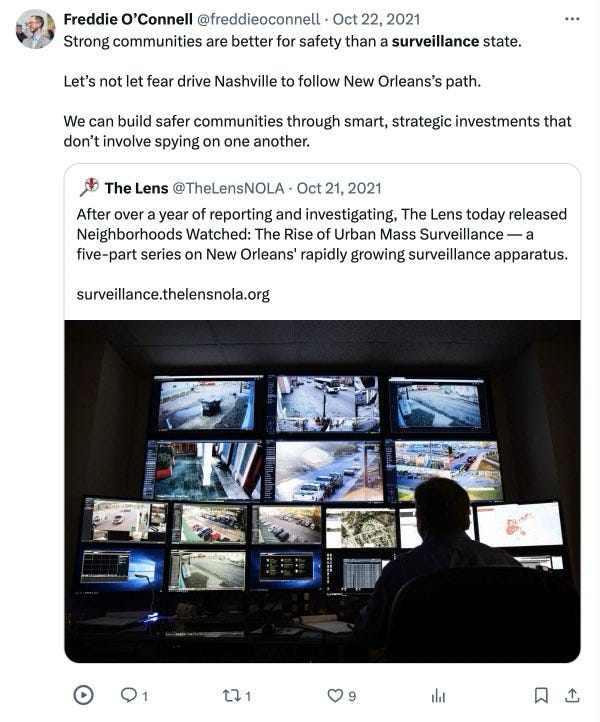
To the privacy nihilists, of whom O’Connell has joined the ranks in the past five years, I ask: if we’re already so surveilled, then why do you need so much more surveillance?
Is it because it would make a lot of money for the people Nashville’s leaders are trying hardest to impress — like our newest neighbor on the East Bank, Larry Ellison, who told financial analysts that AI surveillance will ensure “citizens will be on their best behavior because we are constantly recording and reporting everything that’s going on”?
Let us take this question seriously and think through how LPRs, something that doesn’t cost tax payers that much money at the end of the day, could help make millions and the dreams of total surveillance/total control of Larry Ellison (a man a Trump advisor recently referred to as a Shadow President of the United States and who last year was briefly the richest man in the world).
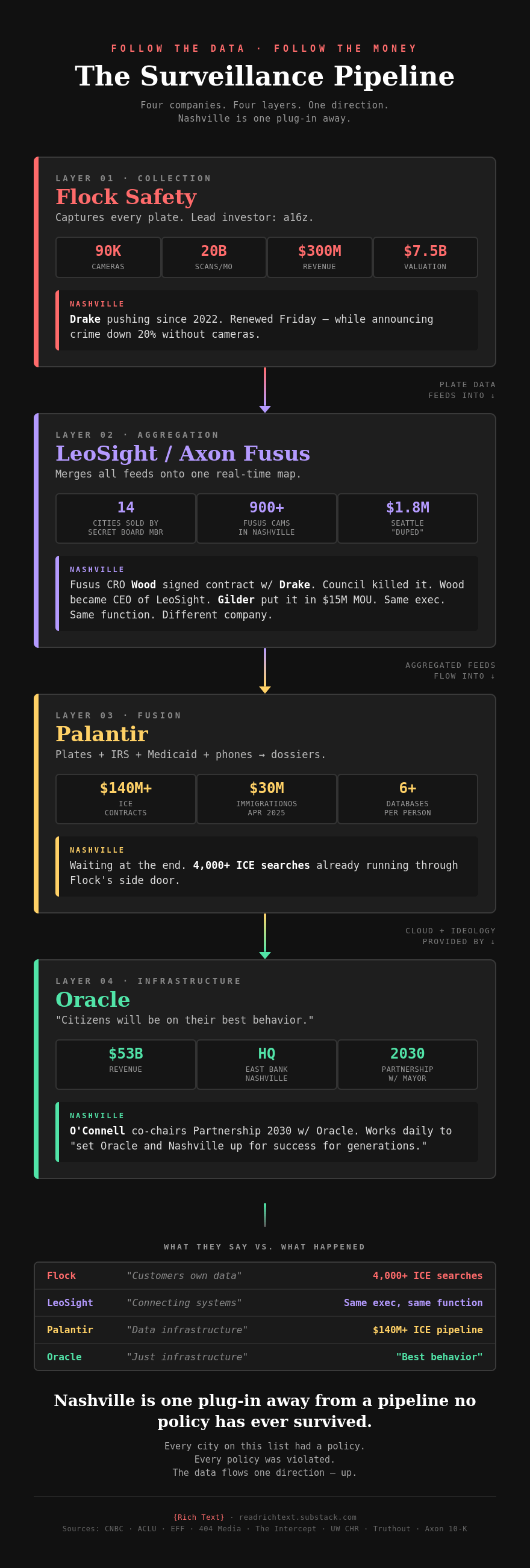
Flock captures your plate. Nearly 90,000 cameras, 20 billion scans a month. $300 million in revenue last year, growing 70%. Valued at $7.5 billion. Lead investor: Andreessen Horowitz. Drake has been pushing their product since at least the 2023 pilot.
LeoSight or Fusus aggregates it. Mark Wood, Fusus’s former Chief Revenue Officer (whose name appears on the original Fusus contract next to Chief Drake’s) “co-founded” LeoSight in March 2025 — the exact moment Nashville killed Fusus. Deputy Chief Gilder appears to have put LeoSight into the $15M MOU, according to his Council testimony, filed on Friday before Thanksgiving. Extraordinarily similar product. Same guy. New name. Meanwhile in Atlanta, a senior police official was secretly on Fusus’s board while selling it to 14 cities — Seattle said everyone involved was “duped.”
Palantir fuses it with everything else. $287 million in ICE contracts connecting plate data with IRS records, immigration databases, Medicaid enrollment, and cell phone location — all viewable about a single person in one place. Their newest tool uses Medicaid data to populate a map with deportation targets and assign each one a “confidence score.”
Oracle is Palantir's cloud infrastructure partner. In April 2024, Palantir chose Oracle Cloud Infrastructure to host its Foundry and Gotham platforms — deployable across Oracle Government Cloud and air-gapped regions for defense and intelligence customers. Palantir's ImmigrationOS — the system that uses Medicaid data to map deportation targets — can run on Oracle's cloud. Oracle's co-founder, Larry Ellison, told financial analysts that AI surveillance will ensure "citizens will be on their best behavior because we are constantly recording and reporting everything that's going on." Oracle is building its new global headquarters on Nashville's East Bank. O'Connell told The Tennessean he works every day to "set Oracle and Nashville up for success for generations to come."
The pipeline is already running. 4,000+ searches on behalf of ICE through Flock’s side door. Border Patrol secretly given direct access to the national network. Palantir linking it all into dossiers at the other end. Nashville is one plug-in away.
Meanwhile, CM and mayoral Candidate Joy Styles has been encouraging private businesses to install their own cameras rather than wait for the city. CM Jordan Huffman told NewsChannel 5 he doesn’t “think LPRs are as intrusive as other methods we are seeing take place all across the country.”
Drake says “it’s a license plate reader. It doesn’t say who you are, who’s in it. It just reads your license plate.” CM Jeff Eslick said they would help “the everyday citizen, the taxpayer out there, live a safer life and feel better.”
Personally, I feel safer knowing where Jeff Eslick is at any hour of the day, and that’s why I built NaiBOR to track his whereabouts, and the whereabouts of all Nashville leaders pushing for surveillance, 24/7, using user-generated data that is completely legal under Tennessee and Nashville law.
It’s like Flock, but we get to track them.

We built what they’ve been asking for, but we’re pointing it at them.
NaiBOR uses the same technology Nashville’s leaders have been championing — license plate scanning, real-time tracking feeds, pattern-of-life analysis — and points it at the officials, lobbyists, and vendor executives pushing to point it at you. Every feature mirrors a real capability offered by Flock Safety, Axon/FUSUS, and the vendors Nashville has been courting for four years.
The “After Dark” feature — tracking where officials’ vehicles sit between 10 PM and 6 AM — is not something we invented. It is an inherent capability of every ALPR system ever deployed. It is exactly what Officer Morales used to track his ex-girlfriend in Menasha. It is exactly what the Johnson County Sheriff’s Office used to hunt a woman who had an abortion. NaiBOR just gave it a name and a weekly digest.
LPRs: What happens after you build it
We’re really excited for NaiBOR, and are confident it could never be misused. As proof, here’s what’s happened in cities that installed a high volume of license plate readers.
They used it to hunt a woman who had an abortion. A sheriff’s deputy in Johnson County, Texas searched 83,345 Flock cameras nationwide — including in states where abortion is legal — with the search reason: “had an abortion, search for female.” Flock’s CEO called the reporting “clickbait.” Court records obtained by the EFF showed deputies had opened a “death investigation” into the fetus and consulted the DA about charging her. The woman had come to the sheriff’s office to report that her partner held a gun to her head. Congress launched a formal investigation into Flock.

Over 4,000 immigration searches — in a system that prohibits them. Flock’s policy explicitly bans immigration enforcement use. 404 Media found over 4,000 searches where officers typed “ICE,” “immigration,” and “deportee” into the reason field. In Virginia, the VCIJ found nearly 3,000 more. In Atlanta, officers searched for “locate alien” then told reporters they had not assisted federal immigration enforcement. Today, 404 Media reported that Florida’s wildlife cops are running immigration searches through Flock — through cameras meant to protect endangered species. Flock’s CEO told reporters the company had “no federal contracts.” Weeks later, Flock admitted it had been secretly giving Customs and Border Protection direct access to its nationwide network without telling any of its 6,000+ customers.
An Atlanta cop secretly sat on Fusus’s board while selling it to 14 cities. A senior APD official owned equity in Fusus and served on its board of directors while pitching the product to cities as a law enforcement “peer.” Seattle signed a $1.8 million contract. When The Intercept informed Seattle’s auditor, she said everyone involved was “duped.” This is the same Fusus system Nashville’s $15M MOU included.
They left cameras streaming on the open internet. In December 2025, 404 Media discovered that Flock left at least 60 AI-powered cameras live-streaming with no password — filming children on playground swings, shoppers in parking lots, a woman walking her dog. A reporter watched himself on his phone as the camera recorded him. Researcher Benn Jordan called it “Netflix for stalkers.” Senator Wyden separately reported that Flock login credentials were for sale on Russian cybercrime forums. Flock’s CEO called the reporting a “coordinated attack” by people who want to “normalize lawlessness.”
Officers used it to stalk women. Three Wisconsin officers were charged or investigated in three months for using Flock to track romantic partners and ex-girlfriends. Every case was discovered by the victim — not by audits. The ACLU identified “a disturbing trend… in most cases women.” Senator Wyden investigated Flock’s safeguards and called them “meaningless.” The system logged every abuse. It stopped none of them.
Cities are canceling. Charlottesville disconnected entirely. Three Oregon cities ended contracts. Milwaukee banned facial recognition. They’re not canceling because the cameras don’t work. They’re canceling because they do.

Vanderbilt Law’s Christopher Slobogin who helped draft Nashville’s Surveillance Ordinace, warned: “It’s not entirely clear the city can prevent a state or federal subpoena from being executed.” But with the way the data flows, there’s no need for a subpoena. Not one of the 4,000+ ICE searches through Flock's network required one — a local cop just typed "immigration" into the reason field and pressed enter.
Every city the Flock has run afoul of had a policy. Every policy was violated.

Does this feel safe to you?
If the site makes you uncomfortable — if seeing an official’s name next to a timestamp and an address that isn’t their home makes your stomach turn — sit with that. That is exactly what it feels like to be on the other side of the lens. To discover that you are just another variable in someone else’s risk model.
NaiBOR is a satirical website. It’s a joke. It’s not a real app and it shouldn’t be. But we could totally make it. I legitimately could, and it would be dirt cheap compared to what the city is being charged. But I bet that seems like a bad idea to a lot of people who are trying to install these systems.
The fact that it seems like a bad idea if the community makes it, but would “be totally fine” if the government had it, should tell you something. Why do conservatives suddenly trust the government implicitly? Why are liberals so fine with corporations tracking their whereabouts?
Could it have something to do with the fact that Axon's SEC filings show $92 million in annual sales and marketing spending? Ghat Flock reported $690,000 in federal lobbying and "sophisticated LinkedIn advertising aimed precisely at police chiefs and city procurement officers"? That the two companies most relevant to Nashville's surveillance debate are spending an estimated $150–200 million a year on sales and marketing, aimed at the same people, Nashville residents get two minutes of public comment to reach?
What are the odds that no one working for MNPD isn’t being paid to tell us we need to buy this? I look forward to the release of MNPD disclosure forms to confirm whether or not this is happening.
Here’s the thing: the people on the other side of the real cameras didn’t get a satirical website to warn them. They got a wildlife cop in Florida running their plate for ICE. They got an officer searching 83,000 cameras because they had an abortion. They got a cop who couldn’t sleep tracking their car at 2 AM.
It is extraordinarily difficult to believe that officials have residents’ best interests at heart when they push for more invasive surveillance equipment while the crime rate is dropping — and while we know these corporations are actively paying police officers to sell their products.
I’m increasingly part of national conversations with surveillance researchers who are watching America’s law enforcement become weaponized salespeople for the surveillance industry. It is deeply embarrassing, dangerous, and shameful.
I’m not saying I have any evidence that this is how our fine officers in MNPD blue behave. But if NaiBOR were real, I’m sure we could find out who our law enforcement is really working for.
And not to do MNPD any PR favors, but a heads up: noting that crime rates are dropping while your case closure rate trails other cities is about as strong an argument for police abolition as anyone could make. If crime is dropping (without expanded surveillance) and MNPD isn’t solving many more cases, the most likely explanation is that the crime rate has little to do with policing — and that we should be spending a good chunk of the police budget on the things that actually reduce crime.
Since Nashville doesn’t have a massive LPR deployment, we already know it isn’t surveillance gear making us safer. The data is in. The public records requests for financial disclosure forms from MNPD are still pending.
{Rich Text} is Nashville’s Best Metro Watchdog (Nashville Scene Best of Nashville 2025). If this work matters to you, subscribe and share it with someone who needs to see it.
I'm grateful for your research, your diligence when it comes to holding feet to the fire accountability for our local powerbrokers.