
Correction About THP Trooper Throwing Man to Ground for Kicking His Car (After Almost Running Him Over)
NDP points to THP. THP claims it doesn't count as "use of force." Also it took place in September not October.

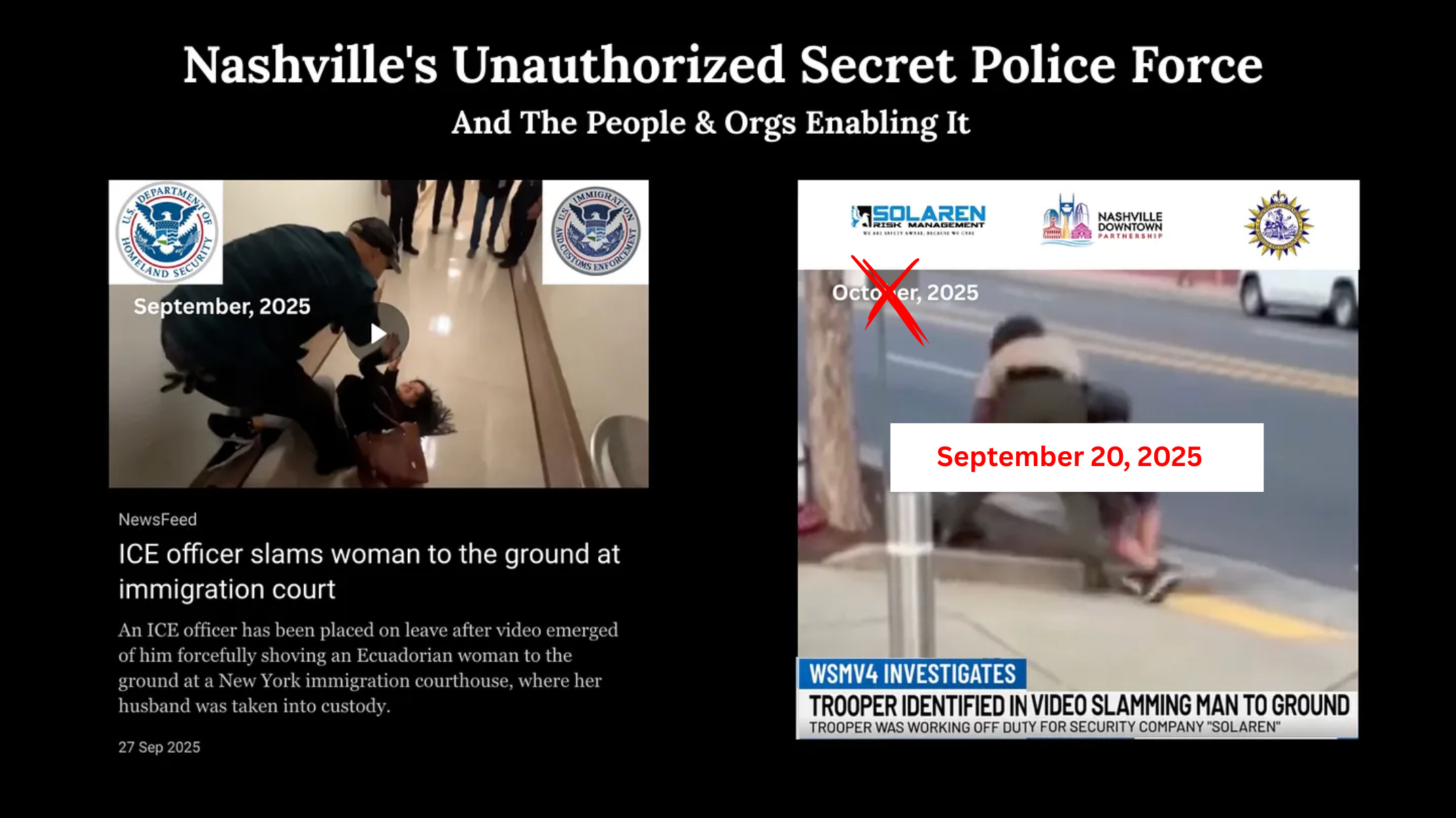
Recently, I published a post about how private police forces, like the kind Metro Council has effectively been subsidizing and endorsing by not reviewing the Nashville Downtown Partnership budget for 22 years, are unaccountable and dangerous.

As evidence, I cited this incident where an off-duty THP Trooper working for Solaren slammed a man to the ground. The man was not charged with any crime, and the officer stormed off after the incident. Really, it wasn’t an interaction between a suspect and perpetrator; it was a physical altercation between a man on the street and a uniformed highway patrol trooper working for a private security firm paid for with money pushed through the Nashville government without authorization.
Here’s the first correction: I had initially described the victim as “kicking cars.” That was incorrect.
Multiple witnesses interviewed by WSMV’s Jeremy Finley report that the man only kicked one car, and it was the vehicle driven by the THP Trooper that allegedly sped through a crosswalk that the man was trying to use.
A witness said: “He kicked it pretty hard… it was because the trooper in his truck was not yielding to him in this crosswalk.”
Also, I said the incident likely occurred in Q4 2025, since that was when WSMV obtained and published the video. A rep at WSMV was unable to confirm to me the precise date of the incident, saying NDP and Solaren were refusing to answer further questions about it.
Today I received confirmation that the incident occurred on September 20, 2025. This would seemingly explain why the Q4 2025 Human Rights Report provided by NDP did not include this incident, as I reported.
So 2nd correction: it was Q3 2025, not Q4 2025.
But, it appears that it will not be in the Q3 2025 report either.
The source who provided the correction on this date stated: “THP did not consider that incident a use of force.”
A few questions one might consider asking as a follow-up:
Uh, da fuq?
Why are THP’s internal determinations what count as a “use of force” for off-duty police working for Solaren?
Why is this not something that the District Management Corporation, which has a shell company called NDMC that holds a private policing license registered at Solaren’s Mt. Juliet address, would investigate internally?
Solaren’s CEO told WSMV that they were conducting an internal investigation into this incident. Was that conducted?
Solaren, until recently, had a Director of Administration who was in charge of these types of things (a person who happened to be the son of the NDP’s Director of Safety). Did he have any formal findings? Or was this not something that his immediately previous employment, “team lead” at a Regal Cinemas, prepared him for?
If THP’s determination is that this was not use of force because it wasn’t conducted in an interaction connected with a legitimate law enforcement activity, wouldn’t this just be easily categorizable as assault?
If THP can say they are not accountable for the actions of officers working off-duty for Solaren, if Solaren says that the officers have sole discretion and defer to THP, if NDP defers to Solaren and THP, are the officers basically operating with complete immunity from consequences of their actions while patrolling downtown with weapons and arrest powers?
What is Use of Force, Anyway? And why this clearly qualifies.
For those of us with mere bachelor's degrees who may find ourselves looking into things way above our pay grade, like “use of force” policies, here’s a crash course.
How Use of Force Is Determined
The governing constitutional standard — established in Graham v. Connor (1989) — holds that officers may use only the force that is objectively reasonable to effectively gain control of an incident, while protecting the safety of the officer and others.
Three factors, known as the “Graham factors,” govern whether force was reasonable: the severity of the crime at issue, whether the subject posed an immediate threat to the safety of the officer or others, and whether the subject was actively resisting arrest or attempting to evade arrest by flight.
Force may only be used when no reasonably effective, safe, and feasible alternative exists, and only at the level a reasonable officer on the scene would use under the same or similar circumstances.
Officers must be trained in de-escalation tactics designed to gain voluntary compliance before resorting to force, and those tactics must be employed when objectively feasible.
THP’s internal Use of Force policy is governed by General Order #500, which all troopers are required to read, understand, and follow.
What Happened With Sgt. Topps
The incident began when a pedestrian kicked a white pickup truck after it drove through a crosswalk without yielding — witnesses confirmed the posted sign required drivers to yield to pedestrians at that location.
Why This Is Use of Force By Any Standard
A body slam is a physical takedown — force analysis applies to all claims of excessive force, deadly or not, in the course of any seizure of a free citizen, and is not limited to weapons or injuries.
All three Graham factors cut against the force being reasonable: low-severity offense (kicking a vehicle), no evidence the subject threatened the officer, and no resistance or flight.
De-escalation is required when feasible and would not increase danger to the officer or others — Topps made physical contact within seconds of exiting his vehicle with no attempt at verbal de-escalation.
Tennessee’s reform framework requires comprehensive reporting any time force is used — classifying this as something other than use of force means no G.O. #500 report is filed, no supervisory review occurs, and the incident generates no data trail whatsoever.
Appreciate you uncovering abuses like this. TYFYS.