
MNPD Launches Unauthorized 'Trial' With War Drone Manufacturer Skydio, In Blatant Violation of Surveillance Ordinance Precedent
The city held a public hearing for 15 fixed cameras in January. It skipped one for drones with cameras (and capable of much more) in May.


MNPD launches a “Drone as First Responder” trial today, reportedly deploying three Skydio drones with cameras over five council districts in Nashville, focusing on Madison.
No Metro Council resolution was introduced authorizing the surveillance technology. No public hearing was held. Metro Code § 13.08.080 requires both.
It runs in blatant contradiction to the precedent that Mayor O’Connell and Metro Legal set only months ago.
Clarification: the title of this piece originally called this a “pilot”, though the MNPD press release calls it a “trial”. Neither of the undefined terms qualify as an exception to the surveillance ordinance.
This is unfolding during what O'Connell himself described a year ago as “erosions in the rule of law on a federal level,” erosions that have only exponentially increased since he made that statement.
Four months ago, the city held exactly that type of hearing for 15 fixed cameras worth $150,000 and rejected them 20-15 (WPLN, January 20, 2026). Suddenly, the rules seemed to have changed, even though the law hasn’t.
MNPD leadership has a long habit of blatantly violating the surveillance ordinance and shirking all civilian oversight.
Fusus, a program that integrates private business surveillance cameras with MNPD's real-time operations center, was implemented in 2022 under a $175,000 sole-source contract without the Council resolution or public hearing required by Metro Code § 13.08.080.
MNPD operated the system for roughly 18 months before it was paused in February 2024, after the unauthorized implementation became public. An expanded contract was brought to Council later that year and defeated. Subsequent efforts to pass it by the O’Connell Administration also failed.
Similar to MNPD’s license plate reader pilot that, as a report released last week noted (which Chief Drake cited in an effort to lobby for renewal of that AI-powered corporate mass surveillance technology), this too will be targeted at a part of the city that is disproportionately non-white and working class.
Efforts to call this a “trial” or a “loan” do not change what the law requires, requirements that come into effect when the city is leveraging technology that is:
capable of collecting, capturing, recording, retaining, processing, intercepting, analyzing, monitoring, or sharing audio, visual, digital, location, thermal, biometric, or similar information or communications specifically associated with, or capable of being associated with, any specific individual or group.
Metro Code § 13.08.080
emphasis ours
It is the latest in an unending onslaught of AI-powered corporate mass surveillance technologies being thrust on Nashville despite a historic decline in crime and violence.
It is the latest example of a Mayor condoning this activity, a man that made his political reputation on the idea that safer communities are not ones that spy on their citizens.
This is unfolding during what O'Connell himself described a year ago as “erosions in the rule of law on a federal level,” erosions that have only exponentially increased since he made that statement.
What is happening?
Secondhand reports are that the Mayor's Office is not considering this "surveillance" and is claiming it does not trigger the so-called "surveillance ordinance." This assessment is not possible to square with the Mayor's Office's and Metro Legal’s own admission that their efforts to place additional security cameras downtown via a $15 million MOU triggered the public hearing and civil rights review.
Among Metro watchers there is suspicion about what is happening here:
One theory is that the Mayor’s Office and Metro Legal have, since Trump took office the second time, become fully aligned with the President’s push for AI-powered corporate mass surveillance that, in the words of the East Bank’s most prominent new resident, Larry Ellison, will ensure that “citizens will be on their best behavior because we are constantly recording what they are doing.” This analysis would hold up to their constant push for this type of technology over the course of the O’Connell Administration.
The Alt Explanation:
It may be that the Mayor's Office is going along with the narrative that drones do not count as "surveillance" because they simply cannot control MNPD and are scared of the political ramifications of running afoul of them.
These drones are from the same manufacturer as those used in warzones by the U.S., Ukrainian, and Israeli militaries for espionage and the delivery of small, lethal explosives, and the assertion that they are not capable of “surveillance” strains all credulity.
Analysis: MNPD, like other law enforcement agencies around the country under the Trump administration, appears to have been emboldened by billion dollar corporations with hundreds of millions of dollars in sales and marketing budgets, firms whose business model is to blanket the United States with AI-powered corporate mass surveillance sold as ‘public safety.’
MNPD, the department, whose high ranking officials reportedly helped gut their community oversight board that passed in a landslide referendum, appear to be frustrated by having to follow laws, including those passed by Metro Council, and it is finding avenues to sidestep civilian oversight by any means necessary.

What the ordinance actually says
“Approval by the metropolitan council, by a resolution adopted after a public hearing, shall be required prior to any of the following actions by the Metropolitan Government of Nashville or Davidson County, the departments, boards or commissions thereof, or any individual or entity acting upon its behalf:
...acquiring new surveillance technology, including but not limited to procuring such technology without the exchange of monies or consideration.”
Metro Code § 13.08.080(C)
“The approval by the metropolitan council for any action set forth in subsection 13.08.080(C) above shall be granted only upon the determination that the benefits to the citizens and residents of Nashville and Davidson County outweigh the costs; that the proposal will safeguard civil liberties and civil rights; and that, in the judgment of the metropolitan council, no alternative with a lesser economic cost or impact upon civil rights or civil liberties would be as effective.”
Metro Code § 13.08.080(D)
The word “trial” does not appear in this ordinance. The word “pilot” does not appear in this ordinance. The word “prior” does. The hearing happens before the deployment, not after. A 30-day trial is a deployment.

The only exemption for temporary use reads:
“This section shall not apply to acquisition or use of surveillance technology by or on behalf of law enforcement that is used on a temporary basis for the purpose of a criminal investigation supported by reasonable suspicion, or pursuant to a lawfully issued search warrant, or under exigent circumstances as defined in case law.”
Metro Code § 13.08.080(E)
All emphasis ours.
This exemption requires a specific criminal investigation backed by reasonable suspicion. The DFR program is not a criminal investigation. It is a standing dispatch system. MNPD‘s own authorized call list includes non-criminal calls: 10-35 Mentally Ill Person, 10-45 Traffic Crash, 10-63 Suicidal Person. “Temporary” in the ordinance means a specific, bounded investigation with a legal basis. It does not mean “we plan to stop eventually.”
What MNPD did
Announced the DFR trial Friday afternoon, May 22, before Memorial Day weekend. Launched Tuesday, May 26 (MNPD press release, May 22, 2026).
Three
Skydiodrones on the roof of theMadison Precinct. Two-mile radius. Five council districts. Video retained 7 days (MNPD DFR Policy 8.50).Equipment loaned by
Skydio, the manufacturer, at no stated cost (MNPD press release).No Council resolution. No public hearing. No committee review. Five council members briefed (NewsChannel 5, May 22, 2026).
What the city already decided
January 20, 2026. Council held a § 13.08.080 public hearing for 15 fixed cameras ($150,000) from the
Nashville Downtown Partnership. Approximately 20 residents testified in opposition. Council rejected the cameras 20-15 (WPLN, January 20, 2026; Nashville Scene, January 21, 2026).December 2025.
Metro Legaltold the Public Health & Safety Committee that Metro must comply with Metro Code 13.08.080 regardless of MOU language and that acceptance of donated surveillance equipment for Metro use requires Council approval (Citizen Portal, December 2025).

The connections
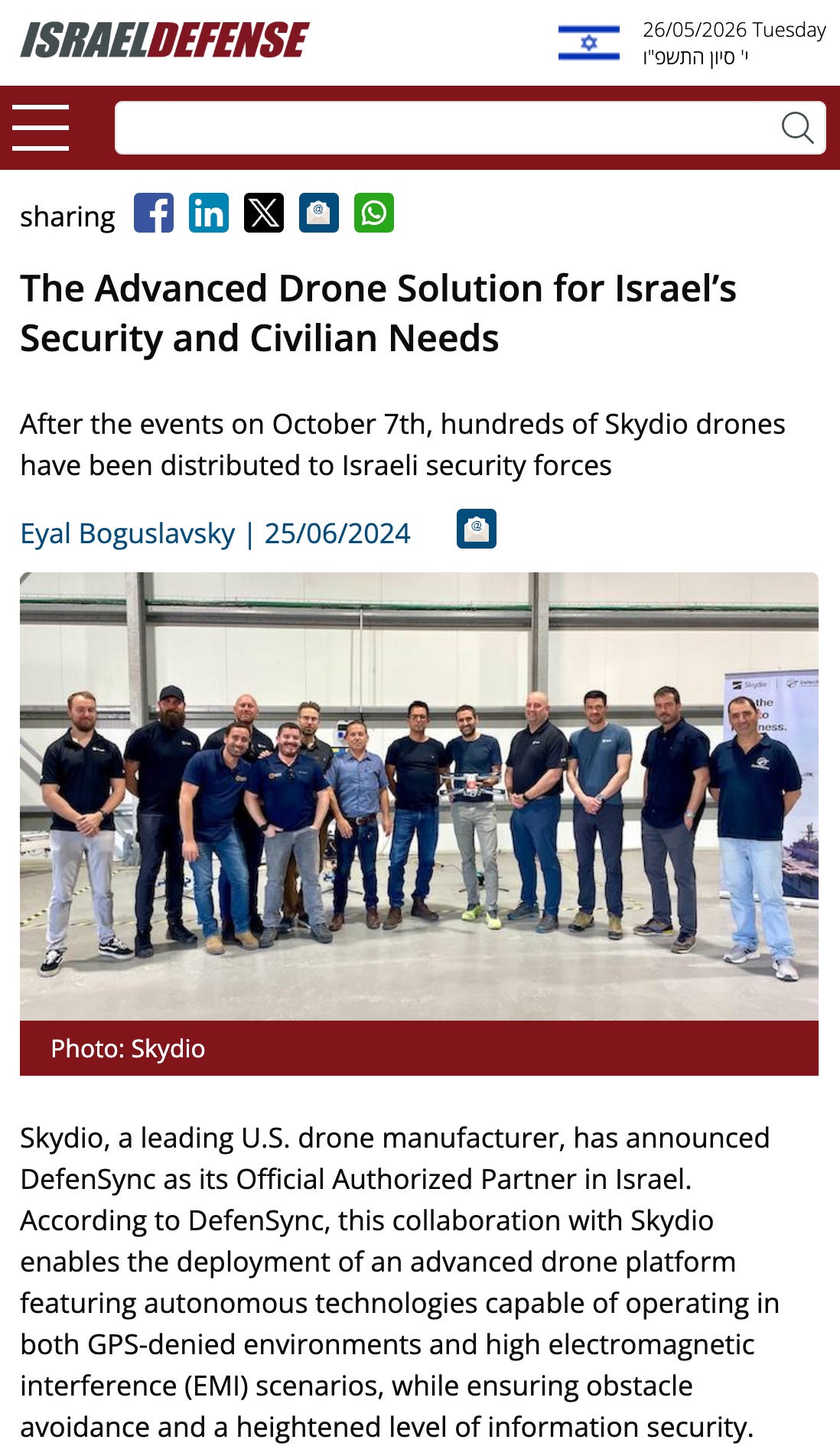
MNPD→Fususcontract without hearing (2022) → paused after outcry (2024) (Nashville Banner, February 5, 2024) → expanded contract fell one vote short of the 21 needed to pass (NewsChannel 5, December 4, 2024) →Mayor O'ConnellabandonedFusus(April 2025)Mayor O'Connell→ filed MOU containingLeoSightthe Friday before Thanksgiving 2025 (Nashville Scene, December 2025) →LeoSightfounded byMark Wood, formerFususCRO who signed the original 2022 contract withChief Drake(Rich Text, November 2025) → stripped public outcry that demanded it.Skydio→ shipped hundreds of reconnaissance drones to the Israeli military after October 7, 2023, withDefenSyncas its authorized partner in Israel (Israel Defense, June 30, 2024; AFSC Investigate) → same X10 platform now flying over MadisonSkydio→ ran identical zero-dollar pilot withDenver Police(October 2025, transparency concerns (Denver7, December 13, 2025)) →Orlandorequired formal council vote for $6.83M contract (DroneXL, February 25, 2026) →Portland, Mainerequired two council votes for a single $45,316 drone (Portland Press Herald, March 3, 2026) →Syracuserepeatedly withdrew its DFR proposal after surveillance review failures

Skydio DFR Command is the software that operates these drone programs. Axon Fusus is the real-time surveillance integration platform that Nashville’s Council has voted against repeatedly. Skydio‘s own product documentation says these two systems connect directly (Skydio DFR Command). The connection requires entering a single Axon API key in the settings. Whether that connection is turned on in the Nashville deployment is a question the public has not been given the opportunity to ask, because no hearing was held.
What you’re looking at: The city applied its surveillance ordinance to 15 fixed cameras in January (WPLN, January 20, 2026). The community showed up. Council voted. The cameras were rejected. Five months later, the same city launched a more invasive capability. Autonomous drones dispatched to calls involving people in mental health crisis, suicidal persons, and domestic disturbances, with no public process.
MNPDPolicy 8.50 authorizes deployment to 25 call codes plus a catchall, including 10-35 Mentally Ill Person, 10-40 Suspicious Person, 10-41 Domestic Disturbance, 10-63 Suicidal Person, and all Code 3 calls (MNPD DFR Policy 8.50). The policy says this is not surveillance (MNPD DFR info page). The ordinance does not care whatMNPDcalls it. It defines surveillance technology as any device capable of collecting, recording, or sharing information associated with specific individuals or groups (Metro Code § 13.08.080). The pattern has now completed three times.Fususwithout a hearing in 2022.LeoSightin a Thanksgiving MOU in 2025.Skydiodrones over Memorial Day weekend in 2026.
How it lands: This is a 30-45 day trial (MNPD press release, May 22, 2026). At the end, MNPD will present results and seek a permanent contract. That is how Fusus started. The ordinance says “prior to.” Not “after.” Not “when convenient.” Not “unless you call it a trial.” The announcement was made Friday afternoon before a holiday. The program launches today. The timing is the tell.
