
New surveillance tech requires a public hearing. But our politicians are pretending it's "not surveillance."
But we're the ones spreading "misinformation"...

This is related to these prior posts.


There’s a law on the books in Nashville written by Mayor O’Connell’s Legislative Director Dave Rosenberg. Its language is very clear.
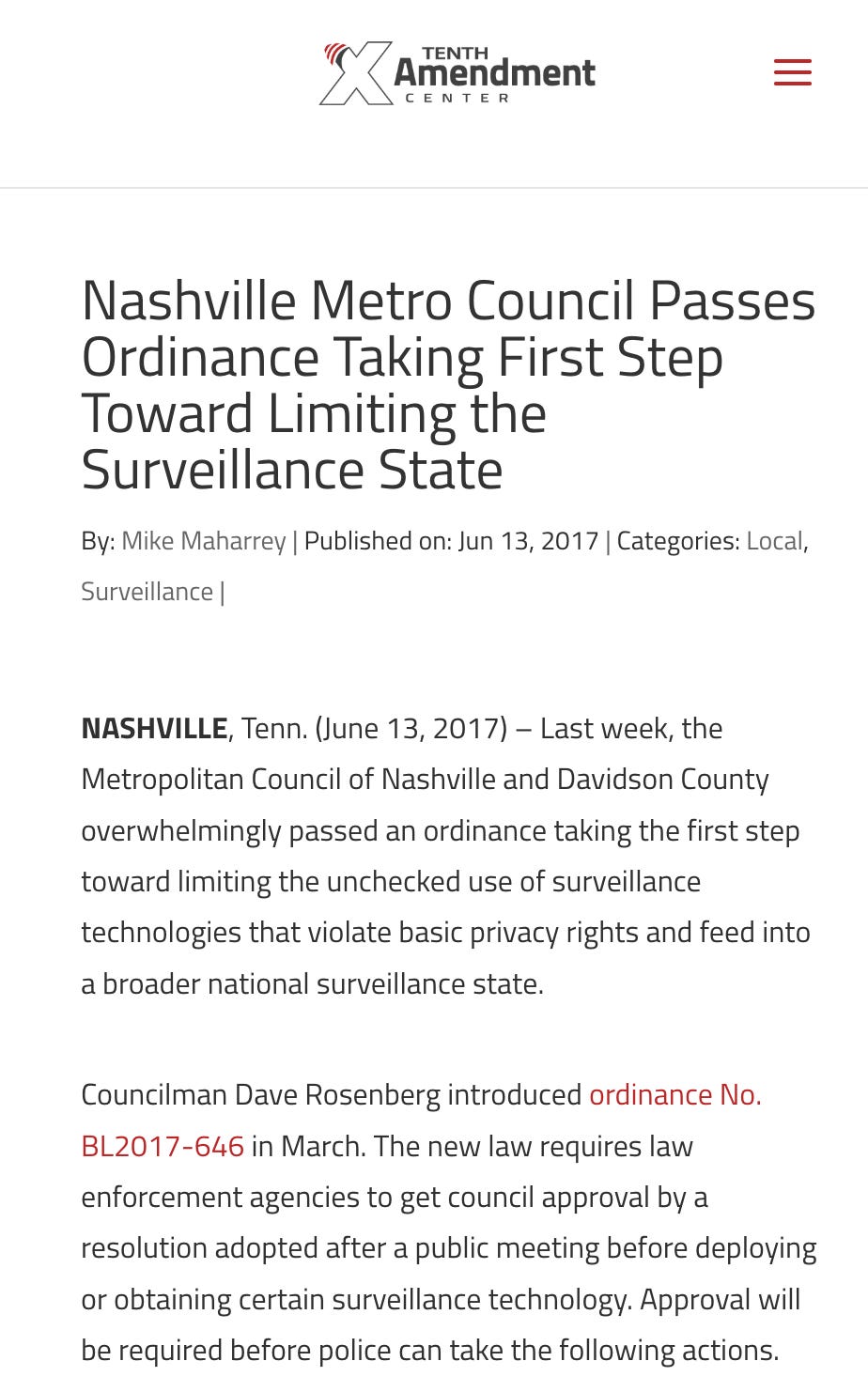
It says that a public hearing must be held in the event that surveillance technology is obtained by the city.
Beginning July 1, 2017, approval by the metropolitan council, by a resolution adopted after a public hearing, shall be required prior to any of the following actions by the Metropolitan Government of Nashville or Davidson County, the departments, boards or commissions thereof, or any individual or entity acting upon its behalf…
(2) Entering into an agreement with a private entity to acquire, share or otherwise use surveillance technology or the information it provides if such agreement includes exchange of any monetary or any other form of consideration from any source, including the assessment of any additional fees, interest, or surcharges on unpaid fines or debts absent approval by the metropolitan council;
(3) Accepting state or federal funds or in-kind or other donations for surveillance technology;
(4) Acquiring new surveillance technology, including but not limited to procuring such technology without the exchange of monies or consideration;
(5) Entering into an intergovernmental agreement
It’s very simple. If Metro Nashville intends to obtain, through purchase, gift or otherwise, surveillance technology, it can only do so after it holds a public hearing. A public hearing is a specific thing.
For a public hearing to happen, a specific notice to the public must be made in advance of the Council Meeting when it is to take place.
The Vice Mayor will open the public hearing for a particular legislative item and ask for a show of hands of those in favor and those opposed to the legislation. Citizens will have 2 minutes to speak, and must identify themselves by name and home address before addressing the Council. An individual may address the Council only once for each particular piece of legislation. Individuals are encouraged not to repeat what has been said by previous speakers.
nashville.gov/departments/metro-clerk/public-hearing
Yet, Council Members who are sponsoring the Mayor’s resolution for surveillance are saying that this does not apply.
Council Member Jordan Huffman, Chair of the Public Health and Safety Committee, made the case on WKRN last night that the MOU, despite containing a long list of surveillance tools, “does not add any police power.”
One might say that it is strange that a $15M investment into public safety does not “add any police power”. That sounds like a waste of public safety aimed taxpayer money (and I’m not saying that is a wrong assumption). But the distinction he is likely trying to make is that this MOU is not adding any categorical new abilities to police power.
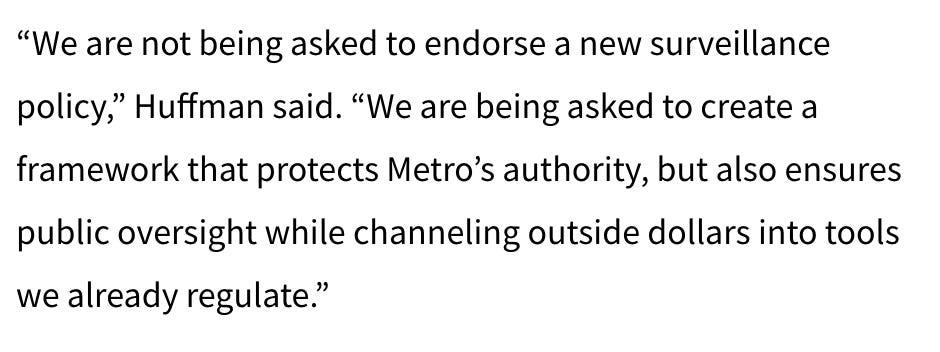
His statement that this MOU does not involve any “new surveillance” is completely false.
For example, in the line items for the MOU there are two lines for software services, identified by the vendors that Metro would obligate NDP to purchase technology from. These two firms are examples of surveillance technology.
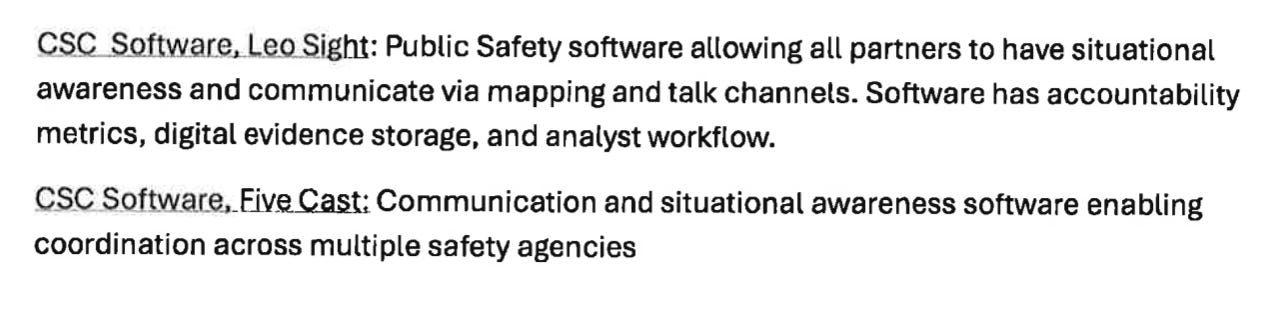
Here is what my research has found these tools, that Metro currently does not have contracts for (or anything similar), are:
Fivecast is an AI-powered open-source intelligence (OSINT) platform designed for law enforcement and national security agencies. It’s described as “a powerful intelligence toolkit“ with capabilities including “automated account discovery to quickly find & de-anonymize individuals” and “easy to use risk detectors powered by AI to quickly uncover networks.” The platform “delivers unmatched access to multi-media data across a diverse range of platforms on the Surface, Deep and Dark Web.” Their main product, Fivecast ONYX, provides “access to billions of data points from millions of sources” and uses “AI-powered risk analysis” to “uncover threats.”
The company markets its ability to monitor social media and detect sentiment. U.S. Customs and Border Protection has purchased this software, which “according to its proprietor, can detect ‘problematic’ emotions of social media users and subsequently report them to law enforcement for further action.”
LeoSight is a real-time crime center platform that “brings law enforcement, fire, and emergency management into one Unified Command platform —even across jurisdictions” with access to “drones and automated license plate recognition to sensor networks and live video feeds.” The company is a rebrand of Live Earth—their website states it was “originally developed under the Live Earth brand“—and is now led by Mark Wood, who, three months prior to joining LeoSight, was the Chief Revenue Officer at Fusus.
The functional similarities to Fusus are hard to miss. Both power Real Time Crime Centers by consolidating camera feeds, ALPR data, and sensor networks onto a single map interface. Both enable cross-jurisdictional surveillance sharing. Nashville rejected Fusus in April 2025. Now the same category of surveillance integration software—run by a former Fusus executive—is being introduced through this MOU without a public hearing.
Last night, the Nashville Downtown Partnership published a budget of how the $15M of funds would be used. The budget, which is in no way actually attached to the resolution and MOU and appears to have only been provided for public viewing yesterday to the media, explicitly shows that NDP does not intend to be the end-user of these tools, and they are therefore for Metro Nashville’s use.
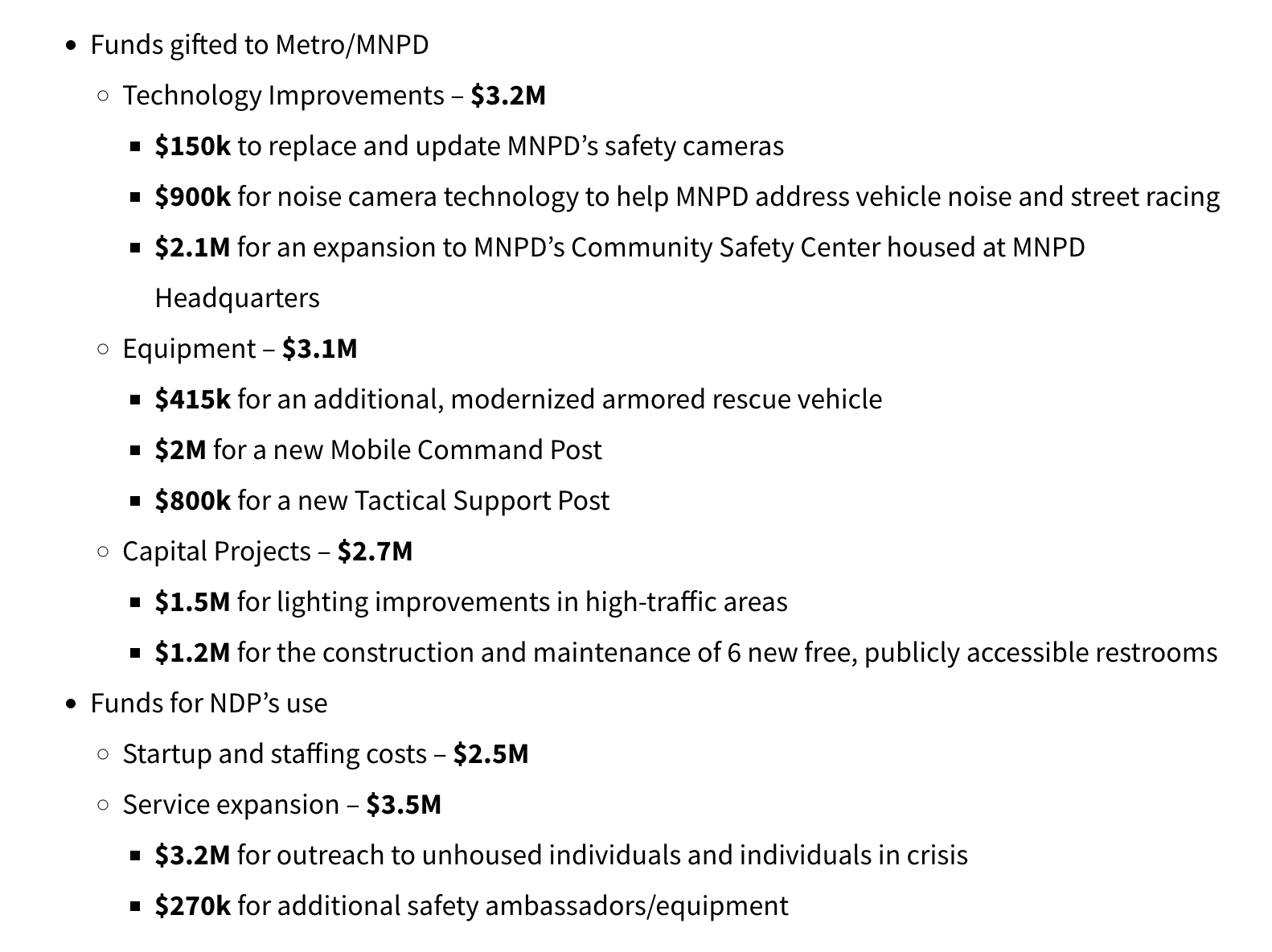
Metro Officials are trying to deny that things like this are surveillance tools, insisting that they are merely “integration” tools. But what, exactly, are they integrating, if not, surveillance?
To me, someone who once worked in B2B marketing, this sounds like a talking point a product marketer would pass along to a client who was worried they couldn’t get their product approved through their firm’s compliance department. “Well, if you look at it like this, it’s actually NOT surveillance at all!”
The argument is that it doesn’t count as surveillance if they simply integrate surveillance data. Surveillance, they argue, is explicitly and only the action of recording information. Logically speaking, this is absurd.
It is not the act of pointing a camera at someone that is the meaningful part of surveillance, it is integrating that observation with personally identifying information and analysis that make it surveillance. If a camera films a tree falling in the forest, and no one watches the video, the tree was not surveilled.
But such academic arguments are easy to get lost in the weeds on, and debating semantics with politicians is the surest way to obtain a migraine. This is precisely why legislation comes with definitions, so that people may not “well, actually” their way out of ignoring laws entirely.
And in 2017, Council Member Dave Rosenberg made the effort to actually define what counts as “surveillance technology.” Rosenberg puts the nail in the coffin for the argument that this MOU does not contain surveillance technology and therefore does not require a public hearing.
“Surveillance technology” shall mean any electronic surveillance device, hardware, or software that is capable of collecting, capturing, recording, retaining, processing, intercepting, analyzing, monitoring, or sharing audio, visual, digital, location, thermal, biometric, or similar information or communications specifically associated with, or capable of being associated with, any specific individual or group; or any system, device, or vehicle that is equipped with an electronic surveillance device, hardware, or software.
See you at the public hearing.