
The ACLU is Suing Them for Civil Rights Violations. Reps from Nashville's Largest Institutions Want to Keep Using Them Without Oversight. Will Metro Council Endorse THP as Private Police Downtown?
Council votes on NDP's budget on Tuesday, May 19. What you need to know about NDP's budget in a new streamlined format (by popular demand).

{Rich Text} is changing. The same dissertation-length posts will be available for those interested, but I’m working on a more accessible, structured format. I’m calling this new format {Plain Text}. Here is its first edition.
On Tuesday, May 19 Metro Council may decide whether the Nashville Downtown Partnership gets to keep its private police force. As you will see, there are many reasons they’ve proven they can’t be trusted with a private police force (something that, IMO, just shouldn’t exist anywhere).
How to Read This
▸ {Plain Text} If you read nothing else in the email, read this section.
▸ What We Know — sourced facts, bold labels
▸ The Connections — the board list, legal exposure
▸ Accountability Shell Game — follow the deflection
▸ What You’re Looking At — the pattern, as best we see it now
▸ Analysis — the liability shield that probably isn’t
▸ How It Lands — what’s at stake Tuesday
{Plain Text}
Three things happened on Wednesday May 13, 2026.
The state suspended NDP’s recent security vendor
{Solaren}’s license and fined it $118,000 for intentional violations of Tennessee security law in its program that leveragedTennessee Highway Patrol ({THP})troopers.The
{ACLU}sued{THP}in federal court for a pattern of constitutional violations in Memphis as part of the Trump administration “Memphis Safe Taskforce.”The
{Nashville Downtown Partnership}, which until very recently paid off-duty{THP}troopers through{Solaren}to police homeless people downtown, presented its budget to{Metro Council}a statutory requirement they are obligated to do on a yearly basis, for the first time in twenty-two years.
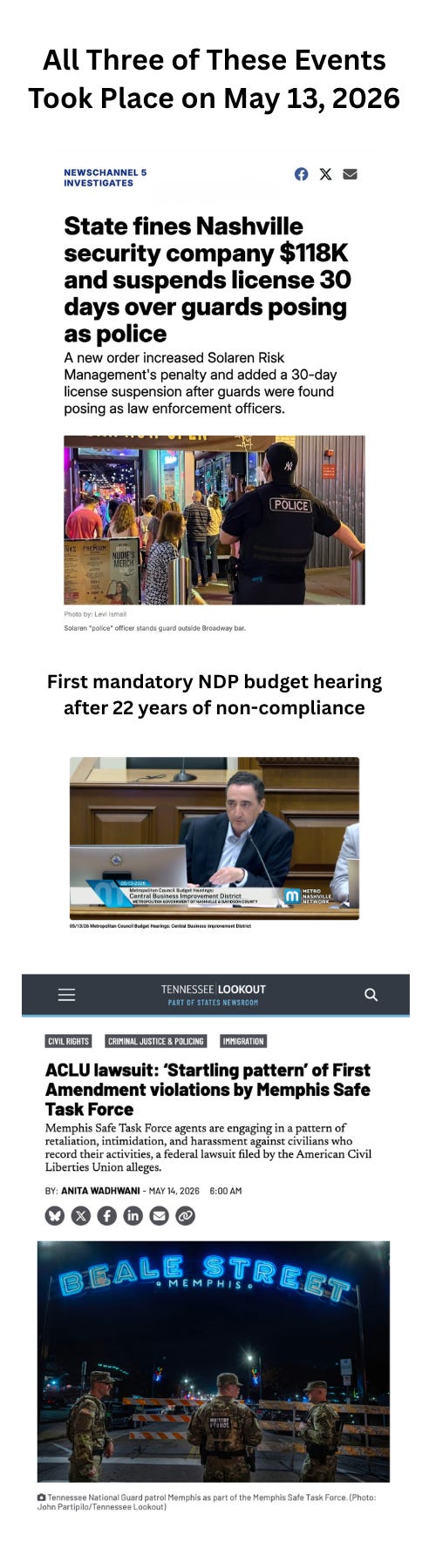
The District Management Corporation, ({DMC}) is the quasi-governmental org overseen by NDP whose budget is required by Metro ordinance O98-1037 to be submitted to {Metro Council} for annual review and approval. It wasn't, for twenty-two years.
There has been no public explanation as to why the budget submissions stopped abruptly in 2004.
The extraordinary nature of this private policing arrangement may never have happened if {NDP} had submitted its budget as required, and it likely would never have come to light if community advocates had not forced Council to perform its statutory oversight for the first time in over two decades.
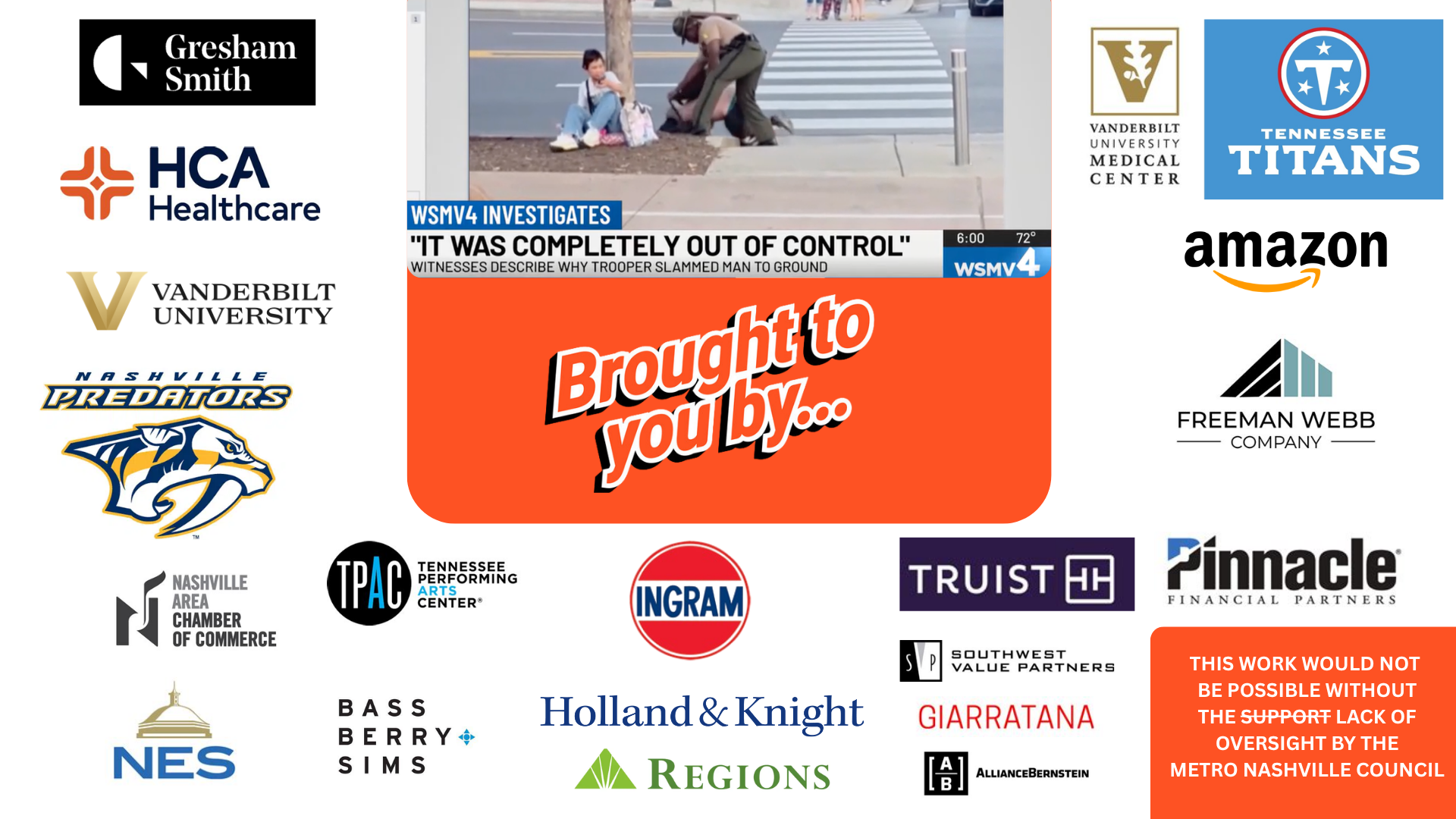
The {NDP} board that oversees this operation includes {Gresham Smith}, {HCA Healthcare}, {Vanderbilt University}, {Pinnacle Financial Partners}, {Holland & Knight}, the {Tennessee Titans}, the {Nashville Predators}, {Amazon}, {Live Nation}, and dozens of Nashville’s most prominent institutions. Many of the firms on the board are also major campaign donors to Metro Council and Mayoral candidates.
The {Nashville Downtown Partnership} pays off-duty {Tennessee Highway Patrol} troopers to patrol downtown Nashville. {WSMV} documented 337 arrests between 2023 and 2024, 209 targeting people who listed their address as homeless or a shelter. Most charges were dismissed by prosecutors. A whistleblower trooper on the detail told {WSMV}: "Our job is to police the homeless community. Profiling is what it is."
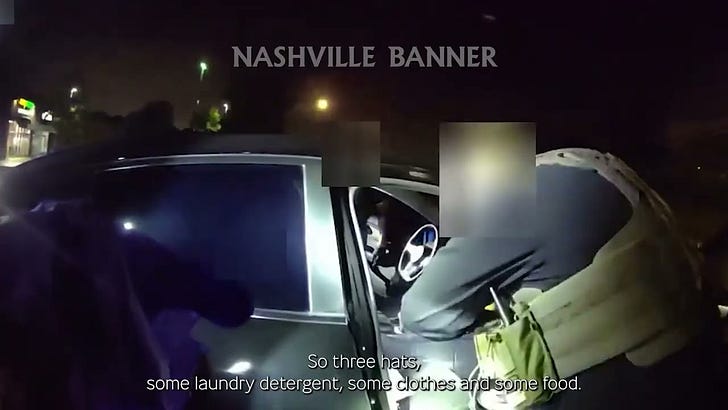
These are troopers from the same {THP} that conducted the May 2025 joint operation with {ICE} in South Nashville, in which troopers made over 580 traffic stops, racially profiled drivers in predominantly Latino neighborhoods, and handed them to federal agents for deportation. A six-newsroom international investigation by {Lighthouse Reports}, {Mother Jones}, the {Nashville Banner}, {Nashville Noticias}, {NewsChannel 5}, and the {University of Memphis} found that {DHS} inflated its arrest numbers, that 75% of those detained had no criminal record, and that troopers ignored traffic violations to continue helping {ICE} target immigrant families.
{NDP} pays these officers off-duty, claims no control over their conduct, and is now transitioning to a new vendor while changing nothing about the operation itself. On May 13, {NDP} CEO {Tom Turner} told {Metro Council} that his organization does not give any instructions to these troopers. The same day, the {ACLU} filed a federal lawsuit against the {Memphis SAFE Task Force} for a pattern of constitutional violations by the same {THP}.

Since our post entitled “Nashville’s Unauthorized Secret Police Force And The People & Orgs Enabling It” on April 2, 2026, it appears that the Mayor’s Office may be quietly distancing itself from NDP, with O’Connell staffer Patrick Hamilton no longer appearing as a Board Director on NDP’s website. The most recent archive.org listing for the NDP site was from July 30, 2025, and listed Jamari Brown from the Mayor’s Office as a director on its board.
The man who, as best we can tell, oversees the activities of the THP officers is {NDP}‘s {David Corman}, a former MNPD Commander.
Mr. Corman’s son, a recent college graduate (majoring in Geology) whose immediately prior job was “Team Lead” at a Regal Cinemas, ran compliance as the Director of Administration at {Solaren} while the state was building its case. NDP’s private policing license is still registered at Solaren’s address.
To say NDP was not intimately involved in the administration of Solaren, and by extension, the conduct of the THP Officers it employs, strains all credulity.

{NDP} recently announced it would not be renewing its contract with {Solaren}. Beyond just overcoming the PR issues the firm and its eccentric owner, {Jack Byrd} presented, the revocation of its license on the same day {NDP} had to present its budget for the first time in 22 years revealed that it was likely an unavoidable change long in the making.

But {NDP}’s new private security vendor comes with its own baggage. {Civicity Services, Inc.} is associated with {Block by Block} — same parent company, same headquarters, same chairman on the incorporation. {Block by Block} is the {NDP} contractor that stored fuel containers without permits in a city-owned parking garage, causing a fire that shuttered the downtown library for nine months and will require partial demolition. {NDP} blamed {Block by Block} at the time. The fire liability is unresolved. The policing contract is going into effect this weekend.
When something goes wrong, no one is accountable. In October 2025, a {THP} trooper working for {Solaren} slammed a man to the ground on camera.The reason: the officer had nearly run the man over in a crosswalk, and the man kicked the trooper’s car. The man was charged with no crime. He was not formally detained. He was, by any normal definition of the word, assaulted. {Solaren} deferred the incident to {THP}. {THP} did not consider it a use of force. {NDP} did not include it in its reporting to Council. No entity investigated, reported, or took responsibility.

{Turner} told Council the new vendor begins Saturday, before Council has voted to approve the budget that oversees it. {Councilwoman Suara} asked for the contract. {Turner} agreed. The previous contract, with {Solaren}, was never produced; {NDP} cited a confidentiality clause. Council is being asked to approve a budget for a policing operation whose contractual terms have never been made public.
Council votes Tuesday, May 19 to approve the budget that funds it.
What We Know
Already spending before the vote.
{Tom Turner}told Council the{Civicity}-managed{THP}detail “would begin on Saturday” (transcript, 00:40:36), then added: “We don’t expect there to be a difference.” The budget bills authorizing the spending ({BL 2026-1381},{RS 2026-1963}) have not been voted on;{Councilmember Kupin}noted in the same hearing that those bills are “on the agenda next meeting” (transcript, 00:37:22). The operation is spending before authorization, which is the pattern that has defined this arrangement for twenty-two years.“We don’t direct them” — contradicted by published investigations.
{Derek Hughes},{Block by Block}EVP, told Council: “We don’t direct them to arrest people. We don’t direct them to act in any kind of manner or under any kind of protocol when it relates to unhoused” (transcript, 00:30:31).{Turner}told the{Nashville Banner}that{NDP}“has no control over which laws sworn THP officers do or do not enforce.”
A{THP}whistleblower told{WSMV}the opposite: “These companies were fed up with that. So they are paying Solaren to pay us to police downtown Nashville.”{Jack Byrd}stated in a witness statement to state investigators that troopers check on designated “hotspots” and “homeless persons sleeping either illegally or dangerously.” Designated hotspots and specified target populations constitute operational direction.NDP frames homelessness as a behavioral problem, not a housing problem.
{Turner}told Council that housing placement “hasn’t been as much of an issue as it has been in the past” and that the primary deficit is “true mental health services” (transcript, 00:43:15–00:44:47). At{Metro}‘s own budget hearing,{Office of Homeless Services}Director{April Calvin}identified housing as the leading need.{OHS}‘s stated mission is “to secure attainable and accessible housing for all Nashvillians” using a Housing First model.
When the city’s homelessness agency says the answer is housing and the private entity policing homeless people downtown says the answer is mental health services, the framing determines the response: one leads to investment in housing, the other to justifying enforcement against people whose primary problem, according to the city’s own purported expert, is that they have nowhere to live.What the troopers are actually doing: 337 arrests, most targeting the unhoused.
{WSMV}documented 337 arrests between 2023 and 2024 by the off-duty{THP}detail, 209 of which targeted people who listed their address as homeless or a shelter. Most charges were ultimately dismissed by prosecutors. In November 2024, troopers conducted a spree of felony camping arrests under Tennessee’s unauthorized camping statute, which{MNPD}does not enforce.
A whistleblower trooper told{WSMV}: “Our job is to police the homeless community. Profiling is what it is.” The trooper described explicit targeting: leave tourists alone because they bring in revenue; leave an attractive woman sitting on the sidewalk alone; only deal with the homeless.{Turner}told Council he “completely” disagreed that the troopers arrest people where Metro would not (transcript, 00:11:16).No oversight, and no one accountable when force is used. Asked what accountability exists,
{Turner}described a comment form on{NDP}‘s website, “available for a yay and a nay,” and noted “there have not been specific comments of concern since that was established” (transcript, 00:51:51). There is no civilian oversight board. No independent complaint process. No public use-of-force policy.No body cameras on the
{THP}troopers.{Hughes}confirmed that{Civicity}body cameras are used on “community response officers deployed, which we’re not here” (transcript, 00:52:40). The officers making arrests in Nashville have no cameras. What happens when force is used was demonstrated in October 2025:{THP}Sgt.{DeWunya Topps}, working off-duty for{Solaren}, slammed a man to the ground after the man kicked his unmarked truck for driving through a crosswalk without yielding. The man was not charged.{Solaren}deferred to{THP}: “We defer comments to the Tennessee Highway Patrol until the reviews are complete.”{THP}confirmed an internal investigation but did not consider the incident a use of force. The incident does not appear in{NDP}‘s quarterly reporting to Council. Three entities, zero accountability:{NDP}defers to{Solaren},{Solaren}defers to{THP},{THP}says it wasn’t a use of force.Who actually directs the officers:
{Turner}told Council the $258,000 staff cost line covers “two safety service employees, both retired Metro Nashville Police Department employees” (transcript, 00:54:22). One is{David Corman},{NDP}‘s Director of Safety Services ($116,943 in 2024 per NDP’s 990 filing), who directs the{THP}detail day-to-day. Until recently,{Corman}‘s son, a recent college grad with a Bachelor’s Degree in Geology and whose immediately prior employment was “Team Leader” at a Regal Cinemas, served as{Solaren}‘s Director of Administration, responsible for compliance and risk mitigation, during the period the state cited{Solaren}for 62 violations and an administrative law judge found the conduct intentional.The contract hasn’t been produced.
{Councilwoman Suara}asked for the{Civicity}contract (transcript, 00:26:38).{Turner}agreed. The{Solaren}contract was never produced;{NDP}cited a confidentiality clause, according to{WSMV}‘s editor’s note.Turner’s position on the garage fire changed when the business relationship did. In July 2025,
{NDP}told the{Nashville Scene}the library garage fire originated in space “used by our contractor, Block by Block, and not by the Nashville Downtown Partnership.” By April 2026,{Turner}told the{Nashville Banner}: “it’s an undetermined cause from an undetermined source.”
No publicly reported new fire investigation findings appeared between those statements. The business relationship changed:{NDP}now contracts with{Block by Block}‘s corporate family for policing.THP is now a federal defendant for the same conduct. On May 13, 2026, the
{ACLU}filed Demster v. Blanche in the Western District of Tennessee. The lawsuit alleges{Memphis SAFE Task Force}agents, operating in cooperation with{THP}, retaliated against Memphis residents for recording law enforcement activity: tailing them home, photographing faces and license plates, swerving vehicles at observers, issuing sham tickets never entered into court systems, and jailing one plaintiff for 27 hours for filming from across a street, according to the Tennessee Lookout and the Commercial Appeal.{THP}Colonel{Matt Perry}is a named defendant. The{NDP}downtown detail exclusively hires{THP}troopers, according to the{Nashville Banner}: “only hires state troopers for the program, leaving no doubt that they are certified law enforcement officers.”
The connections
{NDP} pays off-duty {THP} troopers. {NDP} and {Civicity} say they don’t direct what those troopers do. Published investigations by {WSMV} document designated hotspots, target populations, and a trooper who says the job is policing the homeless. {THP} is the same agency that conducted the May 2025 ICE operation in South Nashville, in which 75% of those detained had no criminal record. {THP} is now a federal defendant in Memphis for a pattern of unconstitutional conduct. “We don’t tell them how to do their job” does not sever the relationship between the entity paying for the policing and the conduct of the officers being paid. It is a claim about direction. It is not a claim about responsibility.
# Who is endorsing this
# https://nashvilledowntown.com/about/board

NDP Board of Directors:

  Chair:
    - Kelly Hodges, Gresham Smith

  # Law firms
  Holland & Knight:    Robert R. Campbell Jr.
    # Was at Waller Lansden when the firm created NDMC PSO LLC
  Butler Snow:         Robert M. Holland Jr.
  Bass Berry & Sims:   Mike Stewart
  Gullett Sanford:     Mary Taylor Gallagher

  # Healthcare & higher ed
  HCA Healthcare:      Justin Burk
  Vanderbilt Univ:     Nathan Green
  Vanderbilt Medical:  Matthew Scanlan

  # Finance
  Pinnacle Financial:  Deb Hennessee, Robert McCabe
  Truist Bank:         Johnny Moore
  Regions Bank:        Lee Blank
  First Horizon:       Carol B. Yochem
  FirstBank:           Michael Mettee
  Alliance Bernstein:  Karl Sprules
  Nashville Elec Svc:  Teresa Broyles-Aplin

  # Entertainment & hospitality
  Tennessee Titans:    Haley Davidson
  Nashville Predators: Michelle Kennedy
  Live Nation:         Sally Williams
  Nashville Sounds:    Adam English
  Music City Center:   Charles Starks
  Conv & Visitor Corp: Deana Ivey
  Hermitage Hotel:     Dee Patel
  TPAC:                Jennifer Turner
  Hilton Downtown:     Will Freeman
  The STAGE:           Brenda Sanderson

  # Real estate & development
  Highwoods Properties: Alex Chambers
  Lincoln Property Co:  Michelle Myers
  Boyle:                Logan Hughes
  Giarratana LLC:       Morgan Stengel
  Freeman Webb:         Bob Freeman
  Northwood / Fifth+:   Monika Hartman
  RBN Equities:         Megan Kelly
  Rubicon Equities:     Gabe Coltea
  SW Value Partners:    Charles Robert Bone, Joe Bucher
  Hastings Architecture: William Hastings
  The MLC:              Kris Ahrend

  # Corporate & consulting
  Amazon:              Courtney Ross
  Nashville Chamber:   Stephanie Coleman
  Ingram Industries:   LeEllen Phillips
  HNTB Corporation:    Robbie Hayes
  C.B. Ragland Co:     Michael Hayes
  Barge Design:        Carrie Stokes
  GHP Inc:             Dominique Arrieta
  511 Group:           Richard Fletcher
  MP&F Strategic:      Keith Miles
  Finn Partners:       Philip McGowan
  Hall Strategies:     Joe Hall
  Stones River Group:  Stephen Susano
  Forvis Mazars:       Paul Hopkins
  KraftCPAs:           Becky Harrell
  MarketStreet Ent:    Dirk Melton
  nFocus Magazine:     Janet Kurtz

  # Government
  MDHA:                Dr. Troy White
These are the institutions endorsing a private policing operation with no body cameras, no civilian oversight, no public use-of-force policy, and no public contract, staffed by officers from an agency facing federal civil rights litigation, and directed by staff whose family members held compliance roles at the vendor the state found acted intentionally in violating the law.
Has NDP Actually Protected Itself From Liability from THP Behavior? Legally Speaking? Probably Not. PR-wise? Definitely Not
{Tom Turner}sits at the top of all three entities in the funding chain: CEO of{NDP}, principal officer of the{DMC}per its IRS Form 990, and registered agent of{NDMC PSO LLC}. He presents the budget to Council. He agreed to produce the contract. The last contract was never produced.The corporate architecture does not insulate the people overseeing it. Under Sixth Circuit precedent, off-duty officers in uniform exercising state arrest powers are state actors regardless of who signs their paycheck (Romanski v. Detroit Entertainment, 428 F.3d 629 (6th Cir. 2005); Stengel v. Belcher, 522 F.2d 438 (6th Cir. 1975)). The $312 shell company holding the policing license is a textbook veil-piercing fact pattern under Tennessee law (Youree v. Recovery House of East Tennessee, 705 S.W.3d 193 (Tenn. 2025)): zero income, no employees, no independent operations, single-purpose existence.
Qualified immunity does not extend to private entities performing public functions (Richardson v. McKnight, 521 U.S. 399 (1997)). Municipal liability flows to
{Metro Nashville}under Monell when the unconstitutional conduct results from official policy or deliberate indifference. The mandatory CBID assessment ordinance is the policy. The documented pattern of 209 arrests targeting unhoused individuals, the Topps use-of-force incident, and the absence of any oversight infrastructure supply the deliberate-indifference record.
The accountability shell game
When something goes wrong, every entity in the chain points at someone else. When nothing goes wrong, every entity takes credit. Here is how accountability actually moves through the structure:
Who pays?
{Metro Nashville}collects mandatory CBID assessments →{DMC}receives the money →{NDP}manages the operation → vendor (formerly{Solaren}, now{Civicity}) supplies the officers. The contract between{NDP}and{Solaren}was never produced, claimed to be “confidential.” The contract between{NDP}and{Civicity}has been requested but not provided. Council is being asked to approve a budget that funds a policing operation whose contractual terms are unknown.Who directs?
{NDP}staff ({David Corman}) appears to direct the{THP}troopers day-to-day, and until recently his son was the Director of Administration for the vendor that paid the officers.{Hughes}told Council: “we don’t direct them.”{Turner}told the Banner: “no control.” The whistleblower trooper said the directive from{THP}supervisors on the detail is clear: businesses are frustrated with the homeless, Metro police aren’t focusing on it, so “they are paying Solaren to pay us to police downtown Nashville.”Who is accountable when force is used?
{NDP}defers to the vendor.{Solaren}deferred to{THP}: “We defer comments to the Tennessee Highway Patrol.”{THP}did not consider the Topps incident a use of force. The POST Commission directed questions back to{Solaren}. The incident does not appear in{NDP}‘s reporting to Council. No entity investigated. No entity reported. No entity took responsibility.Who holds the license?
{NDMC PSO LLC}(PSO License 13682, still active at{Solaren}‘s Mt. Juliet address). Also{Civicity Services, Inc.}(CSC License 14426, Nashville address). Two licenses, two classifications, two entities, no explanation of which governs.Who can be sued?
{NDMC PSO LLC}has $312 in assets.{Civicity Services, Inc.}is five months old. Under the doctrines above, the liability reaches past both shells to{NDP}, to the{DMC}, to{Metro Nashville}, and to the board members whose institutions authorized the arrangement.
What you’re looking at
A private policing operation in which no one claims responsibility for what the officers do, but everyone agrees to keep paying for it. {NDP} says it doesn’t direct the troopers. {Civicity} says it doesn’t direct the troopers. The troopers are {THP} employees exercising state arrest powers on private payroll. Someone designates the hotspots. Someone sets the priorities. Someone decided the job was “to police the homeless community.”
The arrangement is structured so that the entity paying cannot be seen directing, and the entity directing can say it isn’t paying. That structure does not eliminate liability. It distributes it. And it distributes it upward: to {NDP}, to the {DMC}, to {Metro Nashville}, and to the board members whose institutions’ names are attached to the organization that implements the operation. The {ACLU} just demonstrated in Memphis what happens when that liability comes due, and the defendant list in Demster v. Blanche includes the head of {THP}.
Nashville’s operation uses the same agency, with less oversight, less transparency, and no acknowledgment that the exposure exists. What would change this reading: {NDP} producing the contract, requiring body cameras on the troopers, establishing civilian oversight with independent review, and publicly accounting for which entity governs the officers making arrests.
Analysis: The liability was never shielded. Only the transparency was.
Someone at {Metro} or {NDP} has recognized the extraordinary exposure created by twenty-two years of unauthorized budgets. The procedural ultra vires problem, which {Rich Text} reported on in April, is almost certainly why {Councilmember Kupin} acknowledged at the hearing that all prior budgets are being submitted going back decades (transcript, 00:37:47). The retroactive documentation is an attempt to close a gap that, if tested in court, could render over $42 million in expenditures unauthorized under Metro’s own Charter.
But the budget gap is not the only liability {NDP}‘s leadership has taken on. Since {Turner} created {NDMC PSO LLC} in 2022, presumably to shield {NDP} from liability for the conduct of {THP} officers reporting to his office under the authority of the {NDP} board, the shield has never actually been in place. It has simply never been tested. A $312 disregarded entity with no employees, no income, and no independent operations does not survive a veil-piercing challenge under {Youree v. Recovery House of East Tennessee, LLC}. It does not insulate {Metro} from a Section 1983 claim when the operation is funded by mandatory government-collected assessments and performs a public safety function.
It does not provide the body cameras, use-of-force policies, or civilian oversight that even the most basic municipal police force operates under. What it successfully shielded was not liability but transparency: the corporate architecture made the policing operation harder for Council, reporters, and the public to see. The only thing the structure protected was information.
And now {Civicity Services, Inc.} replicates the same logic: a separately incorporated entity designed to hold the contract so that {Block by Block} is insulated from policing liability and {NDP} is insulated from {Block by Block}‘s fire liability. The corporate separations serve the same purpose as the confidentiality clause on the {Solaren} contract: not to protect the public, but to prevent the public from knowing what is done in its name and with its money.
Despite the layered corporate structure, there is not a secret, privatized government in downtown Nashville that gets to explode public property, remove public accommodations, and harass residents while paying the same pool of officers who terrorize immigrant neighbors through well-documented racial profiling, and suffer no consequences. The consequences have simply been deferred. Demster v. Blanche is what those consequences look like when they arrive.
How it lands
Council votes Tuesday, May 19, 2026. The budget says “safety services.”
The board list says {Gresham Smith}, {HCA}, {Vanderbilt}, {Pinnacle}, {Amazon}, the {Titans}, the {Predators}, {Live Nation}.
These institutions’ reputations are attached to an operation that a whistleblower trooper described as policing the homeless community, that the state found was run intentionally in violation of the law, and that is staffed by officers from an agency now defending a federal civil rights lawsuit in Memphis. Every one of those board members has a communications team, a legal team, and a brand to protect.
Council members who have received campaign contributions from PACs associated with {NDP} board members’ institutions should expect those relationships to be part of the public record the next time they ask voters for support.
The same applies to any mayoral candidate whose reelection campaign received conspicuously timed donations from entities represented on the {NDP} board.
The question before Council is whether to continue funding an operation that none of its operators claim to control, under a contract that none of them have produced, with oversight that consists of a website comment form that has received zero complaints despite documented profiling, harassment, and at least one assault by an officer on-duty for Solaren. The question for the board members is how long their names stay attached to it. The question for the voters is whether they’ve had enough.