
I Guess It Was Never Really About the Super Bowl
And So, The Cause of the Nashville Mayor's Heel Turn on Mass Surveillance Remains A Mystery.

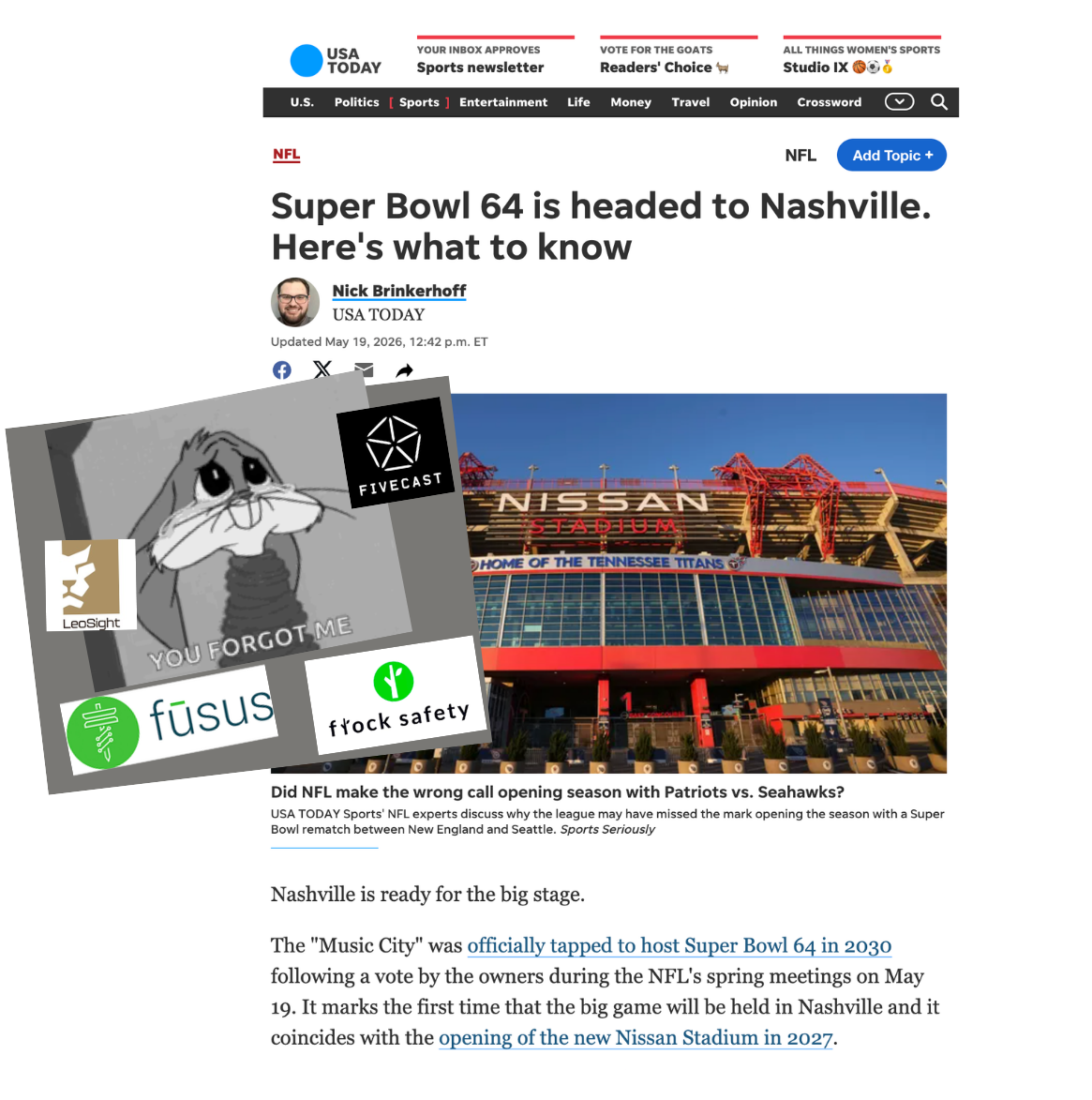
NFL owners voted 32–0 yesterday to award Super Bowl LXIV to the new Nissan Stadium in 2030. All despite us not having installed the mass surveillance that, many people have repeated to me, was allegedly a prerequisite to book the big game.
For the past half-decade, Nashville has endured a nearly unmitigated onslaught of attempts to roll out mass surveillance technology on Nashvillians, all of which are explicitly aimed at circumventing the 4th amendment right to unreasonable search and seizure.
For the past 250 years, grounded in the overthrow of the British Crown’s use of “general warrants,” it has been considered unconstitutional, un-American, and very un-Tennesseean to let the state track you whenever and wherever you go (or to allow corporations to do it, who are then free to provide that data to whoever they want, and explicitly to law enforcement without warrants).
It’s also been uncouth to have ungovernable rogue bands of armed guards with the power to detain you roaming the streets with autonomy. By this I don’t only mean ICE, but also the type of private policing we’ve seen in Downtown Nashville since 2022 (which, incidentally, is made of off-duty officers THP officers, the same pool that assisted in the May 2025 ICE raids terrorizing Nashvillians).
Something’s seriously gone off the rails the past five years, and despite all the red lines being crossed by the Trump administration, little has slowed the roll of efforts to push for mass surveillance, even in allegedly “blue dot” cities like Nashville.
Nashville, actually, according to researchers I'm in touch with, is more effectively protecting civil liberties from mass surveillance technology than virtually any other American city. It is not the politicians and business elites who give us that status. They are, in fact, the people who would inflict these un-American systems on us.
It is the people, those who have spoken up at Council Meetings, sent emails, met people for coffee, protested, boycotted and submitted public records requests who are to thank.
And because of those efforts, we achieved a major victory today. We defeated one of the bosses of neoliberal, capitalist captured democracy: we killed a talking point.
Rumor had it that we could never get the Super Bowl without expanding our mass surveillance dragnet. Guess they'll have to come up with a new reason next time.
It's not a mystery of who has been trying to inflict mass surveillance on Nashville. They mystery is why.
The efforts have been made by MNPD and the Mayor's Office, often in seemingly lock step with a State of Tennessee whose "Immigration 2026" agenda was crafted in coordination with the White House, specifically with Deputy Chief of Staff Stephen Miller, and often in close coordination with the Nashville Downtown Partnership (NDP) and the dozens of business interests it represents.
NDP still thinks they should get a private police force with money collected by Metro and approved by the Council, btw…

Here is what they kept trying to thrust upon us:
Fusus.
License plate readers.
LeoSight and Fivecast, tucked into a $15 million MOU routed through the Nashville Downtown Partnership.
And only last month, MNPD asked for a $2.8 million LPR budget line yet again (the Mayor’s Office appears to have learned its lesson and did not include it in the final budget ask to Council).
Again and again, the same vendors, the same asks, the same officials.

Many reasons have been given as to why this keeps happening.
CM Huffman had his weird line about us needing mass surveillance because we are “one incident away from having the money turn off in Nashville,” making it clear what his priorities are. Not the safety of tourists, public employees, civil liberties, hospitality staff: the money.
I am quite confused when Council Members insist on doing the Chamber of Commerce’s job for them.
I have said this, in so many words, to several Council Members:
“There are actually quite competent people at the Chamber of Commerce, NDP, and Tourism Board. You should let them do their job. It’s kinda rude to do someone’s job for them. You were actually elected to represent the people that elected you. But based on the campaign donation records I’ve been going though, I suppose it can get confusing for you…”
Yet over the past 5 years, or at least since the new stadium needed a raison d’être, there has been a whisper campaign about the necessity of mass surveillance:
Psst! We need it for the Super Bowl.
I want to be clear: there’s not a record of public statements to this effect that I am aware of. Not by MNPD or the Mayor’s Office or the NFL, for that matter. But it is a mantra I’ve had repeated back to me, many times, from people who’ve been invited far deeper into the inner sanctums that I would ever be allowed.
Psst! We need it for the Super Bowl.
It was the justification meant to end the argument. A “thought-terminating cliché” is the technical term. The ultimate trump card to justify corporate-sponsored mass surveillance in the Trump era.
I have imagined how that conversation would have gone with me:
“Sure, we care about civil liberties… but don’t you care about football?”
“Honestly, no. Not in the slightest.”
“Do you want Nashville to lose its shot at the biggest event in American sports because you wouldn’t let the police have their cameras?”
“I am, pretty sure, they have lots of cameras already. And the NFL and DHS will bring plenty more if they feel like they need them, and I’m sure whoever is Mayor then will be very excited to help them trample on our due process and 4th amendment rights if and when we do get the Super Bowl.”
Well, mark your calendars: February 2030.
As an aside: I really don’t know why people are so excited to have a Super Bowl.
A lot of money is made during a Super Bowl. Vanishingly little of it stays local.
NC State researcher Mike Edwards, who studies mega-event legacies, found that most of it "leaks out to national hotel chains and other businesses outside of the city" — and that "the majority of these earnings end up in the coffers of the NFL and other corporations, like hotel chains and real estate developers."
When Santa Clara hosted Super Bowl 50, an independent study found only 7.2 percent of the $240 million generated went to local businesses and city tax revenue. Factor in the public cost of hosting — extra police, EMTs, street cleaning, infrastructure — and it's not clear municipalities come out in the black at all. One assessment found the 2015 Super Bowl in Glendale, Arizona cost the city between $579,000 and $1.2 million — a net loss.
Events like this are a known nightmare for those who serve the most vulnerable. Look to the near-universal displacement of unhoused populations that precedes these events, from Atlanta arresting over 9,000 people experiencing homelessness before the 1996 Olympics, to LA sweeping encampments near SoFi ahead of the 2022 Super Bowl, to New Orleans warehousing homeless people in a facility that advocates compared to a prison before the 2025 game.
It’s almost like it was never about the Super Bowl.
The Idea that the NFL Would Rely on Our Surveillance Infrastructure Was an Obvious Lie
Super Bowl security is a federal operation. DHS classifies it as a SEAR 1 event — the highest public safety designation the government assigns. When New Orleans hosted in February 2025, DHS deployed over 385 personnel: FBI, ATF, Coast Guard, CBP aerial surveillance, CISA, a nuclear-scanning helicopter, TSA surge teams, and bomb-sniffing dogs. When the Bay Area hosted this past February, more than 35 state, local, and federal agencies coordinated security. The NFL’s own chief security officer has compared the planning to a presidential inauguration.
None of that requires a host city to have built out a permanent, AI-powered surveillance dragnet four years in advance. The feds bring their own. They always have. That’s the model. That’s how it works in every city, every year.
So the question we should have been asking all along — the question I’ve been asking for eighteen months — was never whether Nashville would get the Super Bowl without mass surveillance. It was: who was actually demanding it?
Interesting Conflicts
A lot of theories have circulated about why Mayor Freddie O’Connell, the same man who voted to ban LPRs in 2017, voted against their expansion in 2023, and tweeted in 2021 that “strong communities are better for safety than a surveillance state”, reversed himself so completely.
Was it political back-scratching from downtown elites who expected a return on their investment in helping him get elected, and who seemed disappointed that the progressive promises he ran on were ones people would actually hold him to?
If so, shouldn’t that show up on something like a campaign finance disclosure form?
And what’s been up with the MNPD of it all. I think there’s a natural assumption that law enforcement officers are always interested in inflating their budgets and getting the latest toys, whether those be ALPRs or drones as first responders.
I don’t find it surprising that law enforcement is asking for new technology. What’s interesting is which technology, in particular, they seem most interested in getting.
Here’s a question I’ve had:
Were any MNPD officials who put vendors' names into contracts being compensated by those vendors?
If so, shouldn’t that show up in employee disclosure forms that senior MNPD are required to fill out? What’s the deal with those forms? Are they actually filling them out and submitting them?
Ya’ know, these are threads that are worth pulling. Wink wink nudge nudge @WSMV @NashvilleScene @Tennesseean @TennesseeHollar @TennesseeLookout @NewsChannel5 @NashvilleBanner
I would really love not to have to ever put the subheader “Breaking!” in anything I publish on Substack again. But it kinda requires some folks with mastheads to actually look into local politics and be willing to ruffle some feathers that, if you’re honest, aren’t adding any plumage to your caps as it is.
Mark Wood Has a Knack for Leaving His Mark
Chief Drake signed the illegally entered Fusus contract next to the name “Mark Wood,” an exec with a track record of getting law enforcement officers into hot water by shilling for his products without disclosing their financial connections.

Around the same time, Metro Council killed the Fusus surveillance platform, and Mark Wood (Fusus’s former Chief Revenue Officer) left to found a new company called LeoSight.
LeoSight showed up in an MOU, seemingly hand-picked by MNPD’s Chris Gilder. The firm is seven months old, has fewer than 30 employees, and has less than $4 million in annual revenue. And yet it appeared in Exhibit A of the $15 million MOU, filed on the Friday before Thanksgiving.
When Deputy Chief Gilder was asked at a Public Health and Safety Committee hearing how LeoSight ended up in an MOU between Metro Nashville and a private nonprofit, his answer was simple: MNPD was asked what they wanted to buy with their portion of the money, and they put it on the list. MNPD drafted the equipment list.
This is the same Deputy Chief Gilder who, according to a 61-page whistleblower complaint, led the effort to craft state legislation gutting the voter-approved Community Oversight Board — and was reportedly given a small, engraved crystal trophy for it at an internal OPA meeting.
It’s worth pausing on Mark Wood for a moment and seeing the ways he has wreaked havoc on law enforcement agencies across the country.
In Atlanta, a 313-page ethics investigation found that Wood, while still at Fusus, directly asked Atlanta PD’s Chief Administrative Officer Marshall Freeman to speak to other cities about the product. Freeman was introduced as a peer — a fellow public servant. He was, in fact, on Fusus’s board of directors, held equity in the company, and had a dedicated @fusus.com email address. None of this was disclosed.

The Intercept found that cities that expanded or created Fusus contracts after speaking with Freeman include Seattle, New York City, Sacramento, Savannah, Omaha, and Birmingham. Seattle signed a $1.8 million contract. Omaha signed for $22 million. A director in Seattle’s city auditor’s office, when told the truth, said everyone had been “duped.” She’d assumed she was speaking to another public servant. “Not an agent of a for-profit corporation.”
That’s the executive whose new company ended up on Nashville’s shopping list.
There was also the Nashville Downtown Partnership itself, a private nonprofit that served as the procurement vehicle for the $15 million state grant, routing public money for police equipment through an entity that operates beyond democratic accountability. It’s a national pattern.
Atlanta’s Police Foundation did the same thing to build Cop City and contract with Flock Safety — and it was through that foundation that Freeman first negotiated the multimillion-dollar Fusus purchase before moving to Atlanta PD, where he continued promoting it without disclosure.
The Ecosystem Is Larger than the Names the Keep Showing Up
We cannot ignore the extraordinarily powerful vendor ecosystem pushing for mass surveillance across the country.
It is not a collection of independent companies but an integrated surveillance pipeline. Flock Safety, a $7.5 billion company whose investors describe police departments as market channels and your movement data as the product. Flock builds the intake valve: license plate readers that scan every passing vehicle and feed data into a national network searchable by thousands of agencies.
That data can flow into platforms like Palantir, co-founded by Peter Thiel, which holds tens of millions in ICE contracts connecting plate scans with IRS records, immigration databases, Medicaid enrollment, and cell phone location, all viewable about a single person in one place. Axon, which owns Fusus, reports $92 million a year in sales and marketing alone.
And then there’s Oracle, whose chairman, Larry Ellison, told investors that AI-powered surveillance would ensure citizens are “constantly recorded” and “on their best behavior.” That’s not a warning. That’s a business plan.
Oracle is building its world headquarters on Nashville’s East Bank: $1.35 billion, 8,500 promised jobs, $65 million in state subsidies, two million square feet of office space attached to contracts with virtually every part of the country’s surveillance apparatus.
Mayor O’Connell’s response to the man who said that?
“Last year, we heard Oracle co-founder Larry Ellison extol the quality of the life of the city that attracted them, and we work every day to improve it,” O’Connell said. “We continue working toward ensuring we reach the best outcome to set Oracle and Nashville up for success for generations to come. Our commitment to the project is steadfast, and we’ve been in consistent communication with Oracle leadership. I look forward to their breaking ground in the near future.”
The Tennessean, Oct 9, 2025
Between all of these interests, hundreds of millions of dollars a year are spent on the same officials that Nashville residents get only two minutes of public comment to address. And I don’t know about you, but I’ve never seen an ad for “Fusus” or “Flock License Plate Readers”, but that marketing money is going somewhere.
Yet through it all, the backroom conversation kept saying, "Shh shh shh! We just need it for the Super Bowl."
Well. Nashville just got the Super Bowl. Unanimous.
Without Fusus.
Without a citywide LPR network.
Without LeoSight.
Without Fivecast.
Without an integrated video wall of privately owned security cameras.
Without the mobile command post.
Without any of it.
So we can cross one suspect off the list of those who were demanding this technology.
NFL
I’ll be honest. The NFL was never at the top of my list for who was behind all this. Now that they have unequivocally demonstrated that they couldn’t give two shits if MNPD has access to License Plate Readers and “donor cameras,” we can continue to focus on the connections and networks behind all this.
Especially if the effort to circumvent the 4th amendment through mass surveillance continues. If y’all got a warrant, go for it. But ungovernable access to the location data of residents and tourists who aren’t even suspected of doing anything wrong, by corporations and, by extension, all levels of law enforcement, is a no-go.
If lessons have been learned in Nashville, if we are seeing that systematically violating civil liberties is not a price we are willing to pay for, what former District 19 Council Member Freddie O’Connell once correctly called “Surveillance State Theater,” then there are many things this feed would rather focus on.
But given that the same few organizations that would plausibly benefit from a Super Bowl coming to Nashville still seem dead-set on having an ungovernable private police force, comprised of the same pool of officers who conducted the May 2025 ICE raids and are being sued for violating the civil liberties at scale in Memphis alongside federal officials, it does not really feel like lessons are being learned. It feels more like other tactics are being tried.

There are many things that will improve Nashville before the Super Bowl arrives in 2030. Things that will reduce the number of unhoused people on our streets (spoiler alert: it’s decommodified housing).
I hope the unelected “leaders” of our city consider them. It would make this feed a lot less interesting, and them a lot more anonymous. Frankly, I’m getting tired of reposting your names in my newsletter. Those names are:
# Who is endorsing this
# https://nashvilledowntown.com/about/board

NDP Board of Directors:

  Chair:
    - Kelly Hodges, Gresham Smith

  # Law firms
  Holland & Knight:    Robert R. Campbell Jr.
    # Was at Waller Lansden when the firm created NDMC PSO LLC
  Butler Snow:         Robert M. Holland Jr.
  Bass Berry & Sims:   Mike Stewart
  Gullett Sanford:     Mary Taylor Gallagher

  # Healthcare & higher ed
  HCA Healthcare:      Justin Burk
  Vanderbilt Univ:     Nathan Green
  Vanderbilt Medical:  Matthew Scanlan

  # Finance
  Pinnacle Financial:  Deb Hennessee, Robert McCabe
  Truist Bank:         Johnny Moore
  Regions Bank:        Lee Blank
  First Horizon:       Carol B. Yochem
  FirstBank:           Michael Mettee
  Alliance Bernstein:  Karl Sprules
  Nashville Elec Svc:  Teresa Broyles-Aplin

  # Entertainment & hospitality
  Tennessee Titans:    Haley Davidson
  Nashville Predators: Michelle Kennedy
  Live Nation:         Sally Williams
  Nashville Sounds:    Adam English
  Music City Center:   Charles Starks
  Conv & Visitor Corp: Deana Ivey
  Hermitage Hotel:     Dee Patel
  TPAC:                Jennifer Turner
  Hilton Downtown:     Will Freeman
  The STAGE:           Brenda Sanderson

  # Real estate & development
  Highwoods Properties: Alex Chambers
  Lincoln Property Co:  Michelle Myers
  Boyle:                Logan Hughes
  Giarratana LLC:       Morgan Stengel
  Freeman Webb:         Bob Freeman
  Northwood / Fifth+:   Monika Hartman
  RBN Equities:         Megan Kelly
  Rubicon Equities:     Gabe Coltea
  SW Value Partners:    Charles Robert Bone, Joe Bucher
  Hastings Architecture: William Hastings
  The MLC:              Kris Ahrend

  # Corporate & consulting
  Amazon:              Courtney Ross
  Nashville Chamber:   Stephanie Coleman
  Ingram Industries:   LeEllen Phillips
  HNTB Corporation:    Robbie Hayes
  C.B. Ragland Co:     Michael Hayes
  Barge Design:        Carrie Stokes
  GHP Inc:             Dominique Arrieta
  511 Group:           Richard Fletcher
  MP&F Strategic:      Keith Miles
  Finn Partners:       Philip McGowan
  Hall Strategies:     Joe Hall
  Stones River Group:  Stephen Susano
  Forvis Mazars:       Paul Hopkins
  KraftCPAs:           Becky Harrell
  MarketStreet Ent:    Dirk Melton
  nFocus Magazine:     Janet Kurtz

  # Government
  MDHA:                Dr. Troy White